

In 2026, the most effective change order software isn’t actually about tracking work; it’s about ensuring absolute billing compliance. You already know that manual data entry between field reports and your Schedule of Values is a primary cause of payment delays. It’s frustrating when unapproved change orders sit in limbo while your team deals with errors between field logs and financial records. You need a system that prioritizes financial liquidity over simple project documentation.
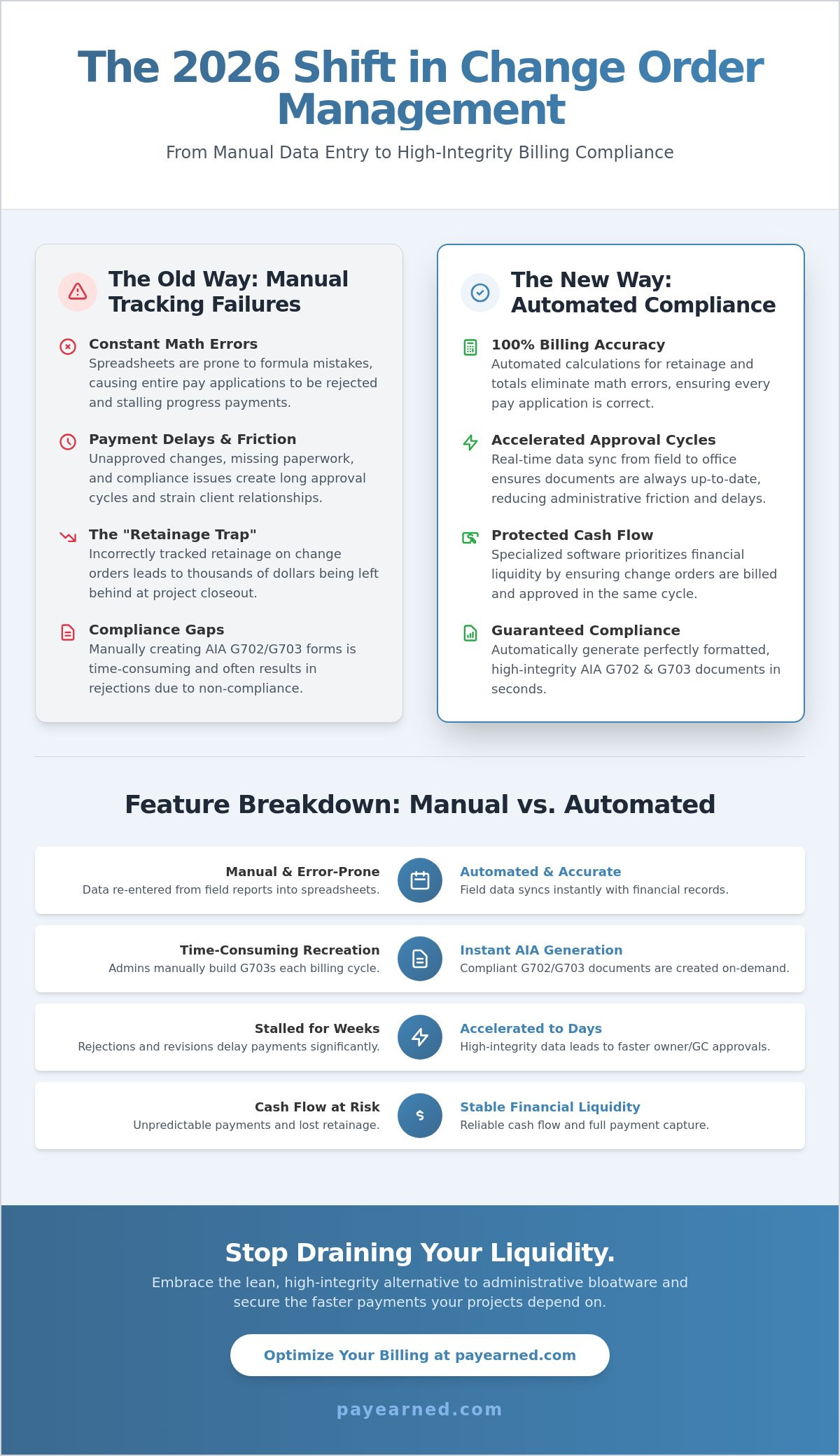
This article demonstrates how modern change order management software for contractors is shifting its focus toward high-integrity billing compliance to secure faster payments. By aligning field data with financial requirements, you can achieve 100% billing accuracy and faster approval cycles from owners or general contractors. We will look at how seamless integration with G702 and G703 documents provides the transparency needed to keep your cash flow steady and your projects moving forward.
Key Takeaways
- Modern systems prioritize billing compliance over simple project tracking to ensure financial liquidity and project stability.
- Transitioning from manual spreadsheets to specialized change order management software for contractors eliminates the math errors that stall progress payments.
- Real-time data entry ensures your continuation sheets and AIA-style G703 documents remain accurate throughout the project lifecycle.
- Automated calculations for retainage and totals accelerate approval cycles from owners and general contractors, reducing administrative friction.
- Specialized billing platforms provide a lean, high-integrity alternative to administrative bloatware by focusing on core financial operations.
Table of Contents
The 2026 Shift in Change Order Management Software for Contractors
In 2026, managing a project isn’t just about moving dirt or pouring concrete. It’s about protecting your cash flow. Modern change order management software for contractors has evolved from a simple log of extra work into a critical financial safeguard. While many view it as a tracking tool, the industry’s most profitable firms treat it as a billing compliance engine. Understanding What is a Change Order? is no longer enough; you must understand how that order impacts your progress billing immediately.
The era of all-in-one construction "bloatware" is ending. According to reports from Construction Software News, contractors are moving toward a tech stack of interoperable niche tools. These specialized platforms focus on one thing: getting you paid. Speed-to-approval has become the primary metric for success. If a change order isn’t approved and integrated into your pay app within the same billing cycle, it’s a liability that drains your liquidity.
To better understand how these systems function in a real-world environment, watch this helpful video:
From Field Logs to Financial Integrity
The definition of management has shifted. It’s no longer enough to just log a change in the field. You need cloud-based synchronization that bridges the approval gap between field reports and office billing. When field data syncs instantly with your financial records, you eliminate the delays caused by missing signatures or lost paperwork. Contractors now prioritize tools that generate AIA-style documents automatically. This automation ensures every change is captured in your G702 and G703 forms without manual re-entry.
The Rise of Specialized Billing Tools
General project management suites often fail at the granular level of G703 continuation sheets. They are built for schedules, not for the mathematical rigors of billing. Utilizing specialized change order management software for contractors ensures your financial data is accurate and ready for audit at any moment. These systems feature built-in search engines that replace messy folder structures. You can find any document or approval status in seconds. This level of organization is essential for maintaining high-integrity billing compliance and securing faster contractor payments.
Why Manual Change Order Tracking Fails Billing Compliance
Many contractors cling to the belief that spreadsheets are sufficient for financial tracking. This "if it ain’t broke, don’t fix it" mentality is a significant liability in 2026. While Excel is flexible, it lacks the structural integrity required for high-stakes billing. Manual entry introduces math errors that stall approval cycles and create friction with owners. When your administrative team spends hours hunting for lost documents or correcting missed deadlines, you’re losing more than just time; you’re losing profit. Relying on outdated methods is no longer a viable strategy for professional firms.
The "Retainage Trap" is a specific danger of manual tracking. It’s common to under-calculate final payments because change order retainage wasn’t tracked correctly across multiple billing periods. If you aren’t using a dedicated system, you risk leaving thousands of dollars behind at project closeout. Furthermore, owners increasingly mandate strict adherence to AIA G702 and G703 formats. Manually recreating these documents every month is an invitation for non-compliance rejections. Professional change order management software for contractors solves this by locking in the math from the start.
The Mathematical Risk of Excel
A single formula error can cause an entire pay application to be rejected by a general contractor or owner. Tracking cumulative change order totals across ten or twenty billing periods is nearly impossible without automation. One wrong cell reference in month three will haunt your billings until the project ends. Manual errors in your financial documentation directly starve your project’s cash flow by triggering immediate payment rejections. You can’t afford to have your capital tied up because of a simple addition mistake. For a detailed breakdown of why this matters, review this comprehensive guide on AIA billing software vs Excel for construction billing in 2026 to understand the true cost of relying on spreadsheets for complex progress billing.
Compliance Gaps in General Purpose Tools
Standard accounting software isn’t built for the nuances of construction progress billing. These tools often miss the specific requirements of the G703 continuation sheet, such as tracking "work completed" versus "stored materials" for every individual change. Informal change orders, like those verbal agreements made in the field, frequently lack the formal audit trail needed for billing. Using specialized change order tracking software for contractors mitigates these risks by creating a rigid, compliant framework for every dollar claimed. You can start streamlining your pay applications today to ensure your math always holds up under scrutiny and your cash flow remains uninterrupted.
Key Features of High-Performance Change Order Software
High-performance change order management software for contractors in 2026 is measured by three non-negotiable metrics: mathematical accuracy, processing speed, and strict billing compliance. Manual logs are simply too slow and error-prone for modern commercial projects. While general project management suites offer broad features, they often lack the specialized financial depth required for complex billing. A dedicated billing platform acts as a stabilizing force, ensuring that every change is captured, calculated, and formatted correctly the first time. It moves your administrative process from a state of chaos to one of precision.
Automated Schedule of Values (SOV) updates are essential. When a change order is approved, it must immediately reflect in the SOV to prevent billing gaps. Integrated retainage tracking for every change event ensures that you aren’t chasing missing funds during project closeout. This level of precision protects your liquidity and establishes you as a reliable partner in the eyes of owners and general contractors. Choosing a tool that focuses on these core financial operations rather than abstract project management concepts is the pragmatic choice for firms that value stability.
Automated AIA-Style Document Generation
Generating AIA-style G702 and G703 documents is the gold standard for contractor billing software. High-performance tools handle these continuation sheets without requiring manual re-typing of data. This automation eliminates the risk of transcription errors between your change order log and your pay application. Standardized, professional formatting builds immediate trust with GCs and owners. It signals that your firm operates with administrative competence and financial transparency. When your documents look professional and the math is indisputable, approval cycles naturally accelerate because the reviewer has fewer reasons to question the data. For a detailed column-by-column breakdown of how these documents should be structured, review this AIA G703 example and contractor’s guide to the continuation sheet to ensure your documentation meets the highest compliance standards.
Retainage and Progress Tracking
Modern software calculates retainage on a line-item basis within every individual change order. This granularity is vital because different line items or change events may have different retention requirements depending on the contract terms. Automated totals ensure your "Balance to Finish" remains accurate across every billing period. If you are unsure about the financial implications of these holdbacks, review this guide on what is retention for deeper financial context. By automating these calculations, you remove the administrative burden and focus on project execution. Specialized change order management software for contractors ensures that your progress billing is a reflection of actual work completed, not a best-guess estimate.
Implementing a Workflow That Accelerates Cash Flow
Moving from administrative chaos to a streamlined billing workflow requires a structured approach. You can’t afford to batch change orders at the end of the month. This outdated practice forces your accounting team to process weeks of data in a few days; often leading to errors that delay your entire draw. Instead, adopt a real-time entry model where every field event is logged immediately. A streamlined 5-step process includes capturing the change, categorizing it against the budget, communicating the cost to stakeholders, confirming the approval, and finally collecting payment through the next pay app.
Training field teams is critical for success. They don’t need to be accountants, but they must provide billing-ready data. This means delivering clear descriptions and specific cost breakdowns that the office can use without constant follow-up calls. A formal review and approve cycle ensures that no change order hits the owner’s desk without internal verification. This prevents the "final pay app surprise" where unapproved work is suddenly billed, causing a total rejection of your payment application. Precision in the field leads directly to liquidity in the office.
Standardizing the Change Order Request (COR)
Consistency is the foundation of administrative speed. Every field-generated change should follow a standardized format that matches your office requirements exactly. By linking every COR to a specific line item in the Schedule of Values, you create a direct path to the G703 continuation sheet. High-performance change order management software for contractors allows you to track "Pending" versus "Approved" statuses in real time. This visibility prevents billing gaps where work is completed but never invoiced because the paperwork was stuck in an email chain. Use a central system to ensure every dollar of extra work is accounted for before the billing deadline.
Syncing Changes with the Payment Application
The transition from an approved change order to a G703 line item must be automatic. Manual re-typing is a high-risk activity that invites calculation errors and slows down your submission. Utilizing specialized application for payment software ensures your monthly draw is finalized with mathematical precision. To get immediate approval from a GC’s accounting team, provide a clean audit trail. This includes the signed change order, the updated continuation sheet, and clear backup documentation. You can automate your billing workflow today to eliminate administrative friction and secure your cash flow for the long term.
How PAYearned Optimizes Change Order Billing in 2026
PAYearned stands as the pragmatic solution for firms that prioritize billing integrity over administrative bloat. While general-purpose tools try to manage every aspect of a jobsite, we focus on the one task that keeps your business alive: getting you paid. Our SaaS platform is designed specifically for the mathematical rigors of commercial construction finance. By choosing change order management software for contractors that specializes in financial documentation, you eliminate the risk of procedural inaccuracies that lead to payment delays. We provide a stabilizing force in the often chaotic transition from field work to office billing.
The platform features a built-in search engine that allows you to retrieve historical project data in seconds. You don’t need to dig through archived folders to find a specific change event or approval signature. This transparency is vital for audits and final project closeouts. PAYearned maintains a no-nonsense approach; we deliver perfect billing and change order management without the unnecessary features that slow down your team. Our focus remains on mathematical precision and the optimization of your financial liquidity.
Automated G702 & G703 Integration
PAYearned removes the administrative burden of manual math. When you add a change order to your project, the platform automatically updates your continuation sheets and progress billing totals. This automation ensures that your retainage tracking remains precise for every line item, preventing the common errors found in manual spreadsheets. Our system handles the complex calculations of work completed and stored materials instantly. PAYearned transforms a change order into a professional billing document that meets the highest industry standards for accuracy and compliance.
A Supportive Partner in Construction Finance
We understand that software’s only as good as the support behind it. In a market dominated by impersonal global platforms, PAYearned provides localized, human-centric assistance. You have access to real-time professional help to ensure your pay apps are always correct. This commitment to service makes us the logical choice for AIA billing software in 2026. We prioritize your financial liquidity and provide the tools necessary to maintain a steady cash flow. Start your PAYearned subscription today to master your change order billing.
Mastering Your Project Cash Flow for 2026
The transition toward specialized billing compliance is the defining trend for professional firms today. You’ve seen how relying on manual spreadsheets or bloated management suites creates unnecessary risk in an industry that demands mathematical precision. By implementing dedicated change order management software for contractors, you protect your business from the common errors that trigger payment rejections and administrative delays. Moving from field logs to high-integrity financial documentation ensures your cash flow remains steady throughout the project lifecycle.
PAYearned provides the specialized tools you need to maintain absolute financial integrity. Our platform delivers automated AIA-style G702 and G703 generation, precision retainage tracking, and a built-in project search engine to keep your historical data accessible and audit-ready. You don’t have to settle for procedural inaccuracies that starve your liquidity or cause friction with owners. Streamline your construction billing with PAYearned’s AIA-style software today. It’s time to move beyond simple project tracking and embrace a system that prioritizes your bottom line and provides true peace of mind. Your path to faster, more reliable payments starts with a commitment to billing accuracy.
Frequently Asked Questions
What is the difference between a change order and a change order request (COR)?
A Change Order Request (COR) is a formal proposal submitted to the owner or general contractor for extra work, whereas a change order is the final, signed legal amendment to the contract. You use the COR to document costs and gain preliminary approval before the work is finalized and added to the official project budget. Using change order management software for contractors ensures that these requests are tracked systematically until they become billable contract items.
Does change order management software replace my general accounting system?
No, this software doesn’t replace your general accounting system; it acts as a specialized front-end for construction-specific billing. While standard accounting tools handle ledgers and payroll, they often lack the granular capacity to manage the mathematical complexities of progress billing and continuation sheets. This tool bridges the gap between field work and your financial records by ensuring your billing data is compliant before it enters your accounting system.
Can I generate AIA G702 and G703 documents with change order software?
Yes, generating AIA-style G702 and G703 documents is a primary function of high-performance billing platforms. The software automatically pulls data from your approved change orders and populates the continuation sheets without manual re-entry. This process eliminates transcription errors and ensures your documentation meets the strict formatting requirements mandated by most commercial owners and general contractors.
How does software help in tracking retainage on change orders?
Software automates retainage tracking by applying the specific contract percentage to every individual line item within a change order. This ensures that the Balance to Finish and Retainage Held columns on your G703 continuation sheet are always mathematically accurate. Manual calculations often fail at this level of detail, leading to under-billing or payment rejections during the final project closeout. For a practical reference on how these columns should be completed correctly, consult a detailed AIA G703 example to understand the continuation sheet structure and avoid common formatting errors.
Is it possible to use specialized billing software alongside my current project management tool?
Yes, you can use specialized billing tools alongside your existing project management software to achieve better financial control. Modern construction tech stacks favor niche tools that excel at specific tasks like billing integrity rather than all-in-one platforms that may offer only surface-level financial features. This interoperable approach allows your team to use the best tool for field execution—such as New Build Log for site management—while maintaining a high-integrity system for your pay applications.
What happens if I bill for a change order that hasn’t been formally approved yet?
Billing for an unapproved change order often results in the immediate rejection of your entire monthly pay application. Most owners and GCs require a signed change order before any related costs can appear on the G703 continuation sheet. Specialized change order management software for contractors helps you manage this risk by clearly categorizing changes as pending or approved, ensuring you only include billable items in your formal draw requests.
How does a built-in search engine help with construction change orders?
A built-in search engine allows you to retrieve historical project data and specific change event details in seconds rather than hours. This feature is vital during audits or closeout negotiations when you must provide backup documentation for specific costs. Instead of digging through physical folders or disorganized email chains, you have an instant audit trail for every dollar claimed on your payment certificates.
Can subcontractors use this software to manage their own change orders for GCs?
Subcontractors can and should use this software to manage their own change orders when billing general contractors. It ensures that the pay apps you submit are professional, accurate, and formatted in the AIA-style documents that GCs expect. By providing high-integrity documentation, you reduce administrative friction and accelerate the approval process for your own progress payments.
PAYearned is an agnostic workflow platform that helps teams manage pay applications
PAYearned is an independent software product and is not developed, endorsed, approved, sponsored or affiliated with the American Institute of Architects (AIA). AIA®, G702®, G703®