

Manual spreadsheet-based AIA billing processes result in an average of over $14,000 in annual billing errors for commercial contractors. You’ve likely spent your evenings wrestling with broken Excel formulas or trying to track retainage across dozens of change orders; it’s a high-stakes environment where one misplaced decimal point can delay your payment for weeks. Implementing specialized AIA G702 G703 software for contractors allows you to automate your pay applications, eliminate calculation errors, and master professional G702 and G703 documentation with modern cloud-based tools.
Managing progress billing shouldn’t feel like a secondary job. You deserve a system that prioritizes mathematical precision and financial liquidity over manual data entry. We will examine current 2026 retainage regulations, the benefits of automated continuation sheets, and the roadmap for transitioning from manual spreadsheets to a streamlined, error-free billing workflow that accelerates your payment cycle.
Key Takeaways
- Define AIA G702 G703 software for contractors and discover how cloud-based precision replaces the inherent risks of manual pen-and-paper or Excel methods.
- Master data persistence to automatically carry over “Previous Applications” figures, ensuring your current month’s totals are always mathematically sound and consistent.
- Eliminate the primary cause of rejected pay applications by moving from fragile spreadsheet formulas to locked, industry-tested math engines.
- Streamline project complexity by rolling approved change orders and automated retainage calculations directly into your G703 continuation sheets.
- Achieve faster payment cycles with professional, error-free documentation that focuses on specialized billing needs rather than bloated, general-purpose management suites.
What is AIA G702 G703 Software for Contractors?
AIA G702 G703 software for contractors is a specialized digital tool designed to automate the complex process of construction progress billing. Instead of relying on manual data entry or fragile Excel templates, these cloud-based platforms generate standardized payment applications that meet the rigorous requirements of architects and owners. For decades, the industry relied on paper forms. Today, digital transformation has turned what was once a multi-hour administrative burden into a precise, minutes-long task.
Most commercial projects, approximately 78% according to industry standards, require these specific formats to ensure transparency and consistency across the project lifecycle. While the American Institute of Architects (AIA) provides official documents, many modern contractors utilize “AIA-style” generation software like PAYearned. This provides the same professional layout and mathematical integrity without the cumbersome licensing hurdles of legacy systems. It’s a stabilizing force in a potentially chaotic administrative environment, ensuring your billing is as professional as your craftsmanship.
To better understand how these forms function in a real-world setting, watch this helpful video:
Understanding the G702 Application and Certificate for Payment
The G702 serves as your project’s high-level financial dashboard. It summarizes the current state of the contract, including the original contract sum and the net change by approved change orders. Modern software ensures that every field, from the total completed and stored to date to the remaining balance to finish, is calculated with zero-sum accuracy. This precision is vital for the architect’s certification section. If the math doesn’t align perfectly, the pay app is rejected, stalling your cash flow and damaging professional trust. Automated systems mitigate this risk by locking calculations and preventing human error.
Demystifying the G703 Continuation Sheet
If the G702 is the cover page, the G703 is the engine. It functions as a detailed Schedule of Values (SOV), breaking down the entire contract into specific line items. Software tracks work completed from previous applications and compares it against the current period’s progress. It also manages “Materials Presently Stored,” a critical field for modern cash flow management where contractors must bill for items purchased but not yet installed. By automating these calculations, you ensure that every line item on your continuation sheet remains perfectly synchronized with your project’s physical reality, providing the cost transparency owners demand.
The Critical Mechanism: How Automated Pay Apps Work
Automated billing systems operate on the principle of data persistence. In a manual environment, you must transcribe figures from last month’s approved application to the “Previous Applications” column of the current sheet. This is where most errors occur. High-quality AIA G702 G703 software for contractors eliminates this risk by automatically carrying forward every approved dollar. It creates a continuous, unbreakable digital chain from the first mobilization to the final punch list.
Real-time math engines serve as the core of these platforms. They perform simultaneous additions and subtractions across the G702 summary and the G703 continuation sheet. If you change a single value on line item 14 of your continuation sheet, the summary page updates instantly. This synchronization ensures your documentation is always audit-ready and free from the manual addition errors that lead to rejected submissions. Because the software is cloud-based, you don’t have to worry about local file dependencies or losing data due to a crashed hard drive.
Automating the Schedule of Values
The foundation of any successful project is a well-structured Schedule of Values (SOV). By importing your contract line items once at the project’s start, you establish a baseline that governs all future billings. The software acts as a financial guardrail. It prevents over-billing by automatically flagging any line item that exceeds 100% completion. This feature is essential for maintaining trust with architects and owners who scrutinize every percentage point. It’s much easier to catch a typo in your office than to explain a rejected pay app three days before your payroll is due.
Mathematical Precision in Progress Billing
Progress billing is a method of invoicing based on the percentage of work completed. Achieving precision in this area requires more than just basic addition. Modern software handles the complex variables that typically lead to rejection by automating the following calculations:
- Balance to Finish: This field automatically calculates the remaining contract sum, including any pending retainage, so you always know your exact project tail.
- Stored Materials: The system tracks inventory that is on-site but not yet installed, ensuring you get paid for materials without manual tracking spreadsheets.
- Retainage Management: The software applies percentage-based withholdings across every line item without rounding errors, keeping you compliant with local regulations.
Cloud accessibility means these calculations aren’t trapped on a single desktop in the main office. You can verify quantities from the job site and update your draft immediately. If you’re tired of chasing broken formulas, consider automating your payment certificates to ensure every submission is mathematically perfect. This transition provides the peace of mind that comes from knowing your financial data is secure, organized, and logically consistent.
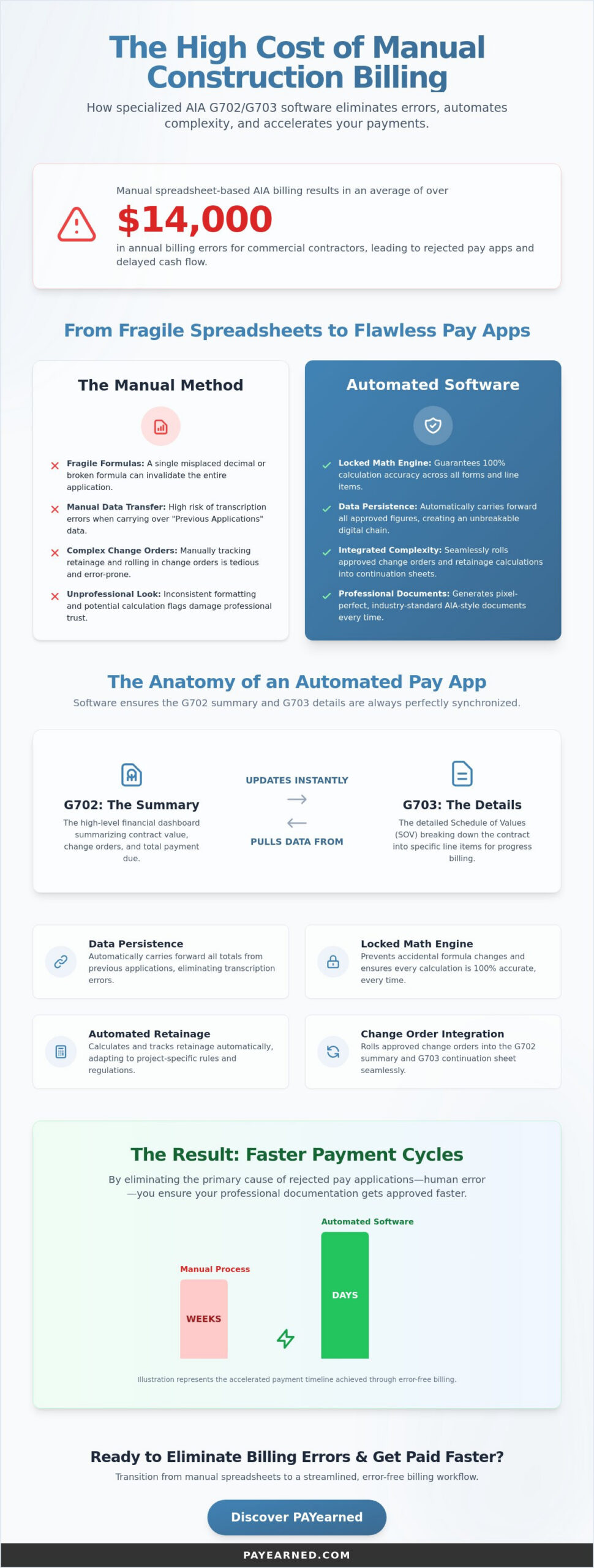
Manual Templates vs. Automated SaaS Platforms: A 2026 Comparison
Switching to specialized AIA G702 G703 software for contractors marks the difference between administrative chaos and absolute financial control. Manual templates are a liability. One broken cell in a spreadsheet can cascade through months of billing history, leading to discrepancies that are nearly impossible to trace. While Excel might feel “free,” the hidden costs of managing complex documents manually are substantial. In contrast, SaaS platforms utilize locked, tested algorithms that ensure every calculation remains logically sound from the first application to the final retention release.
Efficiency is the most immediate gain. Manual entry typically requires hours of meticulous data verification and formatting for every billing cycle. Modern software reduces this to minutes. It replaces buried desktop folders with built-in search engines, allowing for instant access to historical records. Beyond speed, there’s the matter of professionalism. Software-generated PDFs provide a standardized, high-end look that builds immediate trust with general contractors and owners. When your documentation is clean, consistent, and mathematically perfect, you position yourself as a stabilizing force on the project.
The Hidden Costs of ‘Free’ Excel Templates
The financial impact of manual billing is measurable. Research indicates that spreadsheet-based processes result in an average of over $14,000 in annual billing errors for commercial contractors. This figure doesn’t even account for the labor cost of administrative staff spending 4 to 8 hours per month on manual entry. A single rejected pay app can delay your cash flow by weeks, potentially forcing project pauses or high-interest bridge financing. Local spreadsheets are a risk; they lack the redundancy and security required for high-stakes financial data.
Security and Compliance in 2026
Standardization is no longer a luxury. Lenders and surety companies increasingly prefer standardized g702 formats because they provide a predictable framework for risk assessment. Secure, cloud-hosted platforms protect your sensitive data from local hardware failures through enterprise-grade encryption and automated backups. They also provide digital audit trails. You can track exactly who made changes to a pay application and when those changes occurred. This level of transparency is essential for resolving disputes and maintaining compliance with modern construction contracts that demand rigorous cost transparency.
Managing Complexity: Change Orders, Retainage, and Searchability
Complexity is the natural enemy of construction cash flow. As a project progresses, the simple Schedule of Values you started with evolves into a dense web of modifications and withholdings. Utilizing specialized AIA G702 G703 software for contractors allows you to manage these variables without losing sight of your bottom line. Modern platforms act as a central repository for every financial adjustment, ensuring that nothing is left unbilled or forgotten. By rolling approved change orders directly into the G703 continuation sheet, you maintain a single, authoritative version of the project’s financial truth.
Searchability is a critical but often overlooked advantage of SaaS billing. Unlike static Excel files buried in nested folders, a cloud-based system like PAYearned features built-in search engines. You can instantly locate specific line items, past project billings, or historical change order data. This accessibility is a stabilizing force during audits or when answering questions from a project owner. It provides the peace of mind that comes from knowing every piece of financial data is organized and retrievable in seconds.
Mastering Change Order Management
Untracked change orders represent one of the greatest risks to project profitability. When modifications are handled through email or verbal agreements without immediate integration into the billing cycle, revenue is lost. Software maintains a clear, chronological history of the original contract versus adjusted contract values. Change orders adjust the total contract sum by modifying the ‘Net Change by Change Orders’ field on the G702 summary. This automation ensures your “Balance to Finish” always reflects the most current project scope, preventing disputes during the closeout phase.
Retainage and Cash Flow Optimization
Accurate what is retention management is essential for maintaining liquidity, especially with shifting legal landscapes. For example, as of January 1, 2026, retainage on private construction projects in California is capped at 5% of the contract price for new contracts. Automated software applies these specific percentage-based withholdings across every line item, ensuring you don’t over-request funds or violate state regulations.
When it’s time for the final pay application, the system streamlines the retention release process. It calculates the exact totals held to date, allowing you to bill for the remaining funds with a single click. For multi-phase projects, you can even manage partial releases without breaking the integrity of your Schedule of Values. If you’re ready to stop wrestling with manual calculations, you can generate your AIA-style pay apps today and start mastering the payment application process for your next project.
Why PAYearned is the Specialized Choice for 2026 Contractors
Precision in financial documentation isn’t a byproduct of general management; it’s the result of specialized automation. While many platforms attempt to be an all-in-one solution for every construction task, PAYearned focuses exclusively on the critical task of generating professional payment certificates. This high-end automation provides the peace of mind necessary for managing high-stakes billing cycles. By utilizing AIA G702 G703 software for contractors that prioritizes mathematical integrity over unnecessary features, you ensure your documentation is always audit-ready and compliant with industry standards.
The reality of the payment application workflow requires a tool that understands the nuances of progress billing. Reliability is built into the system’s core, ensuring that every calculation, from stored materials to complex retainage withholdings, is handled with absolute accuracy. This user-centric design removes the administrative friction that typically leads to human error, allowing you to focus on project execution rather than troubleshooting broken spreadsheets.
Avoiding the ERP Bloat
Many contractors find themselves paying for enterprise resource planning (ERP) systems that cost between $500 and $2,000 per month. These systems often include a massive suite of project management tools that go unused, creating a bloated interface that complicates the simple act of billing. You don’t need a massive, $500 per month general-purpose system just to bill accurately. Specialized software provides a lean, functional alternative that does one thing exceptionally well. By focusing on financial liquidity through dedicated documentation, you avoid the high costs and steep learning curves of over-engineered platforms.
Getting Started with PAYearned
Setting up your first project is a low-friction process designed for busy professionals who require information at a glance. You can generate your first G702 summary and G703 continuation sheet in minutes, establishing a digital baseline that automates all future applications. The built-in search engine also serves as a powerful administrative asset, simplifying end-of-year reporting and tax preparation by providing instant access to every approved dollar and change order. It’s time to move from outdated, error-prone methods to a stable, automated solution that protects your cash flow. Ready to eliminate billing errors? Sign up for a PAYearned subscription today.
Secure Your Project Financials for 2026
Precision billing is the backbone of a successful construction business. Transitioning to specialized AIA G702 G703 software for contractors ensures your documentation meets the highest professional standards while protecting your bottom line from manual errors. We’ve explored how automation handles complex retainage and change orders, providing a level of accuracy that spreadsheets simply can’t match. By choosing a dedicated tool, you avoid the unnecessary complexity and high costs of general project management suites.
Reliability in your payment cycle starts with organized, searchable data. You can now manage your Schedule of Values and continuation sheets with a system designed for the reality of the field. It’s time to eliminate the stress of rejected pay apps and embrace a workflow that prioritizes your financial liquidity. Start Automating Your AIA-Style Billing with PAYearned today and gain the peace of mind that comes from mathematical certainty. Your future projects deserve the stability of professional, error-free documentation.
Frequently Asked Questions
What is the difference between AIA G702 and G703?
The G702 serves as the high-level summary and certificate for payment, while the G703 is the continuation sheet that provides a detailed breakdown of the Schedule of Values. Think of the G702 as the cover page that requires the architect’s signature; the G703 is the supporting data that proves how you calculated those totals. Both documents must be submitted together to provide full cost transparency for the project owner.
Can I use AIA G702/G703 software for subcontractors only?
Yes, subcontractors use this software extensively to submit progress billing to general contractors. While the AIA provides specific subcontractor versions like the 2017 edition G702S and G703S, many general contractors accept the standard G702/G703 format. Using specialized AIA G702 G703 software for contractors ensures that your billing looks professional and matches the requirements of the prime contract regardless of your role on the job site.
How does software handle retainage on a G702 form?
Software automates retainage by applying a fixed percentage withholding to every line item on your continuation sheet. It tracks the cumulative “Retainage Held to Date” and ensures this figure is accurately reflected on the G702 summary page. This automation is critical for compliance with local laws, such as the 5% retainage cap on private projects in California effective January 1, 2026, preventing you from over-billing or violating contract terms.
How does AIA-style software interact with my existing accounting system?
AIA-style software acts as a specialized document engine that works in parallel with your primary accounting tools. You use the software to generate the mathematically complex pay application and then record the final summary figures in your general ledger. This separation of duties prevents you from cluttering your main financial records with hundreds of line items that are only necessary for the architect’s review process.
Do I need to buy official AIA documents to use this software?
No, you don’t need to purchase manual paper forms or individual licenses from the AIA to use PAYearned. The platform generates “AIA-style” documents that mirror the industry standard 1992 edition G702 and G703 formats. This allows you to produce professional, architect-ready documentation without the administrative burden or the recurring cost of purchasing physical forms for every new project application.
How do I add a change order to my G703 continuation sheet?
You add approved change orders as new line items at the bottom of your Schedule of Values on the G703 sheet. Once entered, the software automatically updates the “Net Change by Change Orders” field on the G702 summary page. This digital integration ensures that your total contract sum and balance to finish are always current, eliminating the need to manually recalculate your entire application whenever a project scope changes.
What happens if my pay application is rejected due to a math error?
A rejection typically stalls your payment cycle for another 30 days while you correct and resubmit the paperwork. This is why AIA G702 G703 software for contractors is essential; it uses locked math engines to prevent addition and subtraction mistakes. If an error is caught before submission, you can fix it in seconds. If you use manual spreadsheets, a single typo can lead to a cascade of errors that damages your professional reputation.
Is cloud-based AIA billing software secure for project data?
Cloud-based platforms are significantly more secure than local files or paper records. They utilize enterprise-grade encryption and automated backups to protect your sensitive financial project data from hardware failure or accidental deletion. You also benefit from a digital audit trail that tracks every modification. This level of security provides peace of mind that your project’s financial history is organized, protected, and accessible from any location.
PAYearned is an agnostic workflow platform that helps teams manage pay applications
PAYearned is an independent software product and is not developed, endorsed, approved, sponsored or affiliated with the American Institute of Architects (AIA). AIA®, G702®, G703®