

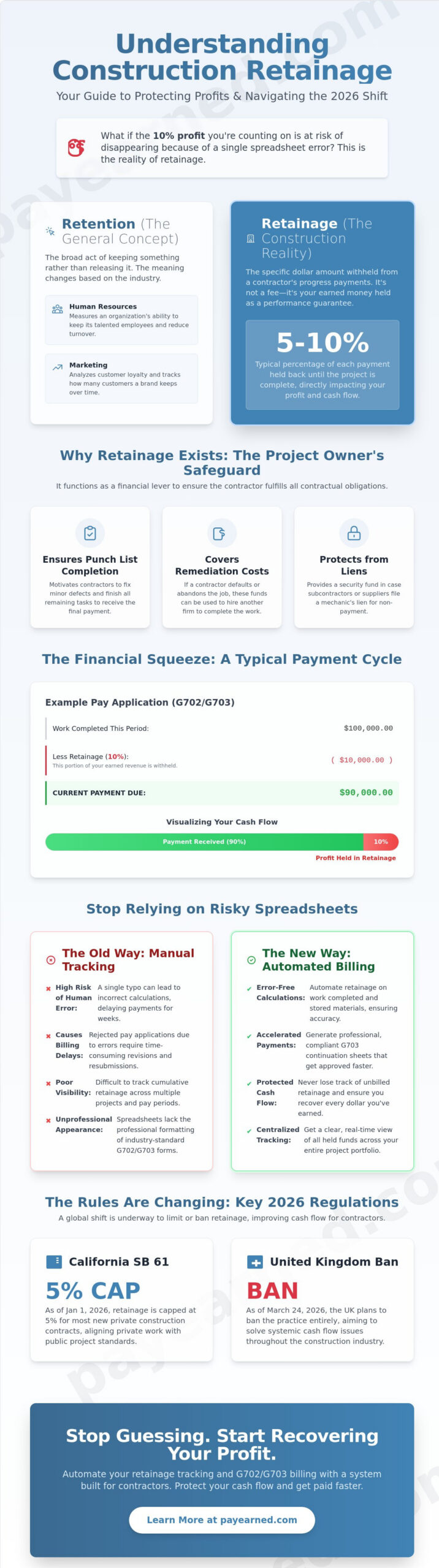
What if the 10% you’re counting on for your company’s profit isn’t just “held back,” but is actually at risk of disappearing because of a single spreadsheet error? When you search for what is retention, you might find general definitions about employee loyalty, but in the construction world, it represents a high-stakes contractual reality called retainage. It’s the money that stays in the owner’s pocket while you take on all the project risk. You likely already feel the stress of tracking these funds across multiple pay periods while worrying that manual calculation errors on your continuation sheets will delay your cash flow even further.
This guide will help you master the fundamental definition of retention and show you how it functions as a critical financial safeguard. You’ll learn how to navigate the latest 2026 regulatory changes, such as California’s 5% retention cap under SB 61 and the UK’s recent move to ban the practice entirely as of March 24, 2026. We’ll provide a clear framework for managing held-back funds on G702 and G703 forms so you can stop guessing and start recovering your project profits faster. We will examine the exact steps to move from manual, error-prone tracking to a professional, automated billing process that protects your bottom line.
Key Takeaways
- Define the critical difference between the general concept of what is retention and the industry-specific application of retainage in construction contracts.
- Identify how withheld funds serve as a financial safeguard to ensure punch list completion and protect project owners from downstream lien risks.
- Master the accurate calculation of retainage on G702 style forms, specifically focusing on the difference between work completed and stored materials.
- Stop relying on risky spreadsheets that cause billing delays and switch to automated G703 continuation sheets for error-free financial tracking.
- Learn how to navigate evolving 2026 regulations like the 5% cap to protect your profit margins and improve your project’s cash flow.
What is Retention? Defining the Core Concept
At its most basic level, understanding what is retention requires looking at the act of withholding. It is the state of keeping something rather than releasing it to another party. While this concept applies to various fields, it serves as a high-stakes risk management tool in professional services. In the context of a contract, it acts as a financial placeholder. It ensures that the person or company performing a service fulfills every obligation before receiving their final payment. It isn’t a discount or a fee; it’s a temporary hold on earned revenue.
To better understand this concept, watch this helpful video:
In the US market, professionals often use the term interchangeably with Retainage. This specific financial amount is withheld from progress payments to ensure a project reaches substantial completion. It provides the project owner with leverage. If a contractor walks away or leaves defects unfixed, that held-back money covers the cost of completion. For example, as of January 1, 2026, California’s SB 61 capped this withholding at 5% for most new private contracts. This regulation mirrors a global shift, including the UK’s announcement on March 24, 2026, to ban the practice entirely to improve industry cash flow.
The Linguistic Roots of Retention
The term originates from the Latin “retentio,” meaning to hold back or keep. Historically, this concept applied to physical storage or the keeping of land titles. In modern professional contracts, it has evolved into a sophisticated financial mechanism. You might see it listed as a “withholding,” “escrow,” or “reserve” in legal documents. Regardless of the name, the function remains identical. It creates a secondary “pot” of money that is only accessible once the work meets a specific standard of quality and completion.
Retention in Different Industries
When you ask what is retention in a general business meeting, the answer depends entirely on who is in the room. Each industry uses the concept to solve a different problem:
- Human Resources: Focuses on employee retention. It measures the ability of an organization to keep its talent and reduce turnover.
- Marketing: Analyzes customer retention and churn rates. It tracks how many customers stay loyal to a brand over a specific period.
- Construction: Uses retainage as a performance guarantee. It protects the owner from mechanics’ liens and unfinished punch list items.
In the construction sector, this withholding is often the difference between a profitable project and a loss. Managing these funds requires precision. Relying on risky spreadsheets leads to calculation errors that can stall a pay application for weeks. As regulations tighten and caps like California’s 5% rule become the standard, contractors must move toward automated billing solutions to ensure every dollar of unbilled retainage is eventually recovered.
Retention vs. Retainage: The Critical Difference for Contractors
While the general search for what is retention often leads to broad definitions about keeping assets or employees, contractors must understand the precise financial application. In construction, retention describes the state of withholding funds; “retainage” refers to the actual dollar amount held back from a progress payment. Mistaking these terms in a legal dispute can create ambiguity in contract enforcement. Retainage functions essentially as a security deposit. It ensures the contractor completes the project according to the plans and specifications before receiving the final portion of the contract value.
Industry standards for these withholdings typically range from 5% to 10%. However, these rates are shifting due to recent legislative changes. As of January 1, 2026, California’s Senate Bill 61 (SB 61) strictly caps retainage at 5% for most new private construction contracts. This aligns private projects with existing public works standards. Understanding what is retention in your specific region is vital because these caps often cannot be waived by contract. Using the wrong percentage on your billing documents doesn’t just annoy the owner; it can lead to immediate pay application rejections.
Defining Retainage in Construction Finance
Retainage is the portion of the contract price withheld by the owner from the contractor to ensure work is completed correctly. These specific funds are usually carved out of every progress payment until the project reaches substantial completion. Tracking unbilled retainage is vital for long term project health. It represents earned revenue that is not yet payable. On a balance sheet, this is an asset, but it’s one you can’t touch until the final punch list is signed off. If you lose track of these held-back funds across multiple months, your final profit margin disappears. You need a system that ensures these totals are always searchable and accurate.
When Retention Becomes a Legal Obligation
Contractual retention is codified in standard industry documents like the G702 Application and Certificate for Payment. On these forms, Line 5 specifically calculates the total retainage to date. Managing these variables on manual continuation sheets is a recipe for disaster. One decimal error can stall a payment for weeks. Using a premium solution for pay applications ensures you never miscalculate these legal obligations. Since state laws vary significantly on maximum percentages, your software must be flexible enough to handle different rates for work completed versus stored materials. This precision protects your cash flow and keeps your project audits clean.
Why Retention Exists: Protecting Project Integrity and Cash Flow
Owners don’t withhold funds simply to be difficult. When you analyze what is retention from a functional perspective, it acts as a high stakes insurance policy. It provides the project owner with vital leverage to ensure the final 2% of the project, often called the punch list, actually gets finished. Without this held back capital, a contractor might find it more cost effective to move their crew to a new, high revenue job rather than spending three days fixing drywall scuffs or adjusting door hinges. This withholding ensures that every technical specification is met before the final check is cut.
Beyond completion, these funds protect the owner against mechanics’ liens. If a general contractor fails to pay their subcontractors, those subs can file a lien against the property. The retained funds provide a financial buffer that the owner can use to satisfy those debts and clear the title. It also serves as a safety net for defective work discovered during the final inspection. If a contractor refuses to repair a faulty HVAC installation, the owner has the cash on hand to hire a third party to fix the issue without dipping into their own pockets.
The Benefit for Project Owners
For many owners, retention serves as a practical alternative to expensive performance bonds. It provides immediate, liquid security that doesn’t require a lengthy claims process with a surety company. This “safety net” ensures compliance with safety standards and technical requirements throughout the project lifecycle. By maintaining a financial stake in the contractor’s performance until the very end, the owner mitigates the risk of abandonment or substandard craftsmanship during the high pressure closing phases of a build.
The Challenge for Subcontractors
While owners see security, subcontractors often face a “Cash Flow Crunch.” When 10% of your gross profit is tied up in unbilled retainage, managing daily overhead becomes a struggle. To recover these funds faster, you must move beyond passive waiting. One actionable strategy is negotiating for “line item release.” This clause ensures that once your specific scope of work is complete and accepted, your retention is released even if the overall project continues for another year.
Another effective tactic is “step down” retention. You can negotiate for the withholding rate to drop from 10% to 5% once the project reaches 50% completion. This significantly improves your operational capital in the later stages of the job. Understanding what is retention in the context of your specific contract allows you to propose these milestones during the bid phase. Proactive negotiation, combined with error free billing on your G703 continuation sheets, is the most reliable way to ensure your profit doesn’t remain trapped in an owner’s bank account for months after you’ve left the job site.
Managing and Calculating Retention: Best Practices
Calculating your project’s financial health requires more than a general understanding of what is retention; it demands mathematical precision on every pay application. On a standard G702 style form, Line 5 is where the math becomes reality. This line represents the total amount withheld from the project to date. If you’re working in a jurisdiction like California post-January 1, 2026, you’ll be applying a 5% cap. However, many legacy contracts still use a 10% standard or apply variable rates depending on the specific type of expense incurred during the period.
A common point of confusion is the distinction between “work completed” retention and “stored materials” retention. Owners often apply different risk profiles to these categories. For example, an owner might hold 10% on labor and installation but only 5% on materials stored on-site. Failing to separate these on your continuation sheet leads to over-withholding, which chokes your cash flow. You must track these cumulative totals across every billing cycle to ensure your final release matches your general ledger. One decimal point error in month three can snowball into a massive discrepancy by month twelve, leading to a rejected application and a delayed check.
Step-by-Step Calculation for G702 Forms
To find Line 5a and 5b on an AIA-style continuation sheet, you must multiply the current percentage by the total work completed and stored materials respectively. First, calculate the total earned to date by adding your current work to previous totals. Then, apply your retention percentage to find the cumulative amount. Finally, deduct the retainage already withheld in previous periods. This leaves you with the specific amount to be held back from the current check. Manual errors in this step are the primary cause of payment delays and rejected applications across the industry. For a complete walkthrough of every line item on the form, our guide to the AIA G702 form explained for progress billing in 2026 covers each calculation in detail.
Tracking Retainage on the Schedule of Values (G703)
The G703 continuation sheet provides the granular breakdown necessary for complex projects. You should track retention by line item to maintain full visibility. This is especially critical for “variable retention” projects where different trades or phases have different withholding rates. If your electrical sub has a 5% rate but your masonry sub has 10%, a single mistake in your manual spreadsheet will throw off the entire certificate for payment. Reconciling these totals with your general ledger at the end of every month prevents the nightmare of unbilled retainage disappearing during final closeout. To ensure your AIA invoice is error-free and compliant with 2026 standards, following a structured checklist for every billing cycle is essential. You can generate AIA-style pay apps automatically to ensure these calculations are always error-free and compliant with your contract terms.
Beyond Risky Spreadsheets: Automating Retention with PAYearned
Stop betting your profit on risky spreadsheets. When you understand what is retention as a financial safeguard, you realize that accuracy isn’t just a goal; it’s a requirement for cash flow. A single decimal point mistake in a manual calculation can stall a pay application for weeks. Owners and architects reject forms for the slightest discrepancy, forcing you back to the start of the billing cycle. PAYearned eliminates this administrative chaos by automatically calculating retainage for G702 and G703 style documents. It ensures that your progress billing reflects the exact contractual withholding required by law or agreement.
Moving from manual tracking to premium automation provides immediate peace of mind. Instead of triple checking formulas, you can focus on project execution. PAYearned tracks unbilled retainage in real time. This ensures you never leave money on the table when it’s time for final closeout. The platform provides a stabilized environment where financial accuracy is the standard, not a struggle. Understanding what is retention management allows you to transition to a professional workflow that protects your bottom line through every phase of construction. For a deeper look at how to eliminate billing errors and optimize your approval cycles, our guide to mastering the payment application for error-free billing in 2026 provides a step-by-step framework for managing every dollar of unbilled retainage.
Automated AIA-Style Document Generation
Generating error free pay applications requires a system built for the task. PAYearned produces documents that include precise retention calculations based on your current work completed and stored materials. This is vital for staying compliant with 2026 regulations like California’s 5% cap. If you need to verify past withholdings, the built-in search engine allows you to find historical data instantly. This level of organization is essential for multi year projects. To understand how this fits into your broader financial strategy, consult our AIA Billing Software Guide. It demonstrates the high return on investment that comes from eliminating manual entry.
Securing Your Final Payment
The final release of retainage is often the most difficult part of a project’s financial lifecycle. PAYearned streamlines this process by generating change orders that accurately reflect retention adjustments. General accounting software often fails to handle these construction specific nuances. It treats every payment the same, ignoring the complex rules of progress billing and continuation sheets. Specialized software ensures that your payment certificates stay in sync with your actual project progress. When you reach the end of a job, your audit trail is already complete. This transparency speeds up the final inspection and ensures your profit moves from “unbilled” to “paid” without unnecessary delays.
Secure Your Profit and Master Your Progress Billing
Mastering what is retention means more than just knowing a dictionary definition; it’s about protecting your company’s liquidity. You’ve seen how the distinction between a broad concept and the financial reality of retainage impacts your legal standing and cash flow. With California’s 5% cap under SB 61 now in effect and the UK’s industry-wide ban announced on March 24, 2026, the landscape of construction finance is shifting toward greater contractor protection. Staying ahead of these changes requires a move away from the risky spreadsheet era.
You don’t have to navigate these complex calculations on your own. Manual tracking leads to the very errors that stall your payments and strain your relationships with project owners. PAYearned provides a premium solution built exclusively for Pay Applications. It offers automatic G702 and G703 style calculations to ensure your totals are always accurate, searchable, and compliant. If you ever hit a snag, our live US-based support team is ready to help you resolve billing issues with a steady hand. Stop fighting with spreadsheets and automate your retention tracking with PAYearned today. Your profit belongs in your bank account, not trapped in a calculation error.
Frequently Asked Questions
Is retention the same as retainage in construction?
In the construction industry, these terms are frequently used as synonyms, though they have subtle differences. Retention refers to the general practice of withholding funds; retainage is the specific dollar amount carved out of a progress payment. Understanding what is retention in your contract is vital because using the wrong term in legal documents can create ambiguity. Both concepts serve the same purpose of providing financial security to the project owner.
What is a typical retention percentage on a construction project?
Historically, the industry standard was 10% of each progress payment. However, current regulations are lowering this burden. As of January 1, 2026, California’s Senate Bill 61 (SB 61) caps retainage at 5% for most new private contracts. This aligns with existing public works standards. In the UK, rates typically hover between 3% and 5% of the total contract sum, though a full ban was announced on March 24, 2026.
Can I charge interest on retention funds held by an owner?
Generally, contractors can’t charge interest on withheld funds unless the contract explicitly allows it or state law requires an escrow account. Some states mandate that owners place retainage in escrow for the benefit of the contractor. Without these specific legal or contractual provisions, the owner keeps any interest earned on the held capital. Always review your local prompt payment statutes to verify your rights and potential for interest recovery.
How do I calculate retention on an AIA G702 form?
You calculate this on Line 5 of the G702 form by applying your contractual percentage to the total work completed and stored materials to date. For instance, if you’ve earned $100,000 and have a 5% rate, your cumulative retainage is $5,000. You then subtract previous withholdings to find the current period’s amount. Using automated software ensures these calculations remain error free on your continuation sheets, preventing the payment delays caused by manual math errors.
What happens to retention if a subcontractor defaults?
If a subcontractor defaults, the owner or general contractor uses the retained funds to pay for the completion of the work or to repair defects. These funds act as a financial buffer to cover the costs of hiring a replacement crew. If the cost to finish the job exceeds the retainage, the owner may pursue further legal action. This is why what is retention management is so critical for risk mitigation on complex job sites.
When is retention typically released back to the contractor?
Release usually occurs upon substantial completion or after the final punch list is signed off. In many contracts, half of the retainage is released when the project is 50% complete, with the remainder paid 30 to 60 days after final acceptance. Some subcontractors negotiate for line item release. This allows them to receive their funds once their specific scope is finished, regardless of the overall project’s status or completion date.
Is retention legal in all 50 states?
Yes, the practice is legal across all 50 states, but it’s heavily regulated by state-specific prompt payment and retainage laws. For example, several states cap the percentage at 5% for public projects. As of January 1, 2026, California extended this 5% cap to private works. You must comply with these maximums to avoid pay application rejections. Some jurisdictions are even moving toward total bans to improve subcontractor cash flow and financial stability.
How does retention affect a project’s cash flow?
Retention significantly tightens a contractor’s cash flow by withholding what is often their entire net profit margin. When 10% of every check is held back, you must fund labor and materials out of your own pocket or through lines of credit. This creates a cash flow crunch that can limit your ability to take on new projects. Managing these funds with automated tracking is essential to ensure you recover every dollar during closeout.
PAYearned is an agnostic workflow platform that helps teams manage pay applications
PAYearned is an independent software product and is not developed, endorsed, approved, sponsored or affiliated with the American Institute of Architects (AIA). AIA®, G702®, G703®