
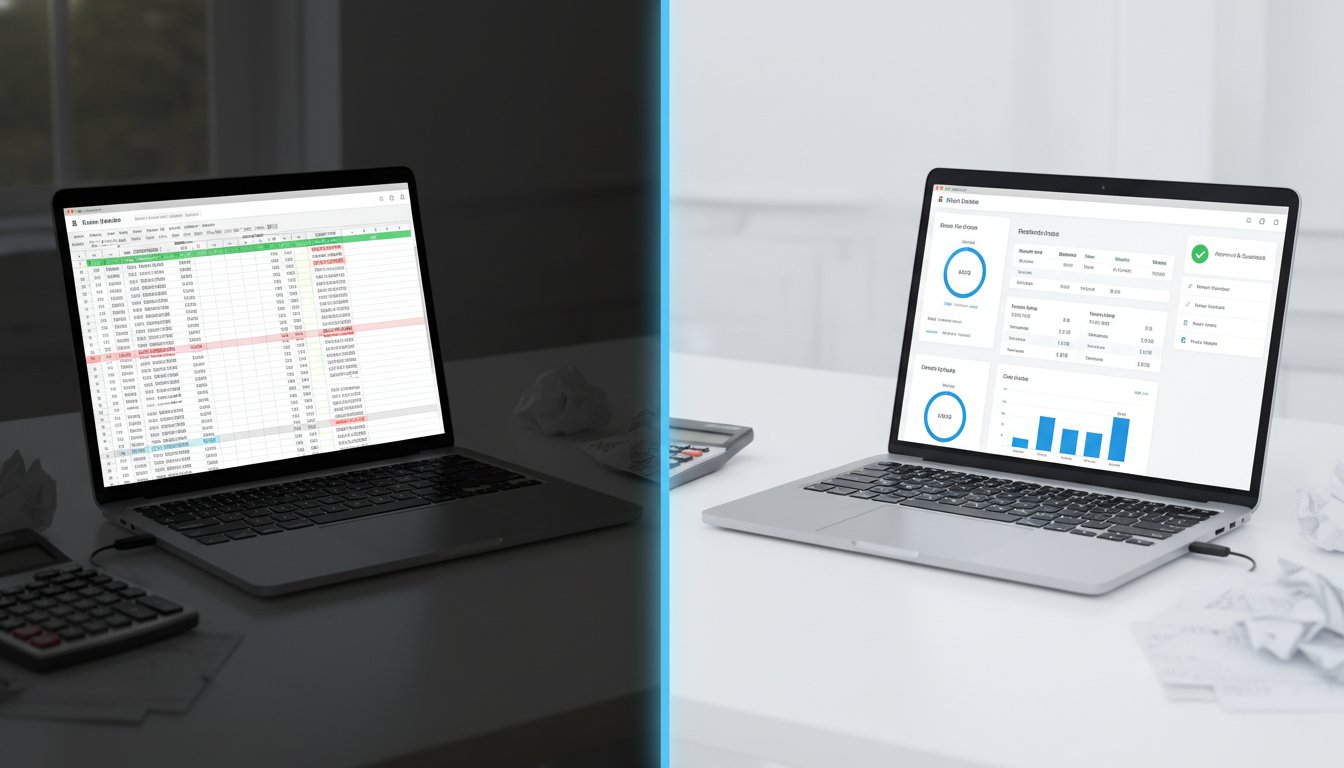
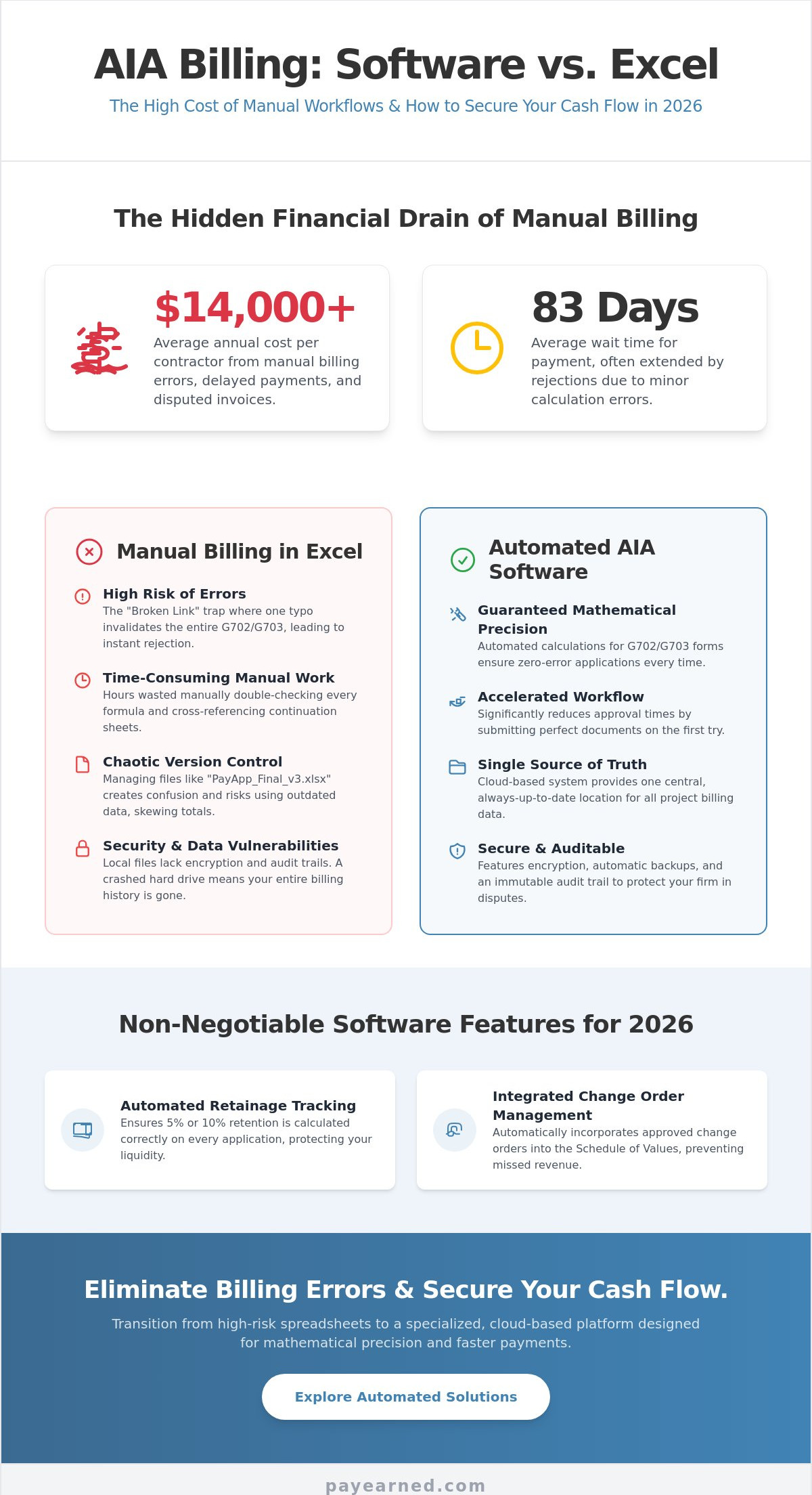
Did you know that manual billing errors cost the average commercial contractor over $14,000 annually in delayed payments and disputed invoices? You’ve likely spent hours squinting at a continuation sheet, hoping the formulas didn’t break when you added that last change order. When evaluating aia billing software vs excel, it’s clear that relying on a general-purpose calculator for a specialized financial workflow is a high-risk strategy. It’s frustrating to wait an average of 83 days for payment only to have a GC or owner reject your application because of a minor math error in your retainage calculation.
We understand that you value precision and reliability in your financial documentation. This guide will show you how to eliminate rejected documents and secure your cash flow by choosing the right tools for 2026. You’ll learn how moving from manual spreadsheets to automated G702 and G703 generation can accelerate your approval times. We’ll preview the best solutions to ensure zero-error payment applications and automatic tracking of change orders, giving you the peace of mind that your project’s liquidity is protected.
Key Takeaways
- Avoid the “Broken Link” trap where a single accidental keystroke in a G703 cell invalidates your entire G702 summary and triggers a rejection.
- Compare the hidden operational costs of aia billing software vs excel to determine if your manual spreadsheet workflow is compromising your financial liquidity.
- Identify the non-negotiable software features for 2026, including automated retainage tracking and integrated change order management.
- Learn a low-friction transition strategy to migrate your Schedule of Values from static files to a specialized, cloud-based environment.
- Secure your cash flow by adopting tools that ensure mathematical precision and significantly reduce approval times from GCs and owners.
The Hidden Risks of Manual AIA Billing in Excel
Excel is a general-purpose calculator, but it wasn’t built to handle the legal and financial rigors of commercial construction. When comparing aia billing software vs excel, the most immediate danger is the “Broken Link” trap. Your G703 continuation sheet columns must feed the G702 summary with absolute precision. One accidental keystroke in a single cell can invalidate your entire document, leading to an immediate rejection from the project owner. This lack of system autonomy forces you to manually double-check every formula, every month, wasting hours that should be spent on the jobsite.
To better understand the benefits of moving away from manual spreadsheets, watch this helpful video demonstration:
Version control adds another layer of risk. Managing files like “Project_PayApp_Final_v2.xlsx” creates chaos when multiple team members are involved. If you pull data from the wrong month’s progress billing, your cumulative totals will be permanently skewed. This is especially dangerous for high-stakes projects where accuracy is monitored through metrics like the Architecture Billings Index, which reflects the broader economic health of the industry. Without an immutable audit trail, your firm is vulnerable during federal audits or contract disputes. Manual tracking of 5% or 10% retainage often leads to over-billing or under-claiming, further complicating your financial liquidity.
The Mathematical Complexity of G702 and G703
The interdependency between the Schedule of Values (SOV) and the Certificate for Payment requires perfect synchronization. Tracking “Stored Materials” and “Work Completed” across dozens of billing cycles is nearly impossible in a static spreadsheet. You must account for previous applications, current work, and materials on site while ensuring the math balances to the penny. Manual payment application errors are the #1 cause of rejected invoices. If you’re relying on a static aia billing template to manage these interdependencies, you’re exposing your firm to the same recurring risks that automated platforms are specifically designed to eliminate.
Security and Data Integrity Concerns
Standard .xlsx files lack the encryption and user-access logs necessary for financial security. Local hard drives are single points of failure. If a drive crashes or a file is accidentally deleted, your entire billing history disappears. Cloud-based systems provide a stabilizing force, offering automatic backups and transparent logs that show exactly who changed a value and when. This level of organization is the baseline for professional operations in 2026.
Evaluating the Best AIA Billing Software for 2026
Choosing the right tool requires understanding the three primary categories of solutions available today: manual templates, enterprise ERPs, and specialized billing platforms. When weighing aia billing software vs excel, the true cost isn’t the monthly subscription fee; it’s the time lost to rejected documents. While a $0 Excel template seems cost-effective, it lacks the system autonomy needed to prevent the recurring errors that plague manual workflows. Enterprise Resource Planning (ERP) systems offer power but often come with a high administrative burden and significant monthly costs. For most contractors, the most pragmatic choice is a specialized aia billing software like PAYearned, which provides mathematical precision without the complexity of a full project management suite.
The GAO Cost Estimating and Assessment Guide emphasizes that improper cost management and documentation are primary drivers of project risk. This is why automated retainage management and change order tracking are non-negotiable in 2026. Automated systems ensure that 5% or 10% retention is calculated correctly every time, protecting your financial liquidity and reducing the risk of disputes. If you are ready to stabilize your administrative environment, you can explore automated billing options that fit your specific workflow.
Specialized Software vs. General Project Management
Large all-in-one construction management platforms are often an unnecessary burden for firms that simply need to get paid. PAYearned acts as a focused partner, excelling at the critical task of document generation without the overhead of tracking daily logs or safety inspections. It includes built-in search functions to help you retrieve historical project data instantly, ensuring you never lose track of a previous pay app or a specific line item in your Schedule of Values.
The 2026 Feature Checklist
Your 2026 checklist must include cloud access, automatic math totals, and aia document g702 style formatting. Interoperability is the priority. You need a system that generates documents owners and GCs recognize and trust. In a competitive market, having a reliable, automated way to track progress billing is essential for survival and long-term project stability.
Transitioning from Spreadsheets to Automated Billing
Moving from manual files to an automated system is a strategic shift toward financial stability. When you analyze aia billing software vs excel, the transition process is often simpler than contractors expect. Start by auditing your current Schedule of Values (SOV) to ensure every line item is accurate before import. Next, choose a platform that offers low-friction entry and real-time professional assistance. Migrating active projects immediately allows you to establish a precise baseline for remaining contract sums. Finally, you must integrate change order management software for contractors to ensure you aren’t billing for unapproved work, which is a leading cause of payment delays.
Accurate documentation is not just a preference; it’s often a legal necessity. For those working on public or high-stakes projects, meeting Prompt Payment Act requirements depends entirely on the submission of a proper invoice. Automated systems ensure your payment applications are “proper” the first time they reach the GC’s desk. This eliminates the back-and-forth communication that typically stalls the payment cycle.
Measuring the ROI of Your Billing Upgrade
The return on investment is immediate. Most firms reduce the time spent on a single pay app from 4 hours down to just 15 minutes. Beyond labor savings, the liquidity benefit is significant. Zero-error submissions often result in getting paid 5 to 10 days faster. In an industry where 61% of firms face cash flow problems, this acceleration provides a critical competitive advantage.
Future-Proofing Your Financial Workflow
Regulations regarding what is retention and how it’s released are constantly evolving across different jurisdictions. A dedicated billing platform updates these logic parameters automatically, ensuring your firm remains compliant without manual research. When evaluating aia billing software vs excel, the choice is between static risk and dynamic security. Stop fighting with broken formulas and secure your project’s liquidity. Start streamlining your AIA-style billing today with PAYearned.
Secure Your Financial Liquidity for 2026
The choice between aia billing software vs excel is a decision between administrative chaos and mathematical precision. Manual spreadsheets are static tools that cannot keep pace with the rigorous demands of commercial construction finance. By automating your workflow, you eliminate the risk of broken formulas and ensure your documentation adheres to industry standards every single month. This transition isn’t just about saving time; it’s about protecting your cash flow from the delays caused by preventable document rejections.
PAYearned acts as your stabilizing partner, offering a specialized focus on G702 and G703 document generation. With built-in change order and retainage tracking, you can maintain an immutable audit trail while accessing your data through a secure, cloud-based environment. It’s time to move beyond the limitations of general-purpose calculators and adopt a solution built for your specific needs. Generate your first error-free AIA-style pay app with PAYearned and experience the relief of a streamlined, professional billing process. Your firm’s financial health is too important to leave to chance.
Frequently Asked Questions
Is AIA billing software better than a free Excel template?
Yes, dedicated software provides system autonomy and eliminates the manual formula errors that lead to rejected applications. While Excel is a general-purpose tool, specialized software offers a stabilizing force by automating the complex link between the Schedule of Values and the Certificate for Payment. This precision reduces the administrative burden and mitigates the risk of financial losses associated with manual entry mistakes.
Can I use PAYearned to generate both G702 and G703 documents?
Yes, PAYearned is specifically designed to generate both AIA-style G702 Payment Applications and G703 Continuation Sheets. The platform auto-calculates totals across both documents to ensure mathematical consistency. When comparing aia billing software vs excel, this integrated document generation prevents the common “Broken Link” errors that occur when summary sheets and continuation sheets are managed as separate, manual files.
How does automated software handle retainage and stored materials?
Automated software uses pre-defined logic to calculate retainage percentages and track stored materials across multiple billing cycles. You simply input the percentage, such as 5% or 10%, and the system applies it to the work completed and materials stored on-site. This prevents over-billing or under-claiming; it ensures your financial liquidity remains optimized without the need for manual spreadsheet tracking or complex mental math.
Do I need full accounting software to use an AIA billing platform?
No, you don’t need a full enterprise ERP or complex accounting suite to utilize a specialized AIA billing platform. PAYearned functions as a standalone SaaS solution that focuses on the critical task of generating professional payment certificates. This approach is ideal for contractors who need a high-end, automated solution for their aia billing software vs excel needs without the overhead and cost of a general-purpose project management system.
PAYearned is an agnostic workflow platform that helps teams manage pay applications
PAYearned is an independent software product and is not developed, endorsed, approved, sponsored or affiliated with the American Institute of Architects (AIA). AIA®, G702®, G703®