

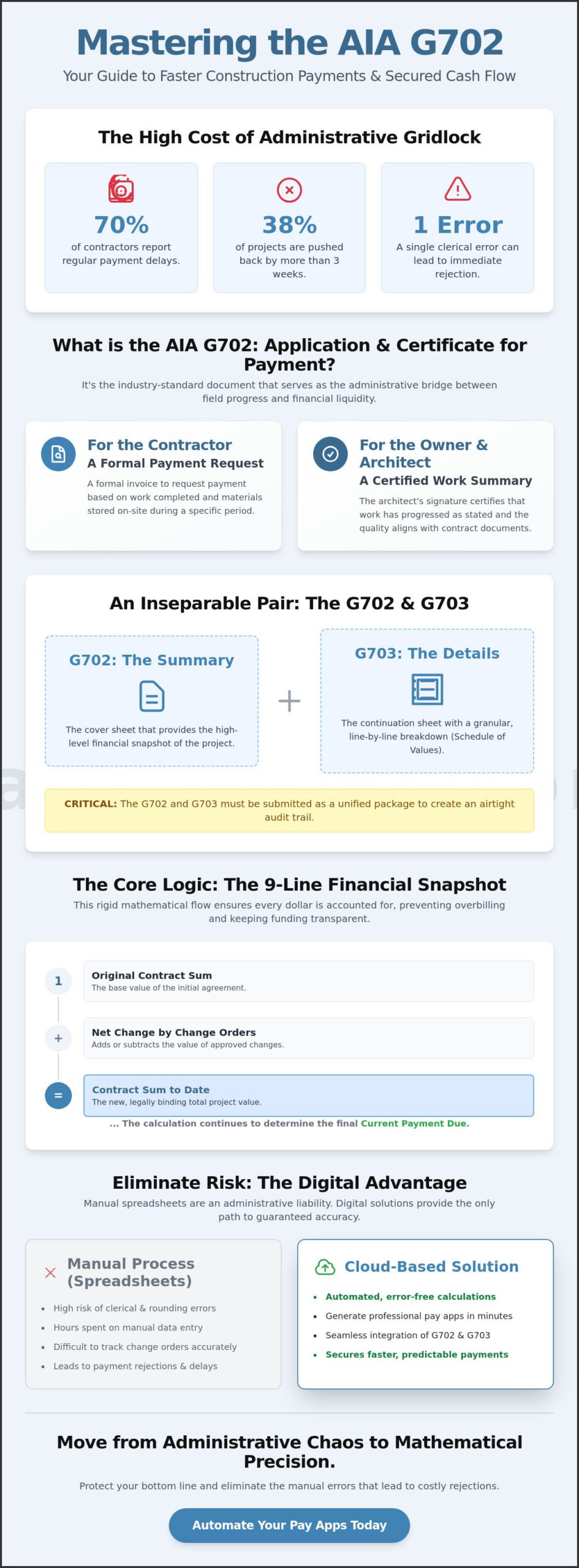
Seventy percent of construction contractors report regular payment delays, with 38% of projects pushed back by more than three weeks as a result. You’ve likely experienced the frustration of a rejected application due to a minor clerical error or a complex retainage calculation. It’s a high-stakes environment where one mistake can freeze your liquidity. Understanding what is aia g702 is no longer just about compliance; it’s about protecting your bottom line from administrative gridlock.
This guide provides a pragmatic look at why the AIA G702 remains the industry standard for payment applications in 2026. We will show you how to use this document to secure faster payments while navigating new regulatory shifts, such as California’s 5% retention cap and the strict interest penalties introduced by SB 440. You’ll learn the specific steps to integrate your G702 with a Schedule of Values and find a way to eliminate the manual Excel errors that lead to costly rejections. Let’s move from administrative chaos to mathematical precision.
Key Takeaways
- Master the dual-purpose nature of what is aia g702 to function as both a formal payment application and a certified summary of work completed.
- Learn to accurately calculate the Contract Sum by properly accounting for the original contract value alongside net change orders and stored materials.
- Navigate 2026 legislative updates, including California’s 5% retention cap and the 2% monthly interest penalties for wrongfully withheld payments.
- Discover why digital document generation is the only way to eliminate the manual spreadsheet errors that lead to payment rejections and administrative delays.
- Understand the vital link between the G702 summary and G703 continuation sheets to maintain an airtight audit trail across complex, multi-year projects.
What is the AIA G702 Form? Defining the Standard for Construction Billing
The AIA G702, officially titled the “Application and Certificate for Payment,” is the bedrock of commercial construction finance. It functions as a summary invoice that documents the financial status of a project at a specific point in time. By providing a uniform language for owners, lenders, and architects, it ensures all parties agree on the value of work performed. The G702 serves as the administrative bridge between field progress and financial liquidity.
To better understand how this document facilitates project funding, watch this helpful breakdown:
This document serves a dual purpose that balances the interests of the payer and the payee. For the contractor, it’s a formal request for payment based on completed work and stored materials. For the architect or owner, it’s a certification process. When the architect signs the G702, they’re confirming that the work has progressed to the point indicated and that the quality of work aligns with the contract documents. Understanding what is aia g702 is the first step toward reducing payment friction.
The Relationship Between G702 and G703
You can’t submit a G702 in isolation. It acts as a cover sheet summary, while the G702 and G703 must be submitted as a unified package. The G703 is the Continuation Sheet that provides the granular data supporting the summary. This detailed breakdown is based on the Schedule of Values, which allocates the total contract sum into specific work items. Without the G703, the G702 lacks the mathematical evidence required to justify the payment request.
Who Needs to Submit a G702?
Submission requirements depend on the contract structure. Typically, general contractors submit these forms to owners for progress payments. Subcontractors also use AIA-style forms to bill general contractors, ensuring that the entire payment chain remains standardized. The Architect’s Certification block is a critical component of the signature area. It acts as a professional gatekeeper, requiring a third-party review of the work before any capital is released. If you’re involved in commercial projects, knowing what is aia g702 ensures you can navigate these professional requirements without risking your cash flow.
How the G702 Works: Understanding the Summary of Work and Retainage
The core of the G702 is a specific nine-line summary that provides a mathematical snapshot of the project’s financial health. It begins with the Original Contract Sum on Line 1. Line 2 accounts for the net change by Change Orders, which then results in the Adjusted Contract Sum on Line 3. This structure ensures that every dollar requested is tied back to a legally binding agreement. When considering what is aia g702 in a practical sense, it is this rigid nine-line logic that prevents overbilling and keeps project funding transparent.
The “Work Completed” section (Lines 4 through 6) is where the actual progress is documented. You must distinguish between work finished in the current period and total work completed to date. This section also tracks “Stored Materials,” which refers to items purchased and delivered to the site but not yet installed. Accuracy here is vital. A single clerical error in these nine lines leads to an immediate rejection of the application, stalling your cash flow. For a deeper look at how these summaries integrate into the broader billing cycle, consult this Guide to G702 and G703 Forms.
Calculating these values manually is a significant administrative liability. Many contractors spend hours every month cross-referencing spreadsheets only to have their payment delayed by a simple rounding error. Using a cloud-based pay app solution eliminates this risk by automating the math across all nine lines.
Calculating Retainage and Stored Materials
Retainage is the percentage of the contract price withheld until the project reaches substantial completion. Understanding what is retention is essential for maintaining your profit margins. As of January 1, 2026, California law (SB 61) now caps retention at 5% for private projects, a shift from the previous 10% standard. You must also account for Stored Materials on the G702. These are high-value items, such as HVAC units or custom cabinetry, that you’ve paid for but haven’t put in place. Including them ensures you are reimbursed for your upfront capital outlay.
Change Orders and the G702 Summary
Line 2 of the G702 must reflect the net total of all approved modifications to the contract. One of the most common causes of payment rejection is including “pending” change orders. If the owner hasn’t signed the document, it cannot appear on the G702. Every entry on Line 2 must have a corresponding, fully executed change order to back it up. Maintaining this discipline is the only way to ensure your payment application passes the architect’s review without friction.
The Strategic Advantage of Accurate G702 Submissions in 2026
Speed of payment is directly tied to the quality of your documentation. A perfectly formatted G702 is paid significantly faster than a handwritten or Excel-based form because it removes the burden of verification from the architect. In the competitive landscape of 2026, understanding what is aia g702 is only half the battle; the other half is flawless execution. When your paperwork is precise, you build immediate trust with lenders and high-end developers who prioritize financial transparency.
Digital AIA billing software is now essential for maintaining audit trails on multi-year projects. Tracking historical data across dozens of pay periods is nearly impossible with paper files. Modern tools allow you to transition from a simple form filler to a strategic financial manager. You gain the ability to forecast cash flow and manage project liquidity with the same precision you use for field operations.
Moving Beyond Manual Templates
The risks of an AIA billing software vs excel approach are too high for modern commercial projects. Excel spreadsheets are notorious for broken cell references and version control issues that lead to mathematical discrepancies. PAYearned automates the G702 and G703 sync, ensuring that every calculation is accurate across both documents. This automation eliminates the human error that frequently causes payment rejections.
Best Practices for 2026 Compliance
- Notarization: Ensure all signatures are notarized if your contract requires it. This is a standard requirement for the G702 and a common reason for administrative delays.
- Documentation: Always attach the G703 continuation sheet. It provides the necessary Schedule of Values backup that justifies the summary on the G702.
- Verify Limits: Stay updated on local regulations. For example, ensure your retainage entries comply with California’s 5% cap if the project is located there.
By mastering what is aia g702 and adopting automated workflows, you protect your business from the payment delays that plague 70% of the industry. Precision in your billing process isn’t just an administrative task; it’s a stabilizer for your entire financial operation.
Secure Your Cash Flow with Standardized Documentation
Commercial construction finance in 2026 demands more than just basic administrative skills. It requires a commitment to mathematical precision and a deep understanding of what is aia g702 in the context of modern regulation. You’ve learned that the G702 is a vital certification of progress that bridges the gap between field work and financial liquidity. By mastering the summary of work and strictly adhering to new retention caps, you position your firm as a reliable partner to owners and lenders.
Manual spreadsheets are a liability you can no longer afford. Errors in retainage or change order calculations don’t just look unprofessional; they freeze your capital. You need a system that provides a steady hand in a chaotic environment. Start generating error-free AIA-style G702 and G703 forms with PAYearned today. Our platform provides automated math calculations to prevent rejection, cloud-based search for instant project retrieval, and dedicated tracking for change orders and retainage. Take control of your billing cycle and ensure your team gets paid for every hour of progress. Your next pay app should be a stabilizer, not a source of stress.
Frequently Asked Questions
Is the AIA G702 legally required for all construction projects?
The G702 is not a universal legal requirement mandated by the government, but it is the most common contractual requirement in commercial construction. If your project agreement specifies the use of AIA documents, you’re bound by that contract to provide them. Many lenders and architects refuse to release funds without this specific format because it provides the standardized data they need to verify project progress against the budget.
What is the difference between an AIA G702 and a standard invoice?
A standard invoice is a simple request for payment, but what is aia g702 is something much more comprehensive. It serves as a project-wide financial summary that accounts for the original contract sum, every approved change order, and the total retainage held to date. Unlike a basic invoice, the G702 requires a formal certification from both the contractor and the architect to verify that the work meets the project’s quality and progress standards.
Can I create my own G702-style form instead of buying the official one?
You can certainly use AIA-style forms generated by digital platforms rather than purchasing official paper documents, provided your contract doesn’t strictly forbid it. When people ask what is aia g702 in a modern context, they’re usually referring to the standardized format rather than a specific physical piece of paper. Most commercial owners accept these high-quality digital equivalents because they provide the same level of financial transparency and professional layout.
How do I handle negative change orders on the G702 summary?
Handle negative change orders by reflecting the deductive amount on Line 2 of the G702 summary. This deduction reduces the total contract sum, which in turn adjusts the balance to finish. You must ensure the deductive change order is fully executed and signed by all parties before including it. Any discrepancy between the summary on the G702 and the detailed breakdown on the G703 will result in an immediate rejection by the architect.
PAYearned is an agnostic workflow platform that helps teams manage pay applications
PAYearned is an independent software product and is not developed, endorsed, approved, sponsored or affiliated with the American Institute of Architects (AIA). AIA®, G702®, G703®