

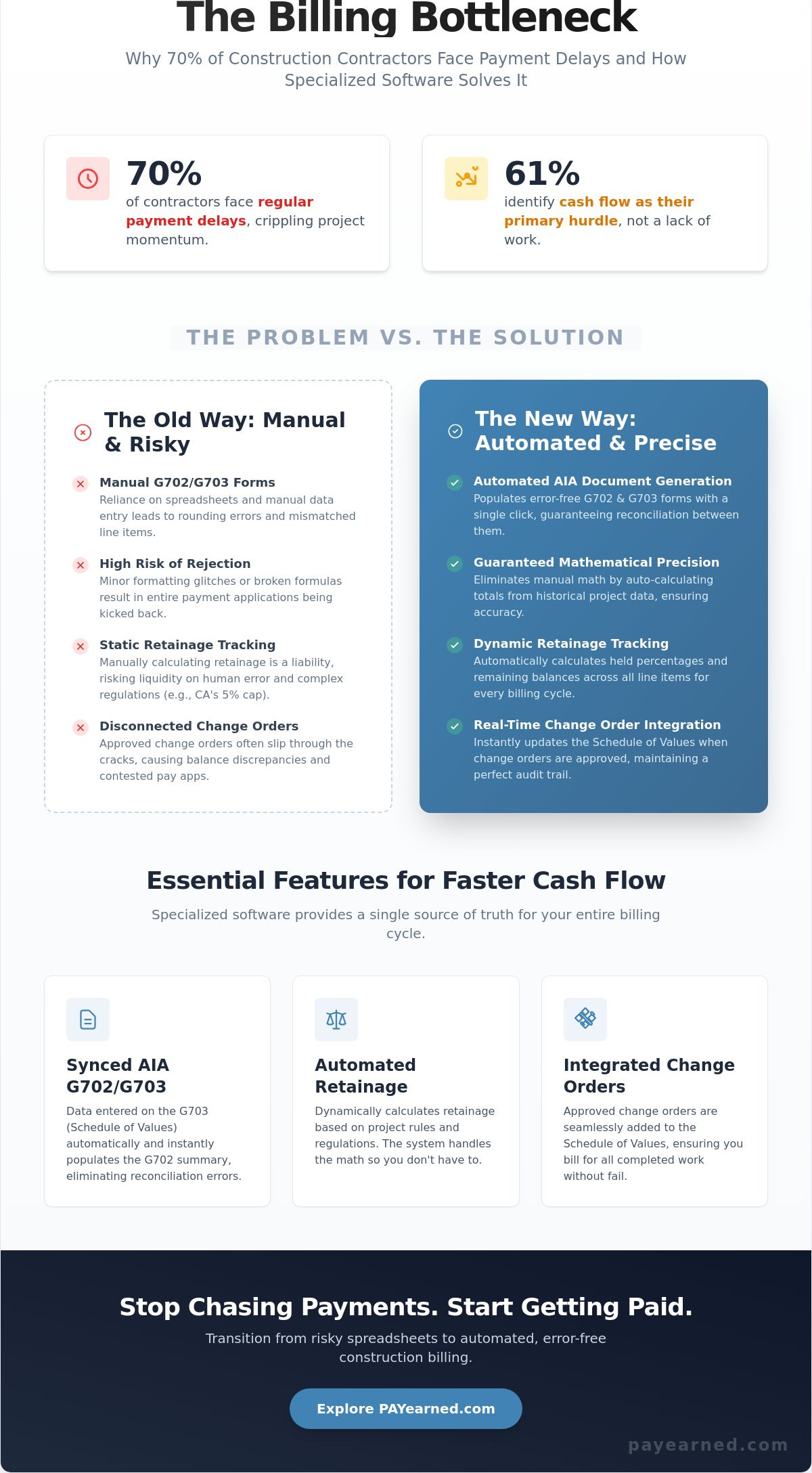
Did you know that 70% of construction contractors face regular payment delays, with 61% identifying cash flow as their primary operational hurdle? For most, the culprit isn’t a lack of work; it’s a reliance on general accounting tools that cannot handle the mathematical precision required for progress billing. Using the wrong construction billing software often leads to rejected G702 forms and lost revenue due to manual entry errors in retainage calculations.
You probably already know the frustration of a payment application being kicked back because of a minor formatting glitch or a change order that slipped through the cracks. It is an administrative bottleneck that threatens your financial liquidity. This guide reveals how specialized construction billing software automates AIA-style document generation and protects your bottom line from costly mistakes. We will examine how to generate error-free G702 and G703 forms, track project retainage under new 2026 regulations like California’s 5% cap in SB 61, and accelerate your entire payment cycle through cloud-based automation.
Key Takeaways
- General accounting tools often lack the native architecture required to manage a complex Schedule of Values (G703) effectively.
- Transitioning to specialized construction billing software automates the generation of AIA-style documents, protecting your cash flow from manual entry errors.
- Dynamic retainage tracking auto-calculates held percentages and remaining balances to ensure mathematical precision across every billing cycle.
- A structured audit of your current payment application process is the first step to identifying where administrative bottlenecks and formatting rejections occur.
Why General Accounting Software Fails Construction Billing Requirements
Most contractors start with general accounting software because it is familiar. It works for overhead and simple payroll, but it fails the moment you need to submit a progress payment. Standard accounting tools lack the native architecture to manage the Schedule of Values (SOV) effectively. This architectural gap forces your team to use manual workarounds and external spreadsheets. These workarounds are exactly where financial risk lives.
Specialized construction billing software is a dedicated tool built for the specific math of the industry. It handles progress billing, retainage, and document generation as a single, unified process. While generic tools treat every invoice as a static event, construction billing requires a moving timeline of data. Without a system that understands this continuity, manual data entry between your accounting software and billing templates creates a high risk of “rejected” pay applications.
To better understand how these financial components interact, watch this guide on how invoicing and cash flow work in the field:
The Complexity of AIA-Style G702 and G703 Documents
The relationship between the G702 summary and the G703 continuation sheet is the primary source of billing errors. Every penny claimed on the G703 must reconcile perfectly with the totals on the G702 Application and Certificate for Payment. Architects and owners will reject a multi-million dollar application for a single rounding error or a mismatched line item. Automated software bridges the gap between field progress and office documentation by pulling data into a synchronized environment where the math is guaranteed.
The High Cost of Spreadsheet Errors in 2026
Spreadsheets are liabilities in 2026. A single broken formula in a legacy Excel file can delay a massive payment for weeks, choking your project’s liquidity. The administrative burden of manually updating “previous applications” data every month is not just slow; it is dangerous. Dedicated construction billing software eliminates this risk by auto-calculating totals and retainage based on historical project data. It ensures that your team spends time on project execution rather than hunting for broken cells in a spreadsheet.
Essential Features for Efficient Construction Payment Applications
Efficiency in the field requires more than just a digital version of a paper form. High-performing construction billing software prioritizes automation and data continuity over general-purpose features. Instead of juggling separate files, look for a platform that populates G702 and G703 forms with a single click. This eliminates the manual “copy-paste” cycle that often leads to formatting rejections and payment delays.
A specialized system provides a stabilizing force in an environment where financial accuracy is non-negotiable. It ensures that every line item on the continuation sheet reconciles with the summary application without requiring a secondary audit. This level of precision is what separates specialized tools from bloated project management suites that often treat billing as an afterthought.
Managing Retainage and Change Orders Without Math Errors
Understanding what is retention is vital for long-term project viability. Retainage acts as a financial safeguard for owners, but tracking it manually across dozens of line items is a massive liability. Your system must dynamically auto-calculate held percentages and remaining balances to ensure accuracy. If your current process relies on manual entry, you are risking your project’s liquidity on human error.
Equally critical is change order integration. When a change order is approved, it must automatically reflect on the continuation sheet. If these additions aren’t tracked in real-time, balance discrepancies will inevitably occur, leading to contested pay apps. A specialized SaaS platform ensures these updates happen instantly, maintaining a perfect audit trail for every dollar claimed.
Cloud-Based Accessibility and Data Organization
By 2026, cloud adoption has become the baseline for construction finance. Real-time access to billing documents is no longer a luxury; it is a necessity for both General Contractors and Subcontractors. Cloud-based construction billing software provides a centralized hub where historical project data and previous pay apps are retrieved instantly. This accessibility ensures that field teams and office staff are always working from the same set of numbers.
Built-in search engines within the platform simplify project audits and financial reporting. Instead of digging through folders, you can locate specific payment certificates or continuation sheets in seconds. This level of organization provides the peace of mind that comes with knowing your financial records are secure, accessible, and mathematically sound.
Implementing Automated AIA-Style Billing for Faster Cash Flow
Transitioning from manual spreadsheets to a dedicated system is a tactical necessity for firms prioritizing financial liquidity. To begin, audit your current workflow to identify exactly where delays and errors occur. Most rejections happen because of mismatched totals or incorrect retainage entries. Once you understand these bottlenecks, select a specialized aia billing software that focuses on your specific form requirements rather than a bloated, all-in-one suite.
After selecting your platform, follow these critical steps to secure your revenue cycle:
- Import your Schedule of Values: Establish a digital foundation that ensures every future application is mathematically consistent.
- Automate G702/G703 generation: Move away from manual data entry to ensure every submission is professional and compliant.
- Standardize change order tracking: Integrate adjustments immediately to prevent balance discrepancies at the end of the project.
This structured approach ensures that your construction billing software isn’t just another tool, but a stabilizing force in your administrative environment. It moves your team away from reactive error-correction toward proactive financial management.
Moving Beyond Manual Excel and Word Templates
Static Word and Excel templates are inherently fragile. They require human oversight for every cell, increasing the risk of procedural inaccuracies. In contrast, specialized construction billing software is dynamic. It maintains a running history of your project’s financial health. Automated payment application generation reduces friction between the field and the accounting office. It ensures that progress updates translate into cash flow without the administrative delays common in non-automated systems.
Why PAYearned is the Tactical Choice for Specialized Billing
PAYearned is the focused partner that excels at one critical task: accurate AIA-style billing. It is the no-nonsense alternative to project management platforms that are often too complex for specialized billing needs. Unlike impersonal global platforms, we provide domestic, real-time professional assistance. This localized support acts as a primary trust signal, ensuring you have human-centric help when a high-stakes deadline is approaching. PAYearned is designed for low-friction entry and immediate ROI. It’s the pragmatic choice for contractors who value stability and precision over flashy, unnecessary features.
Secure Your Cash Flow with Specialized Billing Automation
Relying on general-purpose accounting tools for industry-specific documentation is a risk you don’t have to take. Mathematical precision in your G702 and G703 forms is the baseline for maintaining project liquidity. Moving to a dedicated construction billing software ensures that your progress billing, retainage calculations, and continuation sheets are always synchronized and error-free. This shift protects your firm from the procedural inaccuracies that lead to costly payment rejections.
Efficiency comes from using tools designed for the specific task at hand. By implementing automated document generation and specialized change order management, you eliminate the administrative bottlenecks that stall your revenue. Built-in project search engines further streamline your operations by allowing you to access historical data instantly. It’s time to replace fragile spreadsheets with a stabilizing solution that provides genuine peace of mind.
You can streamline your AIA-style billing with PAYearned now to protect your bottom line from manual entry errors. Our platform is built for contractors who prioritize reliability and financial accuracy. Take control of your revenue cycle today and experience the relief of a truly professional administrative workflow.
Frequently Asked Questions
Is construction billing software different from standard accounting software?
Yes, it is fundamentally different because it handles the specific mathematical continuity of progress billing and the Schedule of Values. Standard accounting tools focus on general ledger entries and simple invoicing. In contrast, construction billing software manages the complex relationship between previous payments, current work, and remaining balances. It bridges the gap between field progress and office documentation that general tools often ignore.
Can I generate AIA-style G702 and G703 forms without a direct AIA contract?
You can generate these standardized document formats regardless of your specific contract affiliation. Many project owners and general contractors require AIA-style payment applications because they are the industry standard for clarity and organization. Specialized software allows you to produce these professional certificates and continuation sheets to meet project requirements without needing to purchase manual forms or maintain direct licenses from the AIA.
How does automated software help with retainage tracking?
Automated software eliminates manual math errors by dynamically calculating held percentages and remaining balances for every line item. It ensures that your retainage calculations comply with project-specific rules or state regulations, such as California’s 5% cap under SB 61. By using construction billing software, you avoid the risk of over-billing or under-claiming. This maintains a perfect audit trail of all withheld funds throughout the project lifecycle.
What is the benefit of using cloud-based billing for change orders?
The primary benefit is the real-time synchronization of approved changes with your active continuation sheets. Cloud-based systems ensure that once a change order is logged, it is immediately available for inclusion in the next payment application. This accessibility prevents balance discrepancies and ensures that both field teams and office staff are working from the most current financial data. It effectively accelerates the overall payment cycle and reduces administrative friction.
PAYearned is an agnostic workflow platform that helps teams manage pay applications
PAYearned is an independent software product and is not developed, endorsed, approved, sponsored or affiliated with the American Institute of Architects (AIA). AIA®, G702®, G703®