

Change order tracking isn’t just a project management task; it’s a defensive financial strategy to protect your billing integrity. You’ve likely felt the sting of performing field work only to realize it never made it onto the G703 because of a buried email or a broken spreadsheet formula. With 85% of construction projects facing cost overruns, often due to poor change order oversight, your profit margin is likely leaking through manual processes.
It’s time to stop the fee erosion caused by unbilled work and the hours wasted re-keying data. By implementing specialized change order tracking software for contractors, you can automate the flow of information from the field directly to your pay applications. This 2026 guide will show you how to achieve faster approval cycles, eliminate mathematical errors on your AIA-style documents, and maintain a centralized record for every project change. We’ll examine how modern tools ensure your continuation sheets stay accurate even as project scopes evolve, helping you meet strict new requirements like California’s SB 440 for timely dispute resolution.
Key Takeaways
- Protect your Schedule of Values from unbilled work by syncing project changes directly with your financial logs to maintain billing integrity.
- Identify the specific features required in change order tracking software for contractors to eliminate manual data entry and the “bloat factor” in your workflow.
- Automate complex calculations for retainage and progress billing to ensure mathematical precision on every AIA-style continuation sheet.
- Streamline your pay application process by following a structured workflow that integrates approved changes into your G703 documents instantly.
- Accelerate your approval cycles and optimize cash flow by generating professional, audit-ready payment certificates that meet industry standards.
The Critical Link Between Change Orders and Construction Billing
Construction finance relies on a single, unwavering truth: your billing is only as accurate as your change order log. While many view scope adjustments as a project management hurdle, they are actually a billing mandate. In the industry, understanding What is a Change Order? is essential, but tracking them is where profit is either secured or lost. Specialized change order tracking software for contractors acts as a financial safeguard, ensuring that every addition to the project scope is reflected in the final payout. Without this direct link, contractors face “fee erosion,” where the cost of extra labor and materials eats into the original profit margin because the paperwork didn’t keep pace with the field work.
By May 2026, the industry has shifted toward specialized, billing-first solutions. Contractors no longer want bloated suites that try to manage every aspect of a job site. They need precision tools that connect field changes to the contract sum. This focus ensures that when it’s time to bill, the data is already verified, organized, and ready for the continuation sheet. It’s a pragmatic move toward protecting liquidity in an environment where margins are increasingly tight. Understanding how change order management software for contractors is evolving in 2026 reveals why billing compliance has become the central priority for firms seeking faster payment cycles.
To better understand how this communication flow impacts your bottom line, watch this helpful video:
Why Spreadsheets Fail in 2026
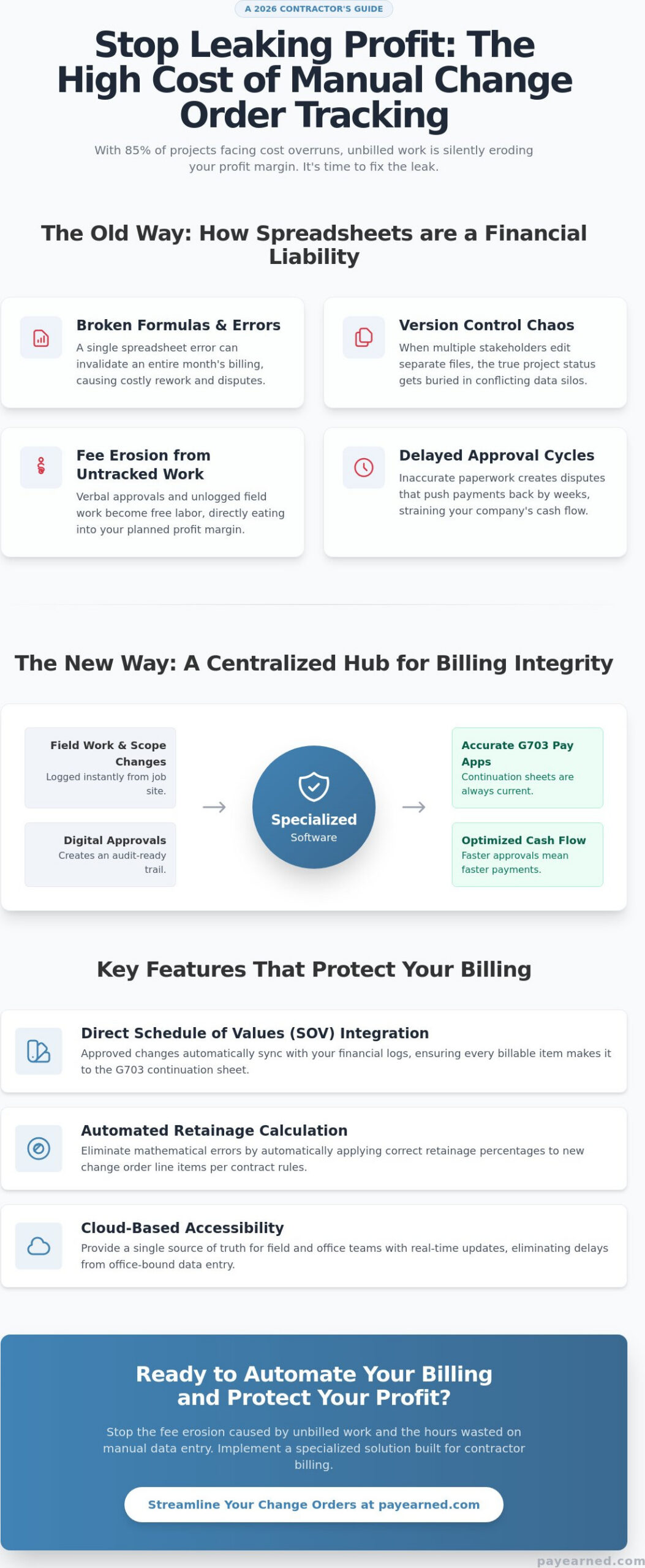
Manual logs are a high-stakes liability. A single broken formula in an Excel workbook can invalidate an entire month’s billing. Version control is another nightmare; when multiple stakeholders edit the same log, the truth becomes buried in conflicting files. These manual entry errors don’t just cause administrative headaches. They create significant delays in the monthly billing cycle, often pushing payments back by weeks while disputes are settled. In a world of automated finance, relying on a static spreadsheet is a risk most contractors can no longer afford.
The Financial Impact of Untracked Work
Untracked work is essentially free labor. Verbal approvals on the job site often vanish during the final billing cycle if there isn’t a centralized digital trail. This lack of documentation leads to immediate fee erosion and complicates your payment application. When you use change order tracking software for contractors, you create an audit-ready history of every project change. This speed and accuracy are directly correlated with faster retainage recovery. If the work isn’t logged, it isn’t billed, and if it isn’t billed, it isn’t paid.
Anatomy of Effective Change Order Tracking Software
Effective change order tracking software for contractors isn’t just a digital version of a paper log. It is a dynamic financial engine that bridges the gap between field operations and the back office. For a software solution to provide true billing integrity, it must offer real-time synchronization with your Schedule of Values (SOV). This ensures that every approved change is immediately billable rather than waiting for a month-end reconciliation that might never happen. When field supervisors and office controllers share a cloud-based platform, the risk of data silos disappears. This centralized approach allows for the generation of AIA-style G702 and G703 compatible documentation that reflects the current, accurate contract sum at all times.
The most critical features of these systems include:
- Automated Retainage Calculation: The software should automatically apply retainage percentages to new change order line items based on existing contract rules.
- Cloud-Based Accessibility: Real-time updates from the job site prevent the delays associated with office-bound data entry.
- SOV Integration: Every change order must link directly to a specific line item or create a new row in the continuation sheet.
Mathematical Precision and Auto-Calculations
Manual billing is a math disaster waiting to happen. High-quality aia billing software eliminates this risk by handling “previous applications” data automatically. It tracks exactly what was billed in prior months, ensuring that current totals for gross earned amounts are mathematically perfect. This level of automation prevents the common “math rejection” from General Contractors, where a five-cent rounding error can stall a six-figure payment. It’s about moving away from the calculator and letting the system enforce the logic of the G702 and G703 forms.
Centralized Search and Data Retrieval
Finding a specific change order from six months ago shouldn’t feel like a forensic investigation. A robust change order tracking software for contractors includes a built-in search engine for instant retrieval. You can filter by date, approval status, or dollar amount to find the exact documentation you need for a dispute or an audit. Adopting a comprehensive change order management process ensures that all historical data is organized. This efficiency saves hours during the project closeout phase, as all changes are already documented and reconciled with the final pay application. To maintain this level of control without the administrative overhead, you can use a specialized billing platform designed for speed and precision.
Billing-Centric vs. Management-Centric Software: Which Do You Need?
Choosing the right technology depends on whether you’re managing a job site or managing a bank account. Many general-purpose project management suites suffer from a significant “bloat factor.” They offer hundreds of features, from safety logs to site photos, which often create unnecessary friction for the accounting department. If your primary goal is to ensure every change order is captured and billed correctly, you don’t need a full ERP system. For many subcontractors, the high entry cost and steep learning curve of enterprise tools outweigh the practical benefits. You shouldn’t have to navigate a complex ecosystem just to update your Schedule of Values.
General contractors often require management-centric software to oversee the entire project lifecycle. However, subcontractors need change order tracking software for contractors that prioritizes the financial side of the equation. This distinction is critical for maintaining liquidity. A management tool might tell you that a change order was discussed, but a billing-centric tool ensures that change order is actually on the next pay application. Using a sledgehammer to crack a nut only leads to administrative fatigue and data entry errors. The shift toward billing-compliance-focused change order management software for contractors reflects a broader industry recognition that financial accuracy must come before general project documentation.
The Subcontractor Case for Specialization
Subcontractors live and die by their cash flow. Specialized tools focus specifically on getting the “pay app” out the door without the distractions of non-financial features. Niche software avoids the “feature fatigue” that plagues larger platforms, allowing your team to master the system in minutes rather than months. By using dedicated application for payment software, you ensure that your change order tracking is always aligned with your billing cycle. This specialization means your financial data remains clean, unencumbered by the “noise” of general project communication.
Interoperability and Financial Accuracy
Your billing software shouldn’t be an island. It needs to work alongside your existing accounting tools to provide a stabilizing force for your finances. Dedicated billing logic prevents the common errors found in general-purpose tools that treat financial data as an afterthought. Mathematical precision in construction finance serves as the ultimate risk mitigation strategy by ensuring that every dollar billed is contractually defensible. When you prioritize financial accuracy over general management features, you reduce the risk of disputes and accelerate your time to payment. This pragmatic approach to change order tracking software for contractors ensures that your office stays focused on what matters most: getting paid for the work you do.
How to Integrate Change Orders into Your G703 Continuation Sheet
Integrating scope changes into your G703 Continuation Sheet is where administrative intent meets financial reality. You can’t simply add a total to the bottom of your bill; you must maintain a structured audit trail that satisfies both the owner and the bank. Using change order tracking software for contractors simplifies this process by ensuring that every adjustment is mapped correctly to your Schedule of Values (SOV). Follow this five-step workflow to maintain billing integrity:
- Step 1: Log the change immediately. Assign a unique ID to every approved change order. This prevents “lost” work and creates a traceable history for every dollar added to the contract.
- Step 2: Map to the SOV. Decide if the change expands an existing line item or requires a new row. Standalone rows are often easier for GCs to audit.
- Step 3: Update the Scheduled Value. Your total contract sum must reflect the revised amount. This ensures your percentages of completion remain accurate.
- Step 4: Audit progress billing. Calculate the work completed to date and compare it against previous applications. This prevents overbilling or double-billing on the same scope.
- Step 5: Generate the G703. Produce the updated document for review. Automated systems ensure that these updates happen instantly, removing the risk of manual data entry errors.
Best Practices for Line Item Organization
Organization is the key to faster approvals. Many contractors prefer grouping all change orders in a dedicated section at the bottom of the G703, while others integrate them directly into specific trades. Whichever method you choose, consistency is vital. Your g702 summary totals must perfectly align with the detailed breakdown on your G703. Use clear, concise descriptions for every change to avoid “line item confusion” during the review process. If the GC can’t identify what the work was, they won’t approve the payment. Reviewing a detailed AIA G703 example with a column-by-column breakdown can help you structure your line items correctly and avoid the most common formatting rejections.
Handling Retainage on Change Orders
Retainage must be applied consistently to every new line item. A common financial error is forgetting to “hold back” the required percentage on scope additions, which can lead to disputes or overpayment. Understanding what is retention in a legal context is essential for protecting your liquidity. Most contracts require the same retention rate for change orders as the original contract sum. Change order tracking software for contractors automates these calculations, ensuring that your retainage amounts are always mathematically perfect. To eliminate the friction of manual G703 updates and secure your cash flow, start using PAYearned today.
PAYearned: The Specialized Solution for Change Order Billing
PAYearned serves as a pragmatic partner for construction firms that prioritize financial liquidity over administrative complexity. While general project management tools attempt to solve every job site problem, PAYearned excels at one specific, high-stakes task: ensuring your billing is accurate and defensible. This specialized change order tracking software for contractors focuses on the critical link between field changes and the Schedule of Values. By removing the “bloat factor” associated with enterprise suites, it provides a stabilizing force for your back office. It’s a tool built for the reality of the professional’s daily life, focusing on core financial operations rather than abstract software concepts.
The platform anchors its utility in mathematical precision and system autonomy. It manages the complexities of retainage tracking and historical data retrieval through a built-in search engine. You can locate any specific project change in seconds; this provides the transparency needed to resolve disputes with general contractors. This level of organization protects your bottom line from the fee erosion discussed earlier in this guide. Because it’s a cloud-based solution, your field and office teams stay synchronized without the hazards of version control failures. It acts as a protective expert, mitigating the risk of unbilled work and procedural inaccuracies.
Automated AIA-Style Documentation
Generating professional pay applications shouldn’t take hours of manual data entry or complex spreadsheet manipulation. PAYearned automates the creation of AIA-style G702 and G703 documents, allowing you to produce audit-ready certificates in minutes. The system auto-calculates totals, balances, and progress billing percentages. It ensures that your continuation sheets always reflect the most current contract sum, including all approved change orders. This standardized formatting provides the peace of mind that your documentation meets industry expectations every time. It’s a high-end solution that bridges the gap between complex accounting requirements and user-friendly technology.
No-Nonsense Implementation
We understand that contractors don’t have time for multi-month software rollouts or “feature fatigue.” PAYearned offers a low-friction entry point with an intuitive interface designed for immediate operation. You can transition from error-prone spreadsheets to a high-end, automated solution without the typical technical headaches. Our focus remains on the utility of the software rather than flashiness. If you need help, our domestic, human-centric assistance is available to ensure your financial workflow remains uninterrupted. It’s a no-nonsense approach to change order tracking software for contractors that excels at protecting your billing integrity. Streamline your change orders with PAYearned today.
Securing Your Financial Future with Precision Billing
Protecting your profit margins requires more than hard work in the field. It demands a stable, automated approach to your back office. We’ve explored how manual logs lead to fee erosion and why specialized billing logic outperforms bloated management suites. Prioritize the accuracy of your Schedule of Values. Ensure every scope change is contractually defensible and ready for payment. Transitioning to change order tracking software for contractors is the most effective way to eliminate mathematical errors and accelerate your approval cycles.
PAYearned provides the specialized tools you need to maintain billing integrity. Our platform offers AIA-style G702 and G703 automation, dedicated retainage tracking logic, and reliable national support for US-based contractors. Stop letting your hard-earned fees disappear into spreadsheet errors. Start your PAYearned subscription for error-free billing and experience the peace of mind that comes with professional financial control. Your cash flow is the lifeblood of your business. It deserves the highest level of precision.
Frequently Asked Questions
What is change order tracking software for contractors?
Change order tracking software for contractors is a specialized digital tool designed to log, manage, and integrate project scope changes directly into the billing workflow. It replaces manual spreadsheets to ensure that every approved change is accurately reflected on payment applications. This software acts as a financial safeguard by maintaining a real-time link between field work and the total contract sum.
How does software help with AIA G702 and G703 compliance?
The software automates the generation of documents that mirror the structure of standardized AIA G702 and G703 forms. It maps change orders to specific line items on the continuation sheet, ensuring the total contract sum and work completed percentages align perfectly. This reduces the risk of rejection by general contractors who require strict adherence to industry-standard formatting. Understanding the structure through a practical AIA G703 example and continuation sheet guide can further help you prepare documentation that passes review on the first submission.
Can I track retainage specifically on change orders?
Yes, effective billing software automatically applies consistent retention percentages to every new change order line item. This prevents the common error of neglecting to “hold back” funds on scope additions. By automating this logic, you ensure that your total retainage matches the contractual requirements for both the original scope and all subsequent adjustments.
Is specialized billing software better than a full project management suite?
For billing integrity, specialized software is often superior because it eliminates “feature fatigue” and administrative bloat. Large project management suites include hundreds of non-financial tools that can overcomplicate the simple task of getting paid. Specialized change order tracking software for contractors focuses exclusively on financial accuracy and document generation without unnecessary distractions.
How does a built-in search engine improve the billing process?
A built-in search engine allows for the instant retrieval of historical change order data by date, status, or dollar amount. This eliminates the need to dig through buried emails or physical files during a dispute or project closeout. Having immediate access to a centralized digital trail ensures that no work goes unbilled and every charge remains contractually defensible.
Does change order software prevent mathematical errors on pay apps?
Yes, the software uses automated calculation engines to handle totals, balances, and progress billing. It tracks “previous applications” data to ensure that current gross earned amounts are mathematically perfect. This level of automation removes the risk of human error, which is a primary cause of payment delays on complex commercial projects.
What happens if a change order is not tracked correctly on a G703?
Incorrect tracking leads to fee erosion, where you perform work that is never billed or paid. It also creates a version control nightmare that can stall the entire monthly pay application process. If the G703 totals don’t match the G702 summary, the general contractor or owner will likely reject the submission, causing significant cash flow delays.
Can subcontractors use this software independently of the General Contractor?
Subcontractors can use PAYearned to generate professional, audit-ready pay applications regardless of the general contractor’s internal systems. This allows you to maintain your own precise financial records and provide standardized AIA-style documentation. Using change order tracking software for contractors independently ensures that your billing remains accurate even if the project’s overall management is chaotic.
PAYearned is an agnostic workflow platform that helps teams manage pay applications
PAYearned is an independent software product and is not developed, endorsed, approved, sponsored or affiliated with the American Institute of Architects (AIA). AIA®, G702®, G703®