

The average commercial contractor loses over $14,000 every year due to billing errors caused by manual spreadsheets. While a “free” download seems like a shortcut, it often becomes a significant financial liability. You’ve likely felt the frustration of a rejected pay application caused by a broken formula or a miscalculated retainage percentage. If you’re tired of the administrative gridlock, finding a professional aia g702 excel template alternative is the first step toward securing your firm’s liquidity.
We understand that managing a complex Schedule of Values in a static file is risky and inefficient. This guide shows you how to transition to a high-precision billing system that guarantees 100% mathematical accuracy and centralizes your project documentation. New 2026 regulations, such as California’s SB 440, now impose a 2% monthly interest penalty on undisputed payments delayed beyond 60 days. You can’t afford the “formula drift” inherent in legacy templates. We’ll explore how to automate your progress billing to ensure faster payment cycles and maintain total compliance with the latest 5% retention caps under SB 61.
Key Takeaways
- Identify why an aia g702 excel template alternative is a financial necessity by exposing the hidden labor costs of manual data entry.
- Prevent retainage creep and cumulative rounding errors by transitioning from static spreadsheets to a dynamic, automated calculation engine.
- Automate your Schedule of Values (SOV) and change order tracking to maintain a perfectly synchronized G703 continuation sheet.
- Use our five-point checklist to evaluate platform security and replace risky local files with a centralized, cloud-based billing hub.
- Discover how specialized software provides a mathematical precision guarantee that removes the administrative burden from your finance team.
The ‘Free’ AIA G702 Excel Template Myth: Hidden Costs of Manual Billing
Many contractors view a downloaded spreadsheet as a simple cost-saving measure. It isn’t. An aia g702 excel template alternative is more than a digital form; it’s a cloud-based billing optimizer designed to eliminate the administrative friction that stalls project funding. While the American Institute of Architects (AIA) provides the industry-standard framework for these documents, a manual file lacks the intelligence to manage them. Relying on a static template means you’re building your financial house on a foundation of unverified data.
The familiarity trap keeps firms tethered to Excel. You know the rows, the columns, and the basic math. This comfort creates a dangerous blind spot. A single typo in a cell reference can propagate through months of billing history. Stop treating your billing like a clerical task. It’s a high-stakes financial operation that requires specialized tools. Using Word for invoice templates is even riskier. Document-based billing fails construction standards because it lacks the basic calculation power required for progress billing. It’s an invitation for human error in an industry where precision is your only protection.
To better understand the complexity of these documents, watch this helpful video:
Why ‘Free’ Templates Lead to Expensive Rejections
When an architect spots a mathematical error, they rarely fix it for you. They reject the entire pay application. This restarts the clock on your payment cycle, often pushing cash flow back by 30 days or more. This delay ripples down to your subcontractors and suppliers. Architects and owners are increasingly skeptical of manual spreadsheets. They want the assurance of a system-generated report that provides a verifiable audit trail. A professional aia g702 excel template alternative provides this transparency, ensuring your applications move through the approval chain without friction.
The Labor Cost of Manual Data Entry
Your accounting team likely spends hours on “double entry” tasks. They manually sync the G702 summary with the G703 Schedule of Values. This manual maintenance is a hidden drain on your overhead that far exceeds the cost of a software subscription. Formula drift is the silent killer of construction billing accuracy, occurring when manual edits slowly corrupt the underlying logic of a spreadsheet over time. If your team spends more than an hour “cleaning up” a spreadsheet each month, you’re losing money. Automated platforms handle these calculations instantly, allowing your team to focus on project execution rather than troubleshooting broken cells.
Debunking the ‘Control’ Myth: Why Spreadsheets Fail Construction Finance
The belief that Excel offers superior control over project math is a common industry misconception. Contractors often stay with manual files because they want to “see the formulas” and maintain the ability to make quick adjustments. This perceived control is actually a liability. In a manual spreadsheet, every cell is a potential point of failure. Unlike a dedicated aia g702 excel template alternative, which uses a relational database to maintain data integrity, a spreadsheet relies on the user to remember every link and dependency. One accidental keystroke can trigger “Retainage Creep,” where small rounding errors accumulate over a twelve-month project, leading to a significant discrepancy in the final payout.
Automated platforms act as a protective expert for your firm’s cash flow. They don’t just store data; they validate it. While Excel math is passive and easily broken, database calculations are active and enforced. This structural difference separates a professional financial tool from a general-purpose ledger. When you use a system designed specifically for construction billing, you’re not just filling out a form. You’re deploying a specialized engine that ensures mathematical precision across every line item of your Schedule of Values. For a deeper look at how these tools compare head-to-head, see our comprehensive analysis of aia billing software vs excel to understand which approach best protects your firm’s cash flow in 2026.
The Danger of ‘Hard-Coded’ Numbers
When an accounting clerk manually overrides a formula to “make the numbers work” for a specific month, they effectively destroy the audit trail. These manual overrides are common when trying to balance “Work Completed This Period” against “Stored Materials.” In Excel, there’s no easy way to lock these figures without breaking the entire sheet’s functionality. Specialized platforms solve this by locking previous months’ data. This ensures that your cumulative totals remain consistent and that your current application always reconciles with your previous certificates. You can eliminate these risks by moving your billing to a secure, automated environment that handles the heavy lifting for you.
Retainage Tracking: Excel’s Greatest Weakness
Tracking variable retention rates across a multi-year project is where spreadsheets truly fail. Many projects involve complex scenarios where retention might be 10% for the first half of the project and 5% thereafter. Managing this manually requires complex nested IF statements that are notoriously difficult to audit. To fully grasp the financial stakes of these errors, it’s essential to understand what is retention and how it impacts your long-term liquidity. A professional alternative handles these calculations automatically, ensuring that “Total Retainage to Date” is always accurate based on the specific rules of your contract. This precision prevents you from over-billing or, more commonly, leaving earned money on the table due to calculation errors.
Change Orders and G703 Integration: The Alternative Advantage
Manual change order tracking is the primary cause of payment delays in construction finance. In a standard spreadsheet, adding a new line item requires you to manually update the G703 continuation sheet and then ensure the G702 summary totals reflect the change. This disconnected workflow is a recipe for disaster. A dedicated aia g702 excel template alternative eliminates this risk by creating a single source of truth. When you approve a change order in an automated platform, the software instantly updates your Schedule of Values (SOV) and recalculates the entire payment application in real time. You don’t have to worry about broken links or missing rows because the database handles the structural integrity of the document.
The stakes for accuracy have never been higher. Under California Senate Bill 440, which became effective January 1, 2026, undisputed amounts not paid within 60 days accrue interest at a rate of 2% per month. This mandatory process for resolving change order disputes means your documentation must be flawless and immediate. Relying on an aia g702 excel template alternative ensures that every change is captured, dated, and reconciled against the original contract sum. You gain the speed required to meet these new legal deadlines without sacrificing the mathematical precision your firm depends on.
Managing the Schedule of Values Dynamically
The SOV is the backbone of your project’s financial health. If your G703 doesn’t perfectly align with your actual progress, you risk the twin dangers of over-billing or under-billing. Over-billing creates liability, while under-billing strangles your cash flow. Using aia document g702 automation keeps your SOV in perfect balance. The system prevents you from accidentally billing more than 100% on any line item, a common “fat-finger” error in manual spreadsheets that leads to immediate rejection by architects. It’s a fail-safe mechanism that protects your reputation and your revenue.
Change Order Transparency for Owners and Architects
Architects and owners value transparency above all else. When you provide a clean, system-generated report, you build trust. Manual spreadsheets often look cluttered and unprofessional, especially when dozens of change orders are appended over time. A cloud-based platform offers built-in search functionality that far surpasses a simple “Ctrl+F” in Excel. You can instantly pull up the history of any specific change, reducing disputes and speeding up the approval process. This level of organization signals to your clients that you’re a sophisticated partner who values accuracy and professional standards.
How to Evaluate an AIA G702 Excel Template Alternative
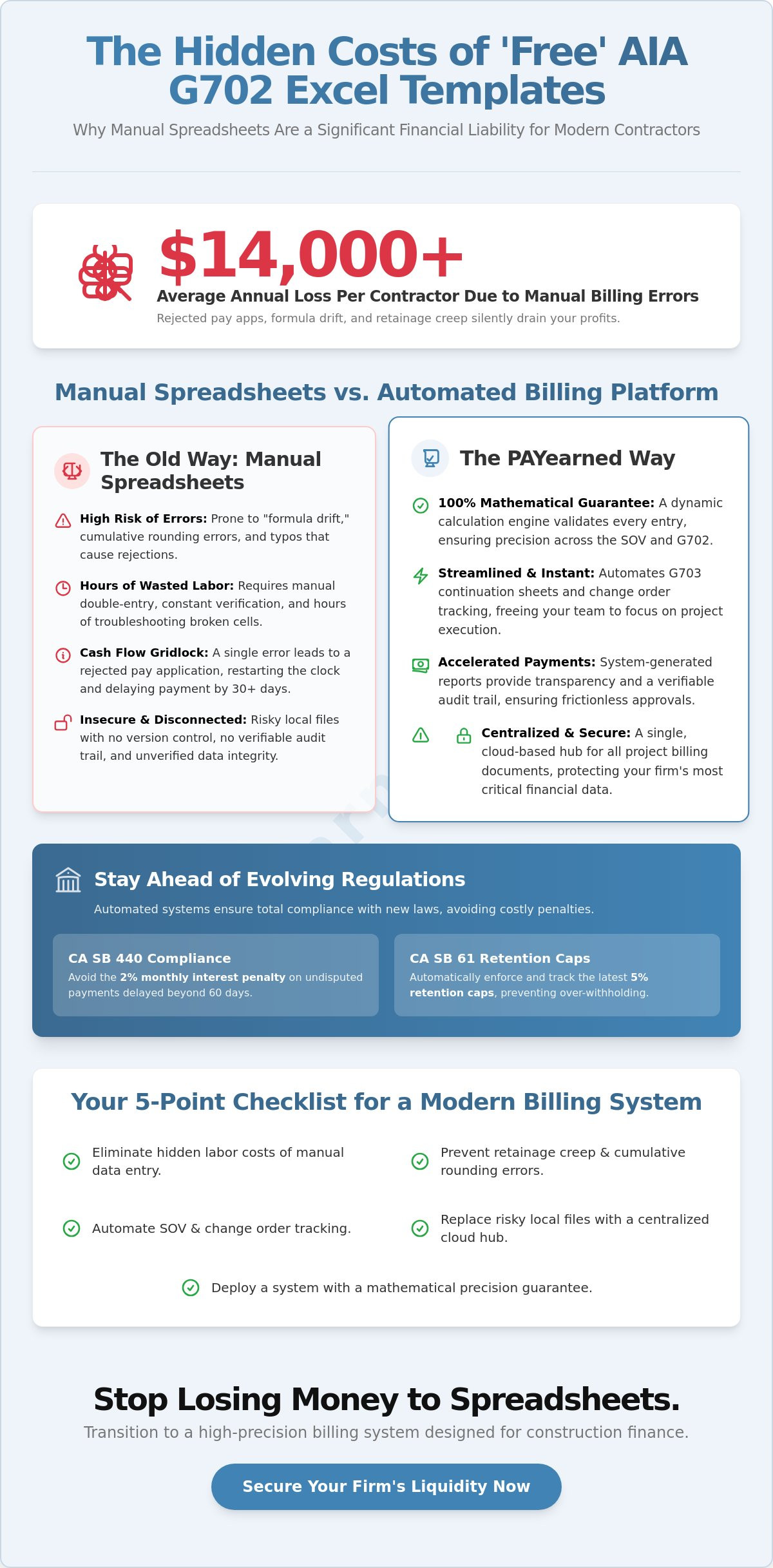
Selecting the right aia g702 excel template alternative requires a shift in mindset. You’re moving from a static document to a dynamic financial system. Busy professionals often make the mistake of choosing a general-purpose accounting tool or a massive ERP system that’s too complex for daily use. Your goal is a specialized platform that excels at one critical task: generating accurate, professional pay applications without the risk of manual error. According to ConstructionBids.ai (May 2026), the average commercial contractor faces over $14,000 in annual billing errors due to manual spreadsheets. This data proves that specialization isn’t a luxury; it’s a financial necessity.
When auditing potential platforms, look for these five non-negotiable features:
- Automated G702 and G703 reconciliation.
- Real-time retainage tracking for multi-year projects.
- Cloud-based accessibility with built-in version control.
- Integrated search functionality for managing multiple projects.
- Domestic, human-centric technical support for rapid troubleshooting.
Security is another critical factor. Relying on local files like “File_Final_V2.xlsx” is a massive liability. These files are easily deleted, corrupted, or accessed by unauthorized parties. A cloud-based database provides encrypted storage and automated backups. This ensures your project history is protected against hardware failure or accidental deletion. You’ll never have to wonder which version of a pay app is the most recent because the system maintains a single, unalterable record of truth.
Feature 1: Automated Calculations and Retainage Tracking
Automated math is the primary reason to switch. A professional payment application platform should handle the complex logic of progress billing without manual intervention. This includes auto-calculating totals, subtracting previous payments, and applying the correct retainage percentage. You want a “one-click” generation feature that produces polished G702 and G703 style forms that architects and owners trust. This level of precision eliminates the “formula drift” that leads to rejected applications and stalled cash flow. For a detailed breakdown of how a static aia billing template compares to automated software across every key performance metric, reviewing the critical differences can help you make a more informed platform decision.
Feature 2: Cloud-Based Project Organization
Cloud-based organization solves the “syncing” nightmare. Your team can access billing data from the job site or the home office without worrying about file transfers. Version control is built-in, meaning everyone looks at the same “Current Period” data at all times. If you’re managing multiple projects, a centralized search engine allows you to pull up historical data in seconds. This is a significant upgrade over the “Ctrl+F” limitations of Excel. If you’re ready to secure your project data and eliminate billing errors, explore a specialized billing solution today.
Don’t assume you need a massive ERP system to improve your billing. Many general project management tools treat pay apps as an afterthought. A specialized aia g702 excel template alternative provides the precision of a niche tool while maintaining interoperability with your existing accounting workflow. It’s a pragmatic choice for firms that value stability and mathematical accuracy over flashy, general-purpose features.
Transitioning to PAYearned: The Evolution of Construction Billing
Transitioning to a professional aia g702 excel template alternative doesn’t have to be a complex overhaul of your entire business. PAYearned provides a low-friction path to modernization by focusing exclusively on the most critical document in your financial workflow. We strip away the unnecessary features of bloated project management suites to deliver a lean, high-precision tool. This specialization ensures that your team can move from a broken spreadsheet to a system-generated pay app in minutes. By automating the heavy lifting of progress billing, you optimize your firm’s liquidity and eliminate the administrative bottlenecks that stall your cash flow.
The “Mathematical Precision” guarantee is the foundation of our platform. While manual spreadsheets are prone to formula drift and human error, our database-driven approach ensures every calculation is flawless. This reliability is vital in 2026, where regulatory changes like California’s SB 440 penalize payment delays with mandatory interest. You don’t need a general-purpose “invoice template word” solution that lacks construction-specific logic. You need a tool that understands the nuance of stored materials, previous payments, and retainage percentages. Our platform provides the stabilizing force your administrative environment requires.
A Specialized Partner for a Critical Task
We focus on billing documentation because it’s the one task you must get right to stay in business. PAYearned isn’t an accounting service or a full project management suite. We’re a niche partner that excels at generating AIA-style documents. This focus allows us to provide localized, human-centric assistance during your first automated pay app. If you ever run into a question about a complex Schedule of Values, our domestic support team is ready to help. Additionally, our built-in search engine simplifies data retrieval, making historical project audits faster and more transparent than ever before.
The ROI of Professionalism in Billing
Submitting a professional, system-generated payment application does more than just secure your money. It builds your reputation with General Contractors and Owners. Clean, standardized documents signal that your firm is organized and reliable. By submitting error-free applications on day one, you significantly reduce the “Payment Gap” caused by administrative rejections. This efficiency provides the peace of mind that comes from knowing your billing is handled by a protective expert. If you’re ready to secure your financial future, start your PAYearned subscription today and leave the risks of Excel behind.
The shift from manual templates to automated billing is a sign of a maturing construction firm. You’ve outgrown the limitations of basic spreadsheets. By adopting a dedicated aia g702 excel template alternative, you’re investing in a system that grows with your project volume. Experience the relief of moving from outdated, error-prone processes to a high-end solution that prioritizes your firm’s financial health and operational efficiency.
Secure Your Project Funding with Precision Billing
The transition from a manual spreadsheet to a professional aia g702 excel template alternative is a strategic move to protect your firm’s cash flow. You’ve seen how manual data entry creates a $14,000 annual drain on overhead and how hidden rounding errors lead to rejected pay applications. In a market governed by strict new standards like SB 440, you can no longer afford the administrative risks of legacy files. Reliability is now a requirement for any contractor who values long-term stability.
By centralizing your project documentation, you gain access to automated G702 and G703 generation, specialized change order management, and a built-in project search engine for rapid data retrieval. These tools ensure that your billing remains accurate, professional, and fully compliant with 2026 industry standards. You deserve the peace of mind that comes from a system designed to handle the high-stakes reality of construction finance. Accuracy isn’t just about math; it’s about securing your firm’s reputation and liquidity.
Stop struggling with Excel—Try PAYearned for Automated AIA-Style Billing
Take the final step toward optimized liquidity today. Your team will appreciate the efficiency, and your clients will value the transparency. It’s time to build a more stable financial future for your firm.
Frequently Asked Questions
Is an AIA G702 Excel template alternative really safer than my own spreadsheet?
Yes. A specialized aia g702 excel template alternative is significantly safer because it utilizes a relational database instead of isolated, floating cells. This structure eliminates the risk of accidental formula deletion or broken file links that often plague local spreadsheets. Unlike a file on your hard drive, a cloud-based platform maintains an unalterable audit trail. This protects your financial history and ensures that every current pay application perfectly reconciles with previous periods.
Do I need to be an accountant to use AIA billing software?
You don’t need accounting credentials to manage your pay applications effectively. We designed the platform for construction professionals who understand project progress but want to avoid the headache of manual calculations. The software handles the complex math behind the scenes. This allows you to focus on verifying work completed and stored materials rather than troubleshooting spreadsheet logic or correcting rounding errors.
How much time can I save by switching from an Excel template to PAYearned?
Most users reduce their billing administrative time by several hours each month per project. By eliminating the need for double entry between the G702 and G703, you can generate a complete, accurate application in minutes. This efficiency allows your team to submit pay apps earlier in the cycle. Speed is critical for maintaining cash flow and meeting the 60 day payment deadlines mandated by 2026 regulations like California’s SB 440.
Can I still generate G703 continuation sheets with an alternative platform?
Yes. The platform automatically generates both the G702 style summary and the G703 continuation sheet in a single, synchronized workflow. Every line item in your Schedule of Values is tracked individually. This ensures the totals on the summary page always match the detailed breakdown on the continuation sheet. You’ll never have to manually sync these documents or worry about mismatched totals again.
What happens to my old Excel data if I switch to a new billing system?
You can easily transition by entering your “Previous Applications” totals as a starting point for your new project within the platform. This ensures your cumulative totals and retainage balances remain accurate from day one. You don’t have to abandon your historical records. You simply move them into a more secure, automated aia g702 excel template alternative that protects the integrity of that data moving forward.
Will my architect accept G702 style forms from a software platform?
Architects and owners generally prefer system-generated forms because they are cleaner and more reliable than manual spreadsheets. A professional platform produces documents that follow the industry standard layout they expect. Providing mathematically verified applications reduces their review time and significantly lowers the chance of rejection. It builds trust in your firm’s administrative competence and professional standards.
Does PAYearned handle retainage and change orders automatically?
Yes. The system auto-calculates retainage based on your specific contract settings and integrates change orders directly into your Schedule of Values. When you add a change order, the software updates all cumulative totals and adjusts the remaining contract balance instantly. This automation prevents the mathematical errors and “Retainage Creep” that frequently cause payment disputes when using manual billing methods.
PAYearned is an agnostic workflow platform that helps teams manage pay applications
PAYearned is an independent software product and is not developed, endorsed, approved, sponsored or affiliated with the American Institute of Architects (AIA). AIA®, G702®, G703®