

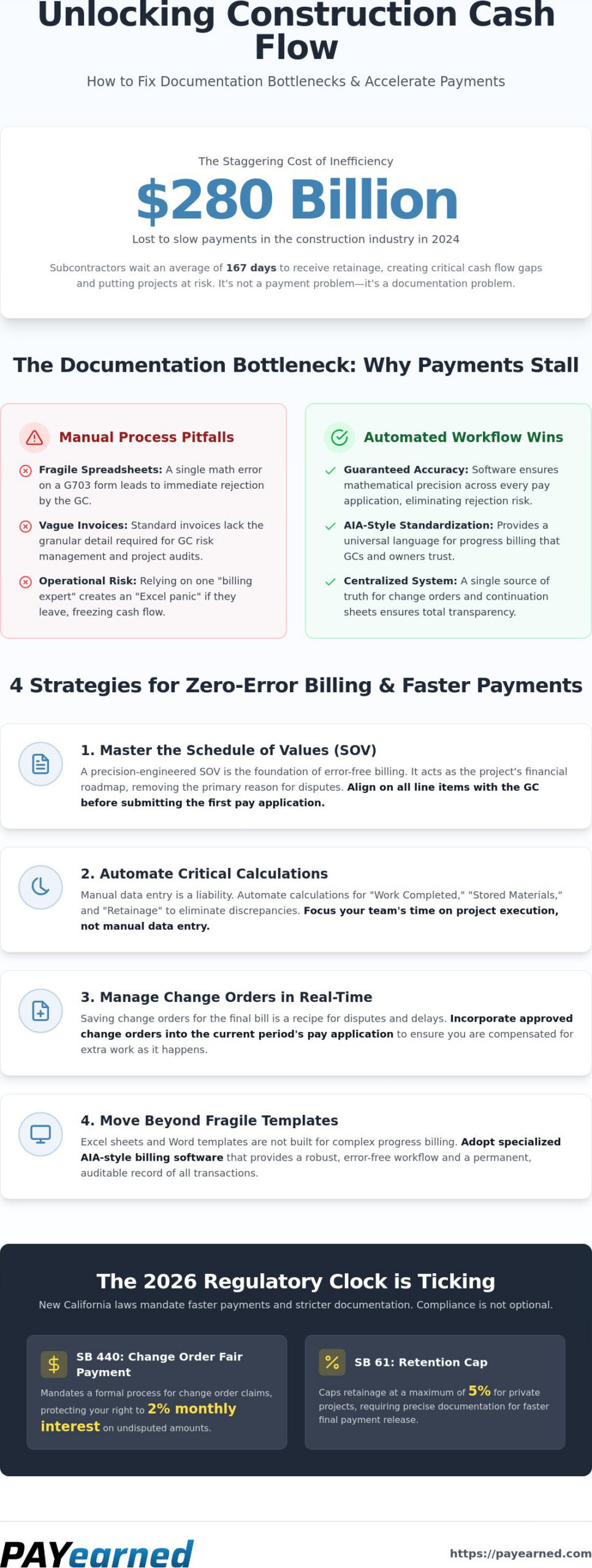
The construction industry lost a staggering $280 billion to slow payments in 2024, a figure that highlights a systemic failure in how projects are funded. If you are a subcontractor waiting an average of 167 days to receive your retainage, you know that the “check is in the mail” is rarely a reliable financial strategy. Speeding up construction payments isn’t just about sending more reminders; it’s about shifting from manual, error-prone spreadsheets to a precise, automated documentation standard. You shouldn’t have to use your personal savings to cover business expenses while waiting for a GC to approve a pay application that was rejected over a minor math error.
We understand the administrative panic that sets in when your billing expert leaves or when a 90-day wait time creates a critical cash flow gap. You deserve a predictable schedule where your submissions are approved the first time. In this guide, you’ll learn the specific workflow adjustments and documentation standards required to accelerate your pay application approvals and improve your overall cash flow. We will break down the 2026 regulatory landscape, including new interest rate penalties for late payments, and provide a roadmap for achieving zero-error billing submissions that keep your projects moving forward.
Key Takeaways
- Identify the documentation bottlenecks that cause GCs to reject standard invoices and stall project funding.
- Learn how a precision-engineered Schedule of Values (SOV) serves as the foundation for error-free progress billing.
- Implement automated calculations for stored materials and work completed to focus on speeding up construction payments rather than manual data entry.
- Move beyond fragile Excel sheets to specialized AIA-style software that ensures mathematical accuracy across every pay application.
- Establish a centralized system for change orders and continuation sheets to provide total transparency during project audits.
The Documentation Bottleneck: Why Construction Payments Stall
Most subcontractors treat invoicing as a final administrative hurdle, but general contractors view it as a risk management exercise. A standard invoice often lacks the granular detail required for complex construction accounting methods. When a GC or owner receives a bill that doesn’t align perfectly with the agreed Schedule of Values, they don’t just fix it; they reject it. This rejection is the primary obstacle to speeding up construction payments in a high-stakes environment where every dollar is scrutinized for project audits.
The “Trickle-Down” effect is a harsh reality for trade contractors. A single math error on a G703 continuation sheet halts the entire payment chain. Because the GC must justify their own draw to the owner or lender, they cannot approve your pay application if the totals are off by even a few cents. This creates a administrative stalemate. Relying on a single “billing expert” who manages complex, fragile spreadsheets creates immense operational risk. If that person leaves, your firm faces an “Excel panic” that can freeze your cash flow for months.
The Hidden Cost of Manual Entry Errors
Manual data entry is a liability. Administrative teams often lose dozens of hours every month to “three-way matching,” where they manually verify work completed against stored materials and retainage. Minor discrepancies in retainage tracking are particularly dangerous; they often remain hidden until the final closeout, leading to major approval delays when you need the cash most. We define the billing chain bottleneck as a failure of standardized data where a single inaccuracy prevents the transfer of funds through multiple project tiers.
Standardization vs. Customization in Pay Apps
Industry leaders rely on AIA-style G702 and G703 formats because they provide a universal language for progress billing. These forms ensure that every party understands exactly how much work is finished and how much remains. Using non-standardized invoice templates in Word or basic accounting software often results in missing data fields that GCs require for their own compliance. Consistency is the only way to maintain financial liquidity across the project lifecycle.
Strategies for Speeding Up the Billing Cycle
Timing is everything in construction finance. Speeding up construction payments requires a proactive approach to the calendar, specifically the “billing cutoff” date. Missing this deadline by even 24 hours can delay your cash flow by an entire month. To avoid this, you must establish a rigid Schedule of Values (SOV) before submitting your first application. A well-structured SOV serves as the project’s financial roadmap, ensuring that both the GC and the owner agree on the value of every line item from day one. When you align these values early, you remove the primary reason for line-item disputes later in the job.
Automation is your best defense against the administrative friction that stalls approvals. By automating the calculation of “Work Completed” and “Stored Materials,” you eliminate the manual tallying that often leads to discrepancies. This level of precision is critical when navigating complex strategies for getting paid faster on federal contracts or large-scale private projects. Under the California Private Works Change Order Fair Payment Act (SB 440), effective for contracts entered into on or after January 1, 2026, there’s a mandatory process for resolving change order claims. Integrating these changes immediately is no longer optional; it’s a statutory necessity to protect your right to 2% monthly interest on undisputed amounts.
Mastering the Schedule of Values (G703)
A transparent G703 continuation sheet prevents line-item queries that trigger rejections. Each entry should clearly reflect the percentage of completion and the specific materials currently on-site. Accuracy here is vital, especially when calculating retainage on G702. With the California Retention Cap (SB 61) now capping retention at 5% for private projects started after January 1, 2026, your documentation must reflect these legal limits to ensure compliance and faster fund release.
Real-Time Change Order Management
End-of-project disputes are usually the result of “saving” change orders for the final bill. Modern change order management requires reflecting these adjustments in the current period’s pay application. This practice protects your cash flow and ensures you’re compensated for extra work as it happens. For a more streamlined approach to your monthly billing, consider using a cloud-based pay application solution that handles these calculations automatically and keeps your project financials in balance.
Beyond Templates: Automating AIA-Style Billing
Relying on a single administrative expert to manage complex spreadsheets is a high-risk strategy for any construction firm. If your billing specialist leaves, your entire revenue cycle shouldn’t grind to a halt. Transitioning from manual Excel sheets to specialized pay app software protects your business from personnel turnover by standardizing the process. Speeding up construction payments requires a system that functions independently of any specific employee’s tribal knowledge. Standardize the process. With cloud-based accessibility, your team can manage billing from the job site or the home office, ensuring that data is captured as work progresses rather than during a month-end scramble.
Project audits become significantly less stressful when you have built-in search engines to retrieve historical data. Instead of digging through paper files or buried email attachments, you can pull up every previous application and certificate for payment in seconds. This transparency builds trust with general contractors and owners, as you can provide instant proof of work completed and materials stored. Mathematical precision is the foundation of this trust; software that auto-calculates totals removes the human error that leads to rejected submissions.
The ROI of Specialized Pay App Tools
The cost of a software subscription is negligible versus the financial damage of a single delayed payment. With the average subcontractor waiting 96 days for payment, any tool that reduces this timeline provides an immediate return. By using AIA-style G702 and G703 automation, you reduce “expert dependency” and allow any trained staff member to generate professional, accurate documents. This shift moves your firm from reactive “panic billing” to a steady, predictable rhythm of construction cash flow.
Ensuring Compliance and Accuracy
Automated systems ensure that your progress billing remains compliant with the latest industry standards without requiring you to be a legal expert. Totals, retainage, and balance-to-finish calculations are handled by the system, eliminating the manual math risk that often triggers GC rejections. You can see these workflows in action by reviewing the PAYearned tutorials, which demonstrate how to generate error-free submissions in minutes. Speeding up construction payments is ultimately a matter of replacing manual friction with automated precision.
Mastering Your Project Cash Flow in 2026
The construction industry is shifting toward a more regulated, high-interest environment where payment delays are increasingly costly for every party involved. Achieving mathematical precision in your G702 and G703 documentation is the only sustainable way to protect your firm’s liquidity. By establishing a rigid Schedule of Values and automating your progress billing workflows, you remove the human error that triggers administrative rejections. Speeding up construction payments isn’t a matter of chance; it’s the result of implementing standardized, cloud-based systems that track change orders and retainage in real time.
Don’t let outdated spreadsheets or personnel turnover threaten your financial stability. You can transition from “Excel panic” to a reliable, professional billing rhythm that general contractors and owners respect. Start generating error-free AIA-style pay apps today with PAYearned. Our platform provides automated G702 and G703 generation, built-in change order and retainage tracking, and cloud-based accessibility for national construction teams. You’ve seen the roadmap to a faster billing cycle; now take the first step toward zero-error submissions and predictable cash flow.
Frequently Asked Questions
What is the most common reason for a construction pay application to be rejected?
Mathematical errors and missing documentation are the primary reasons for rejection. Under the California Private Works Change Order Fair Payment Act (SB 440), payers must fund undisputed amounts within 60 days or face 2% monthly interest. However, if your G703 continuation sheet has even a minor calculation error, the entire amount can be classified as “disputed.” This allows the payer to legally delay funding until the error is corrected and the document is resubmitted.
How does an AIA-style G702 form differ from a standard commercial invoice?
A standard invoice only covers a single billing period, whereas an AIA-style G702 form tracks the entire project’s financial history from start to finish. It provides a cumulative summary of the original contract sum, net change orders, and total work completed to date. This format includes specialized fields for retainage and stored materials. These are essential for progress billing but are almost always absent from basic commercial templates used in other industries.
Can I use Excel to speed up my construction billing process?
Excel often hinders rather than helps because it relies on manual entry and fragile formulas that break as projects grow complex. While a spreadsheet might seem faster initially, the time lost to fixing math errors or re-keying data for project audits is significant. Manual methods create a dangerous dependency on a single billing expert. Transitioning to automated tools is a more reliable strategy for speeding up construction payments and ensuring your billing chain remains unbroken.
What is the best way to track retainage and change orders simultaneously?
The most effective method is using a system that integrates change orders directly into the Schedule of Values. This ensures every adjustment is reflected in the current period’s work completed. With the California Retention Cap (SB 61) limiting retention to 5% for new private projects in 2026, automated tracking prevents over-calculation errors. Real-time software calculates these percentages across every tier of the project, protecting your cash flow from the start of the job to final closeout.
How does cloud-based billing software improve construction cash flow?
Cloud-based software eliminates the office bottleneck by allowing project managers to update work progress directly from the field. This real-time data entry ensures that pay applications are submitted long before the monthly cutoff date. By reducing administrative overhead and ensuring mathematical accuracy, these tools help lower the industry’s average 96-day DSO. Faster approvals lead to more predictable revenue, which is vital for subcontractors facing rising material and labor costs in 2026.
PAYearned is an agnostic workflow platform that helps teams manage pay applications
PAYearned is an independent software product and is not developed, endorsed, approved, sponsored or affiliated with the American Institute of Architects (AIA). AIA®, G702®, G703®