

How much capital is currently trapped in your “pending” folder because of a single mathematical error in a retainage calculation? It’s a common reality for subcontractors and GCs who still rely on manual data entry. With nonresidential construction input prices seeing a 12.6% annualized increase in early 2026, you can’t afford to let your cash flow stall. By improving construction billing workflow and moving away from fragmented systems, you protect your margins and ensure your financial liquidity remains stable.
You’ve likely spent hours digging through email threads for a missing change order or wrestling with spreadsheet formulas that just won’t balance. It’s frustrating to watch your payment cycles drag on while you wait for an architect or owner to approve messy, inconsistent documentation. This guide shows you exactly how to modernize your construction billing process to eliminate these administrative bottlenecks. We’ll examine how to generate error-free AIA-style documents and centralize your project history to ensure faster, more reliable payment approvals for every trade.
Key Takeaways
- Identify the hidden financial risks of manual spreadsheet errors and formula breaks that stall your payment cycle.
- Discover the impact of improving construction billing workflow by adopting standardized AIA-style documentation for faster approval cycles.
- Learn how to eliminate disputes and lost revenue by centralizing change order tracking within your progress billing process.
- Master a strategic approach to auditing your time-to-payment and replacing static templates with automated, cloud-based generation tools.
- Ensure mathematical precision in every G702 and G703 submission to minimize administrative rejections and secure your liquidity.
The Hidden Costs of Fragmented Construction Billing Workflows
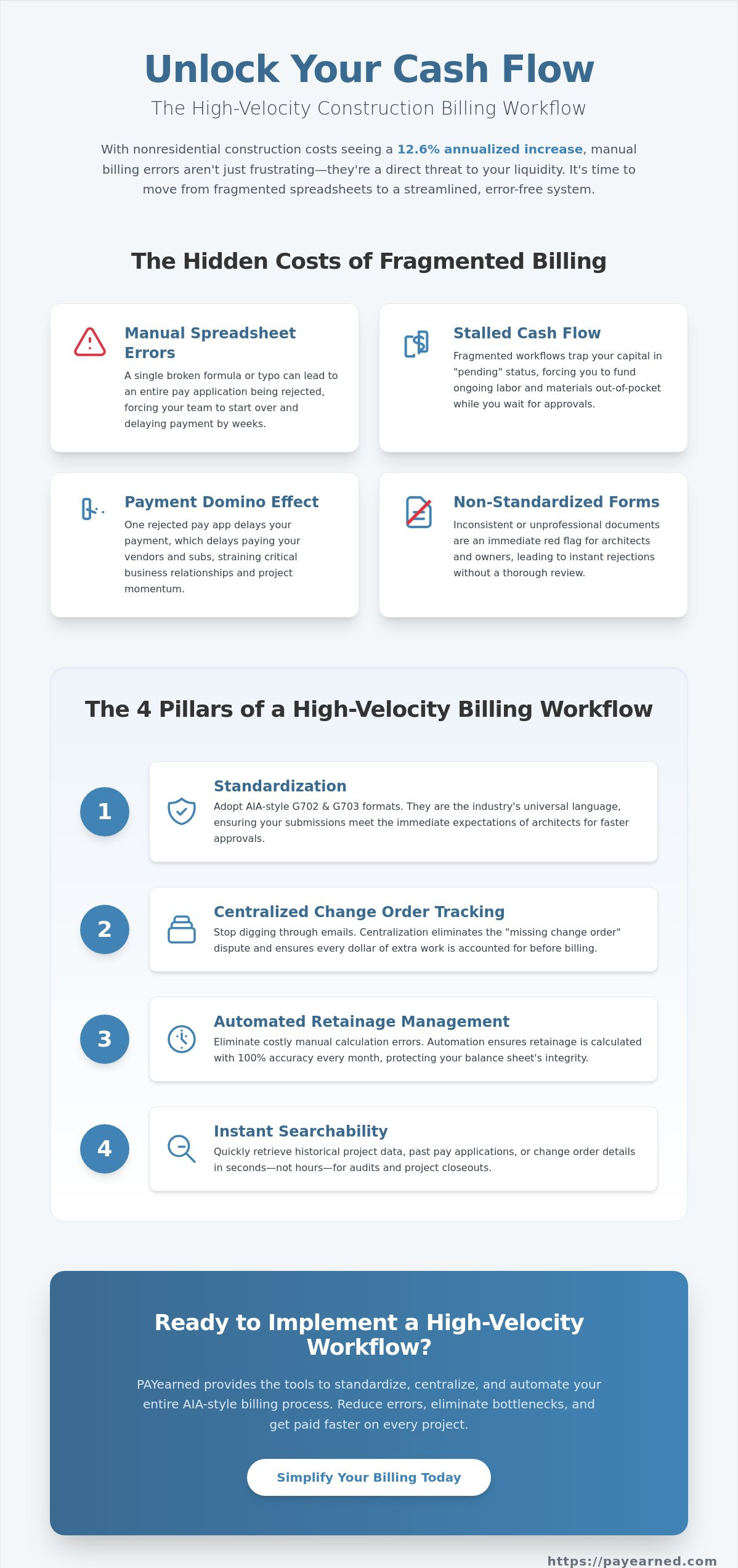
Construction billing isn’t just an administrative chore; it’s the vital bridge between your field team’s completed work and your company’s realized cash flow. When this bridge is fragmented, your business remains in a state of financial limbo. Improving construction billing workflow means tightening the link between performance and payment. Without a streamlined path, your capital stays locked in the project while you continue to fund labor and materials out of pocket.
Many contractors still rely on manual Excel templates, but these are a significant liability. A single accidental keystroke or a broken cell reference in a complex spreadsheet can lead to catastrophic errors. Unlike field mistakes that you can often fix with a quick adjustment, a formula break in a billing document often goes unnoticed until the architect rejects the entire submission. This forces your accounting team to start from scratch, wasting valuable days during the narrow billing window.
A single error on a payment application creates a domino effect that impacts your entire project timeline. One rejected pay app delays your payment, which then delays your ability to pay vendors or subcontractors. This friction damages the trust between subcontractors and GCs, often leading to slow-downs on site or strained negotiations during the next phase of work. Accurate, professional documentation is the only way to maintain these critical industry relationships.
The G702 and G703 Mathematical Headache
Managing what is retention across twenty different billing periods is a logistical nightmare when done by hand. You must track previous payments, current work completed, and stored materials while accurately calculating the percentage of retainage held for each line item. Automated math is the only way to ensure 100% accuracy in continuation sheets and eliminate the risk of human error.
Why ‘Good Enough’ Documentation Stalls Cash Flow
Non-standardized forms are an immediate red flag for architects and owners. If your documentation looks unprofessional or deviates from expected industry standards, it’s often rejected without a second look. High-velocity firms avoid this by using aia billing software to generate clean, universally accepted documents in seconds. Improving construction billing workflow through standardization ensures your paperwork moves through the approval cycle without friction.
4 Pillars of a High-Velocity Billing Workflow
Achieving financial speed requires more than just sending invoices on time. You need a system that removes friction at every touchpoint. Improving construction billing workflow involves four foundational pillars that transform your back office from a bottleneck into a liquidity engine. These pillars focus on precision and accessibility to ensure your pay applications move through the approval chain without a single pause.
- Standardization: Adopt AIA-style G702 and G703 formats. These documents are the industry’s universal language, ensuring your submissions meet the immediate expectations of architects and lenders.
- Centralized Change Order Tracking: Stop searching through email threads for approvals. Centralization eliminates the “missing change order” dispute that often stalls progress billing.
- Automated Retainage Management: Manual overrides are where errors hide. Automation ensures retention is calculated correctly every month, maintaining your balance sheet’s integrity.
- Instant Searchability: Data retrieval is often a hidden bottleneck. Use built-in search tools to pull historical project data for audits or closeouts in seconds rather than hours.
Standardizing the Schedule of Values (SOV)
A clean G703 continuation sheet sets the stage for a frictionless approval process. It provides the transparency owners need to verify work without requesting additional clarification. Align your SOV with actual project milestones to prevent over-billing. This alignment builds trust and ensures your billing stays ahead of your project costs without triggering red flags during the review cycle.
Integrating Change Orders into the Billing Cycle
Your contract sum must reflect project reality in real-time. If an approved change isn’t added before the next pay app is generated, you’re effectively providing an interest-free loan to the owner. Utilizing change order management software for contractors prevents revenue leakage by ensuring every dollar of extra work is accounted for immediately. Improving construction billing workflow means capturing these adjustments before they become lost in the shuffle. You can simplify your documentation process by using tools designed for this level of precision.
Implementing Specialized Technology for Faster Liquidity
Transitioning from manual systems to automated precision requires a deliberate strategy. While some firms attempt to use bloated project management suites, these often lack the specialized focus needed for complex financial documentation. Improving construction billing workflow is most effective when you deploy a dedicated tool that excels at one critical task: generating accurate pay applications. This best-of-breed approach ensures your accounting team isn’t fighting against a platform that was built for scheduling rather than finance.
This philosophy of using specialized AI tools to solve specific business bottlenecks is gaining traction across the industry; for example, Global AI Reps provides similar precision-focused automation for sales and lead generation to keep the project pipeline full.
- Step 1: Audit your current timeline. Track how many days pass between work completion and final document approval. Identify exactly where the paperwork stall occurs in your current cycle.
- Step 2: Replace static templates. Move away from fragile, manual spreadsheets. Implement dynamic g702 and G703 generation tools that handle complex calculations automatically.
- Step 3: Create a cloud-based source of truth. Centralize your financial data. Ensure every team member has real-time access to the most recent contract totals and approved change orders.
- Step 4: Focus on accuracy training. Train your staff on the PAYearned platform. Shift their focus from repetitive administrative volume to high-level accuracy and financial oversight.
The ROI of Automation vs. Manual Entry
The financial impact of automation is immediate. When comparing aia billing software vs excel, the primary benefit is the massive reduction in labor hours spent on manual reconciliation. Manual entry invites errors that lead to immediate payment rejections. By reducing your error rate to zero, you remove the most common cause of 30-day payment delays, directly protecting your project margins.
Securing the Closeout with Accurate Data Retrieval
The final retention release is often the most difficult check to collect. Built-in search engines within a specialized billing platform allow you to pull up every historical pay app and change order for a project closeout audit in seconds. This transparency simplifies the final reconciliation and ensures you receive your final payment without a protracted dispute. PAYearned acts as the stabilizing force for your construction finance, providing the precision and speed you need to maintain healthy liquidity.
Secure Your Project Liquidity Through Administrative Precision
Relying on fragmented systems is a risk your construction business can’t afford to take. We’ve explored how manual errors in retainage and lost change orders drain your resources and stall your cash flow. By improving construction billing workflow through standardization and specialized technology, you move from reactive administration to proactive financial management. Precision in your G702 and G703 submissions ensures your work is recognized and paid without unnecessary delays or professional friction.
Transitioning to a dedicated platform provides the stability required for modern project demands. You gain access to automated AIA-style document generation and built-in search tools for instant retrieval of historical project data. This specialized focus on pay applications and change orders eliminates the friction that typically plagues the closeout process. It’s time to protect your margins and simplify your back-office operations. Start streamlining your billing workflow with PAYearned today and experience the peace of mind that comes with mathematical accuracy. Your path to faster payments and reliable liquidity is clear.
Frequently Asked Questions
How can I reduce errors in my AIA G702 and G703 forms?
You reduce errors by eliminating manual data entry and switching to automated calculation engines. Most mistakes occur in the math for stored materials or the carryover of previous payments on the G703 continuation sheet. Using a specialized platform ensures that every line item balances perfectly and that retainage is calculated consistently across all billing periods. This level of mathematical precision prevents the administrative rejections that stall your payments.
What is the fastest way to track construction change orders for billing?
The fastest method is to use a centralized cloud platform that allows for real-time updates to the contract sum. Instead of digging through email threads or disorganized folders, you should log every approved change order immediately within your billing software. This ensures that the adjusted contract price is reflected on your next G702 application. Instant integration prevents revenue leakage and keeps your project history organized for final closeout.
Why is my construction billing workflow so slow?
Your process is likely slow due to fragmented data and the paperwork stall caused by manual spreadsheets. Improving construction billing workflow requires removing these administrative bottlenecks that lead to inconsistent documentation. When forms aren’t standardized, architects or owners often reject them for minor formatting errors. Moving to an automated system ensures your pay applications are universally accepted and move through the approval cycle without friction.
Is there a difference between accounting software and billing documentation software?
Yes, there’s a significant difference in purpose and functionality. General accounting software handles your overall ledger, payroll, and taxes. Billing documentation software is a specialized tool designed specifically for progress billing and AIA-style G702 and G703 generation. It bridges the gap between your accounting records and the complex documentation requirements of construction lenders and owners, ensuring your pay apps are accurate and professional.
PAYearned is an agnostic workflow platform that helps teams manage pay applications
PAYearned is an independent software product and is not developed, endorsed, approved, sponsored or affiliated with the American Institute of Architects (AIA). AIA®, G702®, G703®