

An estimate is a strategic tool for winning work, but a Schedule of Values is the specialized engine that actually drives your project’s liquidity. The transition between these two documents is where many contractors fall into a cycle of manual data entry, moving spreadsheet rows into rigid forms only to face rejection from an architect. Mastering the process of creating a schedule of values from an estimate is the only way to protect your cash flow and maintain professional credibility with project owners.
You already know the frustration of a stalled payment cycle caused by a poorly structured SOV. It is a common administrative bottleneck that wastes hours of project management time and delays the arrival of critical funds. This guide provides a clear, repeatable workflow to transform your internal bidding data into a professional billing document. You will learn how to align estimated costs with billable line items and use automated tools to ensure your AIA-style G702 and G703 forms are accurate every time. By the end of this article, you will have a roadmap for reducing disputes and securing faster approvals on every application for payment.
Key Takeaways
- Understand the distinction between internal cost estimates and external billing documents to prevent architect rejections and payment delays.
- Follow a structured five-step workflow for creating a schedule of values from an estimate that balances technical accuracy with project-specific formatting requirements.
- Learn how to distribute overhead and profit across major work categories to ensure your AIA-style G703 continuation sheets remain mathematically sound.
- Identify why transitioning from manual spreadsheets to automated billing platforms reduces administrative overhead and prevents data entry errors.
- Establish a professional SOV structure that streamlines change order management and accelerates your progress payment cycles.
Mapping the Estimate to the Schedule of Values (SOV)
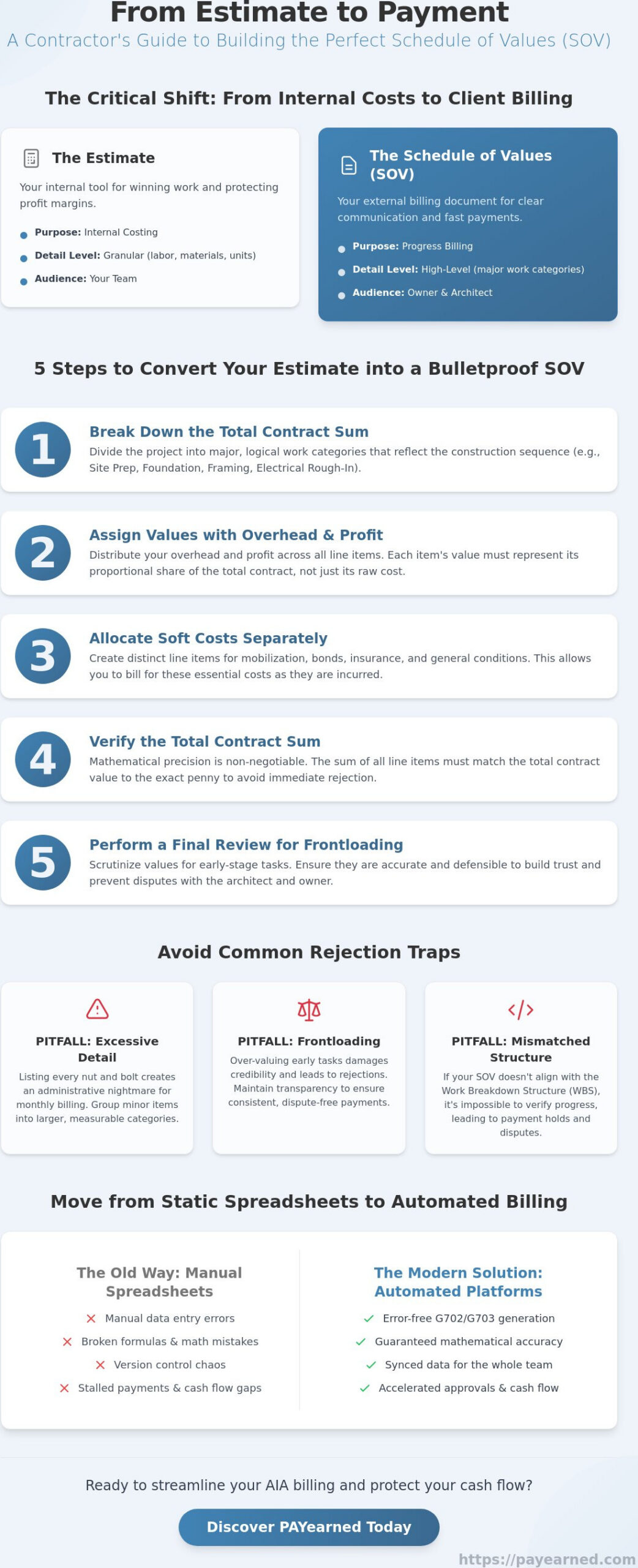
Your internal estimate is a granular breakdown of labor, materials, and equipment designed to protect your profit margins. However, the Schedule of Values is a different animal. It is a high-level summary used to communicate progress to the owner and architect. When you’re creating a schedule of values from an estimate, you must translate those raw costs into a format that facilitates smooth progress billing. This isn’t just about copying data; it’s about strategic re-categorization.
Before you start mapping, confirm the required structure. Some owners demand a breakdown by CSI MasterFormat codes, while others prefer a chronological phasing approach. Regardless of the format, the math is non-negotiable. The sum of every line item must exactly equal the total contract amount. If your SOV is even a penny off, your first application for payment will likely be rejected. Accuracy at this stage acts as a protective barrier against administrative delays.
Balancing Detail with Administrative Ease
Avoid the temptation to include every single nut and bolt from your estimate. Excessive detail creates an administrative nightmare during the monthly billing cycle. If you have 500 line items for a mid-sized project, you’ll spend more time entering data than managing the job. Instead, group minor costs into logical, larger categories. This makes the document easier to manage while ensuring each line item remains measurable. If an architect can’t walk the site and visually verify the percentage of work completed for a specific line, your billing will face constant disputes.
The Pay App Connection
The SOV isn’t just a static list; it is the functional engine for your AIA G703 continuation sheet. Every error or oversight made while creating a schedule of values from an estimate will compound over the life of the project. If you misallocate funds early on, you’ll struggle with cash flow imbalances or “front-loading” accusations that can damage your professional reputation. Proper mapping ensures that your progress billing remains predictable, providing the mathematical precision needed for steady liquidity.
5 Steps to Create an SOV from Your Project Estimate
Moving from a bid-winning estimate to a billable document requires a systematic approach. When creating a schedule of values from an estimate, you must strip away the granular “per-unit” data and focus on high-level deliverables that an architect can easily approve. Follow these five steps to ensure your financial foundation is solid.
- Step 1: Break down the total contract sum. Divide your project into major work categories. These should reflect the actual divisions of work, such as site prep, foundation, or electrical rough-in.
- Step 2: Assign values including overhead and profit. Don’t just list your raw costs. Every line item must represent its portion of the total contract, meaning you must distribute your profit and overhead percentages across the entire schedule.
- Step 3: Allocate soft costs. Items like mobilization, bonds, and insurance should be their own line items. This allows you to bill for these expenses as soon as they are incurred.
- Step 4: Verify the total contract sum. Mathematical precision is paramount. Ensure the sum of every line item matches your contract total to the exact penny.
- Step 5: Perform a final review for frontloading. Scrutinize the values assigned to early tasks to ensure they are defensible and accurate.
Organizing by Work Breakdown Structure (WBS)
A logical hierarchy is the backbone of a functional SOV. Your WBS should follow the actual construction sequence. This alignment ensures that your monthly billing matches the physical work performed on site, reducing the risk of payment delays. For more insights on optimizing this process, check our guide on mastering payment applications. Using a cloud-based billing platform can automate this organization, ensuring your data remains synchronized.
Avoiding the Rejection Trap
Architects are trained to spot imbalances in your documentation. Frontloading is the disproportionate allocation of value to early-stage project tasks to improve initial cash flow. While tempting, this practice often leads to immediate rejection and increased scrutiny of every future pay app. Maintain transparency in your labor and material breakdowns. Building trust with the project owner early on is the most effective way to ensure consistent, dispute-free payments throughout the project lifecycle.
Moving from Static Estimates to Automated AIA-Style Billing
Excel is a liability in construction finance. While it works for the initial bid, using static spreadsheets for progress billing introduces significant risk. Manual data entry often leads to broken formulas and version control issues that stall your payment cycles. Transitioning from a static estimate to a dynamic, cloud-based platform ensures your financial data remains accurate and accessible. When you’re creating a schedule of values from an estimate, you need a system that carries values forward automatically, eliminating the administrative burden of manual AIA-style forms.
Managing Change Orders and Retainage
Change orders are inevitable, but they shouldn’t break your billing workflow. Integrate every approved change order as a new line item in your SOV. This practice maintains a clear audit trail and ensures your total contract sum is always current. Automation also solves the headache of retainage. By calculating retention per line item automatically, you ensure you aren’t leaving money on the table or over-billing. For a deeper look at protecting your profit through these holdbacks, read our reference on retention.
The PAYearned Advantage for SOV Management
PAYearned provides a specialized solution for contractors who need precision without the complexity of enterprise-level suites. Our platform generates professional AIA-style G702 and G703 documents directly from your project data. You can easily locate historical items or specific project details with our built-in search engine. This focused approach simplifies creating a schedule of values from an estimate, allowing you to focus on the build rather than the paperwork. We invite you to view our pricing to see how an affordable, dedicated billing tool can transform your cash flow and reduce administrative fatigue.
Streamline Your Construction Billing Workflow
Precision in your initial documentation is the most effective way to eliminate payment delays and architect disputes. By moving beyond static spreadsheets and adopting a structured approach to creating a schedule of values from an estimate, you protect your firm’s liquidity. You’ve learned how to align internal costs with external billing requirements while avoiding the common pitfalls of frontloading and mathematical errors. This foundation ensures that every subsequent application for payment is built on accurate, defensible data.
Transitioning to a dedicated digital solution allows you to manage change orders and retainage with automated accuracy. This removes the administrative bloat of general-purpose project management tools and focuses specifically on the critical task of getting paid. You can start generating professional AIA-style pay apps today with PAYearned. Our platform automates G702 and G703 generation, providing dedicated tracking for change orders and retention without unnecessary complexity. Take control of your project’s financial health and experience the relief of a streamlined, error-free billing process that keeps your cash flow steady.
Frequently Asked Questions
What is the difference between a project estimate and a Schedule of Values?
An internal estimate tracks every specific cost including labor hours and material units, while a Schedule of Values (SOV) is the contractually agreed-upon breakdown of the total price. When creating a schedule of values from an estimate, you translate those internal costs into external billing line items. The SOV focuses on milestones and work categories that the owner or architect can visually inspect to approve progress payments rather than the raw cost of your supplies.
Can I change my Schedule of Values after the project has started?
No, the Schedule of Values is typically fixed once the architect and owner approve it at the project’s outset. Any adjustments to the total contract sum must occur through formal change orders, which appear as new line items on your G703 continuation sheet. Attempting to shift values between existing items without approval can lead to accusations of frontloading or fraudulent billing, which jeopardizes your professional reputation and payment cycle.
How detailed should my Schedule of Values be for an AIA G703 form?
Your SOV should be detailed enough to allow for clear progress verification without creating excessive administrative work. A common standard is to follow CSI MasterFormat divisions or specific project phases that match the construction schedule. If a line item is too broad, it’s difficult to justify a specific completion percentage; if it’s too narrow, you’ll spend hours on manual data entry for every progress billing cycle.
What happens if the sum of my SOV items doesn’t match the contract total?
If the sum of your SOV line items doesn’t match the contract total exactly, your application for payment will be rejected immediately. creating a schedule of values from an estimate requires mathematical precision to ensure that every penny of the contract is accounted for, including profit and overhead. Modern billing platforms prevent these errors by auto-calculating totals, ensuring your G702 and G703 forms remain perfectly synchronized and ready for approval.
PAYearned is an agnostic workflow platform that helps teams manage pay applications
PAYearned is an independent software product and is not developed, endorsed, approved, sponsored or affiliated with the American Institute of Architects (AIA). AIA®, G702®, G703®