

Did you know that 85% of construction projects in 2026 experience cost overruns, primarily driven by poor change order management? With construction costs escalating at a baseline of up to 6%, your firm’s liquidity depends entirely on administrative precision. Falling into common construction billing mistakes to avoid 2026 can lead to rejected G702 forms and painful cash flow bottlenecks that stall your progress. We know how draining it is to manage manual math on continuation sheets while tracking the 5% retainage cap on California private projects. It’s a high-stakes environment where a single decimal error can delay thousands of dollars in earned revenue.
This guide identifies and eliminates the specific documentation errors that trigger payment rejections. You will gain a clear strategy for managing the 2% interest penalties associated with the Private Works Change Order Fair Payment Act. We will walk through the process of organizing your AIA-style billing to ensure your change orders and retention remain visible and accurate. Moving from manual methods to a specialized, error-free workflow ensures your payments are approved the first time.
Key Takeaways
- Learn how to synchronize your G703 Schedule of Values with G702 summary totals to stop mathematical errors before they reach the owner’s desk.
- Identify common construction billing mistakes to avoid 2026, such as billing for unexecuted change orders that create unnecessary payment friction.
- Master the tracking of multi-month project retainage and net changes to ensure your final closeout is fast and profitable.
- Understand why manual Excel templates are a liability and how it’s simpler to protect your cash flow with automated data retrieval.
Common Mathematical and Structural Errors in AIA-Style Billing
Accounting for stored materials adds another layer of risk to your progress billing. Contractors often forget to move materials “stored on site” from the previous period into the “work completed” column for the current period. This double-counting or omission creates a mathematical ripple effect that compromises the entire document. If you are unsure how to structure your continuation sheet to avoid these errors, reviewing our G702/G703 tutorials can help you establish a clean baseline for your next submission.
The Schedule of Values (SOV) Mismatch
An unapproved or poorly structured SOV is a primary driver of billing disputes. Every line item on your G703 must align perfectly with the original contract and any executed change orders. Misaligning these values violates fundamental construction accounting principles and makes it impossible for the owner to verify progress. Ensure your SOV is broken down into measurable, verifiable segments to provide the transparency required in 2026. This level of detail allows for faster approvals and clearer visibility into your project’s financial health.
Manual Calculation Errors on G702 Summary Sheets
Spreadsheets are the enemy of accuracy. Relying on hard-coded numbers in manual templates often leads to arithmetic errors in percentage-of-completion calculations. These mistakes are easy to make but difficult to find when you’re rushing to meet a month-end deadline. Automated totals are essential for G702 compliance in 2026 because they eliminate the human error inherent in manual data entry. Using a dedicated platform ensures that your retainage calculations and net changes are always mathematically sound, protecting your cash flow from preventable administrative delays.
Procedural Pitfalls: Change Orders and Retainage Tracking
Administrative friction often stems from procedural oversight rather than simple math. One of the most common construction billing mistakes to avoid 2026 is attempting to bill for unapproved change orders before they are formally executed. While the Private Works Change Order Fair Payment Act (SB 440) now mandates that owners respond to claims within 30 days, you cannot legally include that work in your pay application until the document is signed. Attempting to force these amounts into your G702 before they are authorized triggers immediate rejection, stalling your entire payment cycle. To maintain project liquidity, you must align your billing with Federal requirements for progress payments, which emphasize the necessity of formal authorization for all contract modifications.
Delayed Change Order Integration
Managing “off-book” changes is a recipe for disaster on multi-month projects. If you lose track of net changes relative to the original contract sum, your final pay application will never balance. This fragmentation creates a massive visibility gap that leads to disputes at the worst possible time. You can learn more about the 2026 evolution of change order management software for contractors to see how modern systems bridge this gap. Keeping your change orders organized in real-time ensures you don’t leave money on the table during closeout.
Improper Retainage (Retention) Accounting
Retainage tracking is where many contractors lose their grip on cash flow. Calculating retention on a per-line-item basis rather than the total contract often leads to rounding errors that compound over time. With California’s SB 61 capping retainage at 5% for private projects starting in 2026, precision is non-negotiable. It’s vital to distinguish between cumulative retention and current period retention to avoid over-withholding. For a deeper dive, check out what is retention? A comprehensive guide. Failing to track “Retainage Held to Date” accurately is a primary cause of final payment delays. You can simplify your retention tracking by using a system that auto-calculates these values based on the latest regional regulations.
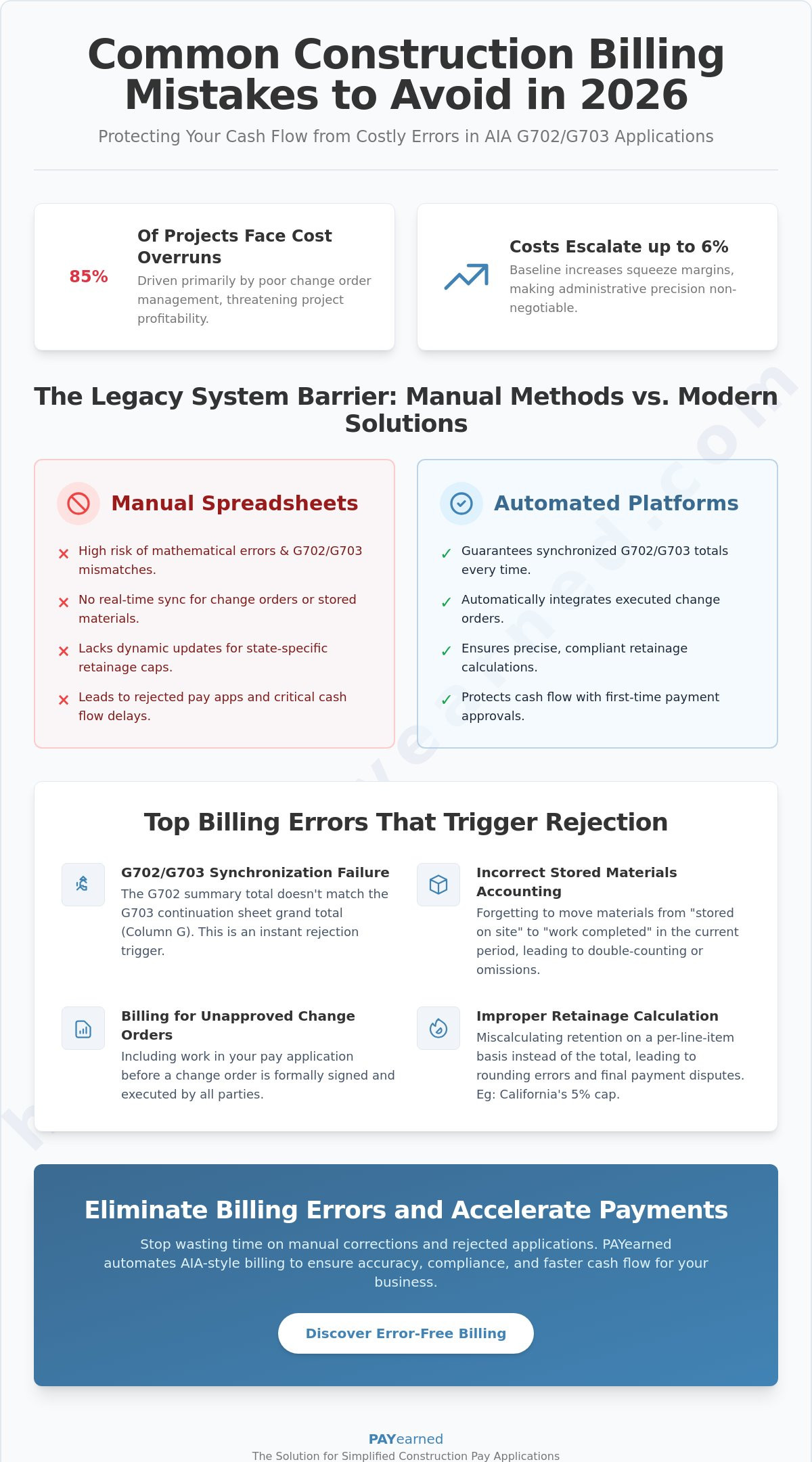
Overcoming the 2026 Legacy System Barrier
Many contractors remain tethered to Excel and Word templates, which are now the primary source of common construction billing mistakes to avoid 2026. These static documents lack the dynamic intelligence required to manage the 5% California retainage cap or the complex math of modern continuation sheets. With 85% of projects experiencing cost overruns due to poor change order management, relying on manual entry is a high-risk gamble. Transitioning to a cloud-based AIA-style document generation platform is no longer an upgrade; it’s a necessity for financial survival.
The ROI of Automated AIA Billing
Comparing the man-hours of manual entry versus automation reveals a stark contrast. A typical project manager might spend four to six hours per month wrestling with spreadsheet formulas for a single project. In contrast, PAYearned subscription automation reduces this administrative burden to minutes. You can explore a deeper comparison in our guide on AIA billing software vs. Excel: the best solutions for 2026. By reclaiming these hours, your team can focus on project execution rather than administrative troubleshooting.
A critical advantage of modern platforms is the ability to retrieve historical project data instantly. Built-in search engines allow you to track every dollar from the initial contract through dozens of change orders. If you can’t find exactly what was billed in month four of a two-year project, your final closeout will be a nightmare. Automated systems maintain a permanent, searchable record that ensures data continuity and protects your profit margins against forgotten costs.
Implementing a Zero-Error Workflow
- Step 1: Standardize your Schedule of Values to ensure every line item is verifiable and aligns with your contract.
- Step 2: Automate progress billing calculations to eliminate the human error inherent in manual data entry.
- Step 3: Use PAYearned to generate AIA-style G702 and G703 forms instantly, ensuring compliance with the latest 2026 industry standards.
Standardizing your workflow is the final step toward financial stability in a high-stakes market. You can explore our tutorials to see how the platform assists with AIA G702 style billing and protects your project’s cash flow.
Securing Your Cash Flow for the Future
The margin for error in construction finance has never been thinner. Between strict 5% retainage caps and rising material costs, your administrative accuracy is your most valuable asset. By synchronizing your G703 continuation sheets and formalizing change order execution before billing, you eliminate the common construction billing mistakes to avoid 2026 that drain your liquidity. Moving away from legacy spreadsheets isn’t just about saving time. It’s about protecting your profit from avoidable rejections and costly interest penalties. Precision in your documentation ensures that your hard work translates into timely payments.
You deserve a billing process that works as hard as your field crews. Our platform offers automated AIA-style G702 and G703 generation, built-in change order and retainage tracking, and a specialized search engine for retrieving historical project data. These tools provide the stabilizing force your office needs to navigate a complex regulatory environment with confidence. It’s time to replace manual math with system autonomy and peace of mind.
Streamline your 2026 billing with PAYearned and start your subscription today.
Take the guesswork out of your pay applications and focus on building what matters. We’re here to help you maintain a steady, reliable cash flow on every project.
Frequently Asked Questions
What is the most common reason a G702 payment application is rejected?
Mathematical discrepancies between the G702 summary and the G703 continuation sheet are the most frequent causes of rejection. Specifically, the “Total Completed and Stored to Date” on Line 4 must match the grand total of Column G on your continuation sheet to the penny. Even a minor rounding error suggests a lack of financial oversight, prompting architects or owners to return the application for correction immediately.
How do I handle change orders on an AIA-style G703 continuation sheet?
You should list change orders as separate line items at the bottom of your Schedule of Values once they are formally executed. Never blend these amounts into original contract lines, as this obscures the audit trail. Clearly state the change order number and description. Ensure the “Net Change by Change Orders” on your G702 summary reflects the total of these additions to maintain document integrity.
Can I use Excel to generate G702 and G703 documents in 2026?
While you can use spreadsheets, manual templates are the leading source of common construction billing mistakes to avoid 2026. Excel lacks the built-in logic to track complex historical data or enforce new regulatory caps, such as the 5% retainage limit on California private projects. Relying on manual entry increases the risk of broken formulas, which leads to payment delays and strained professional relationships.
What is the difference between retention and retainage in construction billing?
There is no functional difference between the two terms; both describe the portion of earned revenue withheld until the project reaches substantial completion. “Retainage” is the technical term found on the G702 form, while “retention” is often used in general contract discussions. Regardless of the terminology, you must track these amounts accurately per period to ensure your final payment application balances correctly during closeout.
PAYearned is an agnostic workflow platform that helps teams manage pay applications
PAYearned is an independent software product and is not developed, endorsed, approved, sponsored or affiliated with the American Institute of Architects (AIA). AIA®, G702®, G703®