

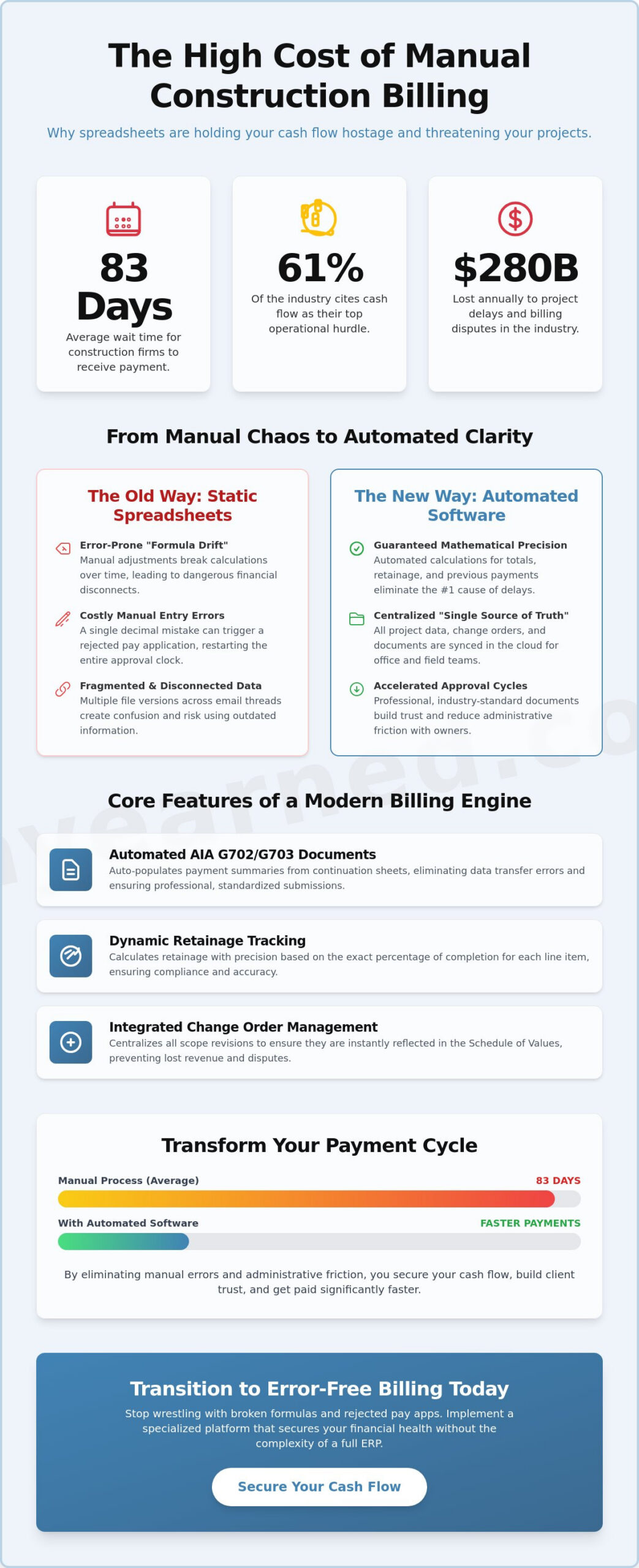
Did you know the average construction firm waits 83 days to receive payment, while cash flow remains the top operational hurdle for 61% of the industry? It’s a staggering reality. The industry loses an estimated $280 billion annually to project delays and billing disputes, often triggered by simple administrative friction. You likely understand the frustration of a rejected pay application because of a math error in a retainage calculation or a change order that vanished into an email thread. These manual mistakes don’t just create extra work; they actively threaten your liquidity. Transitioning to a dedicated construction progress billing software is the most effective way to eliminate these procedural hazards.
We agree that your time is better spent on the job site than wrestling with broken Excel formulas. This article shows you how to move beyond static templates to secure your project’s financial health. You’ll discover how automated workflows produce professional AIA-style documents, track project totals in real time, and ensure your pay applications are approved without delay. We’ll provide a clear roadmap for choosing a solution that provides peace of mind through mathematical precision and system autonomy.
Key Takeaways
- Eliminate the risk of “formula drift” by replacing error-prone manual spreadsheets with a dynamic, automated system.
- Discover how modern construction progress billing software generates professional AIA-style G702 and G703 documents to satisfy industry standards.
- Master dynamic retainage tracking to ensure every calculation is mathematically precise and aligned with project completion percentages.
- Reduce administrative friction and accelerate approval cycles by centralizing change orders and continuation sheets in the cloud.
- Learn how to transition from static templates to a specialized, low-friction platform that secures your cash flow without the complexity of a full ERP.
Why Static Progress Billing Templates Fail in 2026 Workflows
For decades, contractors relied on Excel to manage their finances. In 2026, this approach is a liability. Modern construction progress billing software is a dynamic financial system designed to replace the fragile, error-prone spreadsheets that once dominated the industry. Unlike a static file, this technology integrates directly with construction accounting standards to ensure that every percentage of completion claim remains mathematically sound. It provides a stabilizing force in an environment where financial accuracy is non-negotiable.
To better understand the financial mechanics behind these systems, watch this breakdown of Work in Progress (WIP) reporting:
Static templates suffer from formula drift. As a project spans several months, manual adjustments to rows and columns often break the underlying logic. This creates a dangerous disconnect between your Schedule of Values and your Application for Payment. In a 2026 environment where owners demand cloud-accessible documentation for instant remote approvals, waiting for a corrected spreadsheet to circulate via email is no longer acceptable. Data continuity is essential. If your documents don’t sync perfectly with your current request, you risk significant disputes and frozen liquidity.
The Hidden Cost of Manual Entry Errors
A single decimal error on a G703 continuation sheet can stop a multi-million dollar funding stream. This mistake triggers the rejected pay app cycle, where documents are sent back for correction, effectively restarting the approval clock. This administrative friction is a primary reason the average payment cycle in construction remains at 83 days. Automated math calculations eliminate the #1 cause of payment delays by ensuring totals, retainage, and previous payments always align perfectly without manual intervention.
Templates vs. Automated Billing Engines
Spreadsheets use dumb cells that require manual updates every month. In contrast, an automated billing engine uses smart fields that automatically pull data from previous billing periods. This centralized project data prevents the confusion of fragmented file versions. You don’t have to worry about whether you’re looking at the most recent version of a file. The system maintains a single, unchangeable record of truth for every payment certificate, ensuring that your construction progress billing software acts as a protective expert for your firm’s bottom line.
Essential Features of Modern Progress Billing Software
High-utility features transform billing from a tedious administrative chore into a strategic financial advantage. Effective construction progress billing software must provide more than just digital versions of paper forms. It acts as a centralized engine for financial accuracy. By moving to a cloud-based solution, your office and field teams operate from a single source of truth. This ensures that project data remains consistent across every billing cycle, regardless of where your staff is located.
Automating AIA-Style G702 and G703 Documents
The relationship between the G702 summary and the G703 continuation sheet is the backbone of industry-standard billing. Modern software auto-populates the summary document directly from the detailed line items on the continuation sheet. This eliminates the risk of human error during data transfer. For contractors, understanding the operational shift in AIA billing software vs. Excel is essential for maintaining professional standards. Presenting these standardized, mathematically verified forms to owners builds immediate trust and speeds up the approval process.
Dynamic retainage tracking is another critical pillar of a professional system. Software should automatically calculate held amounts based on the exact percentage of completion for each line item. This precision is vital when adhering to statutory requirements, such as Oregon Law regarding progress payments, which governs how and when contractors receive payment for work performed. Integrated change order management ensures that every scope revision is instantly reflected in the current cycle, preventing lost revenue from unbilled work.
Built-in Search and Data Retrieval
Many general accounting tools fail to provide easy access to historical project data. Specialized construction progress billing software includes robust search engines that allow you to retrieve specific pay applications or change orders in seconds. This capability is invaluable during audits or project closeouts. Having instant access to past project data also provides a competitive edge when bidding on future work, as it allows for more accurate historical cost analysis. To streamline your own documentation process, consider how a specialized pay app platform can simplify your workflow.
Implementing PAYearned for Error-Free Progress Billing
Many software providers push massive ERP systems that are overkill for contractors who simply need to get paid accurately and on time. PAYearned offers a specialized construction progress billing software solution designed for precision without the administrative bloat. This platform replaces the chaos of manual spreadsheets with a high-end, automated engine. It’s a pragmatic choice for firms that value mathematical stability and financial liquidity over flashiness.
Adhering to Federal regulations on construction progress payments requires a level of accuracy that manual templates can’t consistently provide. PAYearned’s math-first approach ensures every pay app is verified before submission, which drastically reduces the risk of rejection. By choosing a dedicated tool, you can master the payment application process and secure your cash flow in minutes.
Streamlining Change Orders and Retainage
Adding change orders to a live application shouldn’t break your formulas. PAYearned allows you to integrate scope revisions seamlessly, maintaining the integrity of your project totals. The system also automatically tracks what is retention across every billing period. This provides the peace of mind that your ‘Balance to Finish’ and retainage held are always accurate, regardless of project complexity.
Getting Started with Professional Billing
Transitioning from a manual template to our subscription-based platform is a low-friction process. Follow these three steps to modernize your workflow:
- Step 1: Upload your Schedule of Values (G703) to establish the project baseline and line items.
- Step 2: Enter the percentage of work completed or the dollar amount for the current period.
- Step 3: Generate and download your professional AIA-style G702 and G703 documents for immediate submission.
Securing Your Financial Future with Automated Precision
The financial landscape of 2026 demands more than just basic record-keeping. It requires a system that actively protects your project’s liquidity. Relying on manual spreadsheets introduces unnecessary risk through formula drift and administrative delays that can freeze your cash flow. By adopting a specialized construction progress billing software, you eliminate these vulnerabilities and establish a stabilizing force in your office. You gain the immediate advantage of automated AIA-style G702 and G703 generation, ensuring every submission is professional and mathematically perfect. Precision tracking of retainage and change orders removes the guesswork from your financial reporting, while cloud-based search capabilities provide instant retrieval of historical project data for audits or new bids. Don’t let outdated, error-prone processes stall your payment cycles or damage your reputation with owners. Transition to a high-end, automated engine that provides the security and organization your business requires to thrive. Start Generating Professional Pay Apps with PAYearned Today. Your team deserves a financial workflow that is as reliable and precise as the structures you build.
Frequently Asked Questions
Is construction progress billing software better than an Excel template?
Yes, dedicated software is superior because it eliminates formula drift and manual calculation errors. While Excel is a static file, construction progress billing software provides a dynamic environment where data flows automatically between billing periods. This ensures mathematical precision and significantly reduces the risk of rejected pay applications that stall your cash flow.
Can I generate AIA G702 and G703 forms with this software?
Yes, the platform is specifically designed to generate professional AIA-style G702 and G703 documents. It auto-populates the summary sheet from the detailed continuation sheet to ensure your totals always align perfectly. This standardized format meets industry requirements and presents a professional image to owners and architects during the approval process.
How does progress billing software handle retainage and retention?
The system automatically calculates retainage based on the exact percentage of completion for each line item. It tracks these held amounts across multiple billing periods without requiring manual adjustments or complex spreadsheet formulas. This approach ensures your balance to finish remains accurate and prevents the common errors associated with tracking retention manually.
Does PAYearned integrate with my existing accounting process?
PAYearned acts as a specialized bridge between your project data and your final financial reporting. While it’s not an accounting service, it generates the standardized documentation your team needs for clean data entry. This interoperability ensures that your construction progress billing software works alongside your current tools without the complexity of a full ERP implementation.
What happens to my change orders when I use billing software?
Change orders are integrated directly into the live pay application as new line items on the G703 continuation sheet. This ensures that every scope revision is accounted for in the current billing cycle rather than getting lost in email threads. The system maintains a centralized record of all approved changes, protecting your revenue from unbilled work.
Is this software suitable for both general contractors and subcontractors?
Yes, the platform provides value for any firm required to submit standardized progress billings. General contractors use it to manage their own applications to owners, while subcontractors benefit from the speed of generating professional documents that GCs can approve quickly. It serves as a stabilizing tool for any contractor prioritizing financial accuracy and liquidity.
PAYearned is an agnostic workflow platform that helps teams manage pay applications
PAYearned is an independent software product and is not developed, endorsed, approved, sponsored or affiliated with the American Institute of Architects (AIA). AIA®, G702®, G703®