

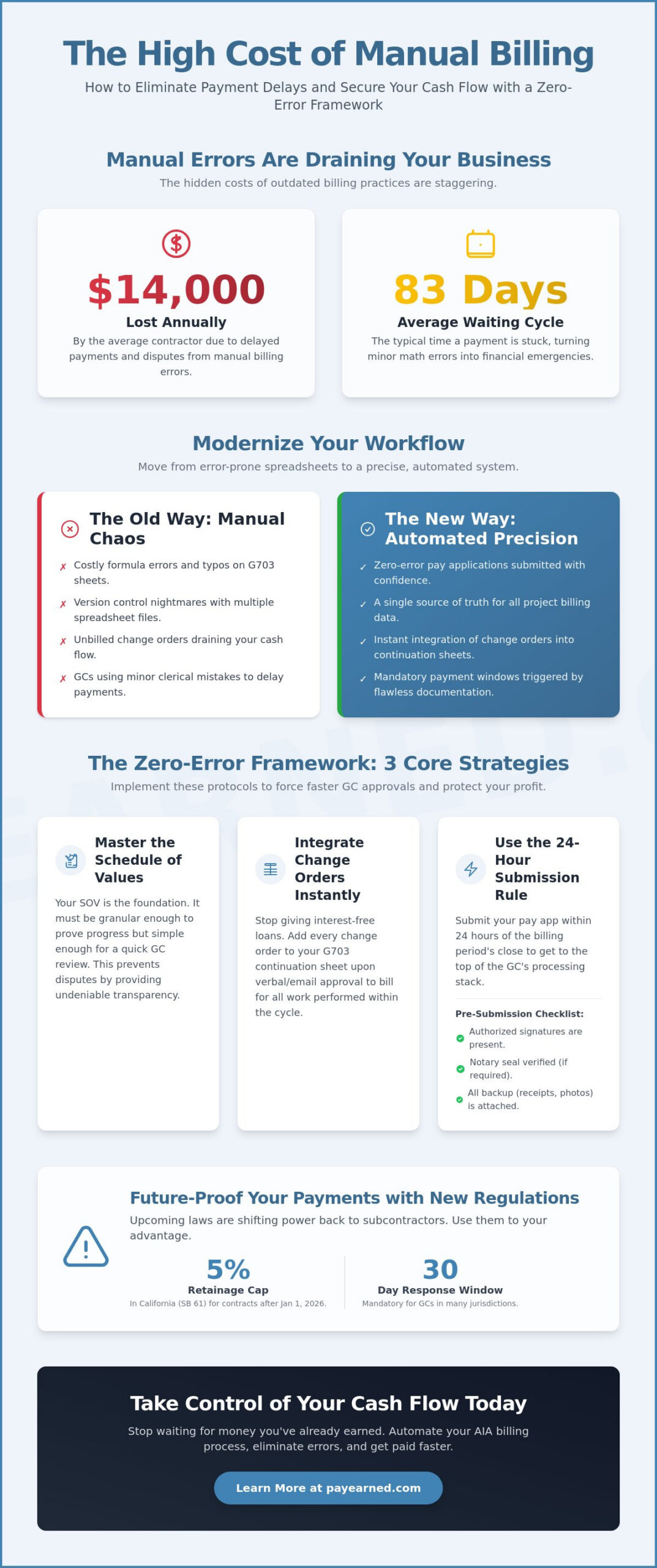
Manual AIA billing errors cost the average commercial contractor over $14,000 annually in delayed payments and disputes. It’s a staggering figure that highlights exactly why learning how to speed up payments from general contractors is no longer just an administrative goal. It’s a survival requirement. When your payroll depends on a check that’s currently stuck in an 83-day waiting cycle, every minor math error on a G703 continuation sheet becomes a financial emergency.
You know the anxiety of watching a cash flow gap widen while waiting for a GC to approve a pay application you submitted weeks ago. It’s frustrating to have your hard-earned money held hostage by minor clerical mistakes or outdated retainage tracking. This guide teaches you the exact documentation strategies and automation workflows that eliminate these delays and force faster GC approvals. We focus on moving from manual, error-prone spreadsheets to a precise, automated system that protects your liquidity.
We will explore how new 2026 regulations, such as California’s 5% retainage cap and mandatory 30-day response windows, shift the power back to subcontractors. You’ll learn to generate error-free, AIA-style documents that trigger mandatory payment windows and keep your projects moving forward without the administrative headache.
Key Takeaways
- Master how to speed up payments from general contractors by adopting a zero-error framework for all G702 and G703 submissions.
- Stop unbilled work from draining your cash flow by integrating change orders into your continuation sheets the moment you receive verbal approval.
- Protect your profit margins by aligning pay applications perfectly with the Schedule of Values to ensure every dollar of progress is captured.
- Eliminate the risks of formula errors and version control issues by moving away from manual Excel templates to automated cloud-based solutions.
- Maintain a single source of truth for your project data to simplify the complex tracking of retainage and multi-year project billing.
Eliminating the ‘Administrative Excuse’: The Zero-Error Pay Application
For many general contractors, a minor clerical error on a pay application isn’t just a mistake; it’s a tactical opportunity to delay payment. Research shows that manual AIA billing errors in spreadsheets cost the average commercial contractor over $14,000 annually in delayed payments and disputes. When you provide an excuse for a rejection, you reset the 30-day clock on your cash flow. Learning how to speed up payments from general contractors starts with eliminating these administrative hurdles. By submitting documentation that is mathematically perfect and professionally formatted, you remove the GC’s ability to claim procedural inaccuracies as a reason for non-payment. This precision is also vital for understanding your right to file a mechanic’s lien, as clean documentation provides the evidence needed if a payment dispute escalates.
To better understand how precision impacts your bottom line, watch this helpful video:
Standardizing your submission format to match AIA-style expectations is a critical strategic move. Even if your contract doesn’t explicitly require G702 or G703 forms, using them signals professional competence and deep domain expertise. It forces the GC’s accounting team into a familiar workflow, reducing the time they spend deciphering your layout. Common math traps, such as incorrectly calculating retainage or failing to carry over previous totals, lead to immediate rejection. Automated systems eliminate these risks by handling the calculations for you, ensuring that your progress billing remains beyond reproach.
Mastering the G703 Schedule of Values (SOV)
Your SOV is the foundation of every progress billing. It must be granular enough to prove progress but simple enough for quick GC review. A well-structured SOV prevents payment disputes by providing undeniable transparency regarding work completed. For a deeper look at these strategies, see our guide on Mastering the Payment Application. Ensure your line items align perfectly with the original contract to avoid confusion during the approval cycle.
The 24-Hour Submission Rule
Submitting your pay app within 24 hours of the billing period close puts you at the top of the GC’s stack. This momentum ensures your application is processed before the GC’s administrative team becomes overwhelmed. Use this checklist for pre-submission verification:
- Signatures: Confirm all required authorized signatures are present on the G702.
- Notary: Verify if a notary seal is required for the specific project or state.
- Backup: Attach all receipts, photos, and progress reports required by the contract.
Managing Retainage and Change Orders for Maximum Liquidity
Unbilled work is the primary cause of subcontractor cash flow failures. When you perform work based on verbal change orders without updating your G703 continuation sheet, you essentially grant the GC an interest-free loan. General contractors often use the absence of a formal line item as a reason to exclude that work from the current billing cycle. Learning how to speed up payments from general contractors requires a proactive approach to these adjustments. Establish a protocol where every change order is added to the continuation sheet immediately upon verbal or email approval. This ensures that when the billing period closes, your documentation reflects the true scope of work performed.
Managing these financial nuances requires a deep understanding of what is retention and how it impacts your final payout. In many jurisdictions, including California under SB 61, retainage is now capped at 5% for private contracts signed after January 1, 2026. If you don’t track this with mathematical precision, you risk losing your profit margin at project closeout. Following federal guidelines on progress payments provides a benchmark for how these funds should be managed and released. Maintaining accuracy here is a stabilizing force for your company’s liquidity.
Proactive Change Order Integration
Every change order needs a dedicated line item on the G703 before the next billing cycle begins. If a change order is still “pending” official signatures, list it with a clear status indicator rather than omitting it entirely. This keeps the additional costs visible to the GC’s project manager. It prevents the work from being forgotten during the final review and ensures you aren’t carrying the cost of labor and materials for months without reimbursement.
The Retainage Recovery Strategy
Don’t rely on the GC’s accounting department to remember your money. Maintain a separate ledger specifically for retainage to ensure your records match the “work completed” minus “retainage held” on every G702 submission. Automating these calculations ensures total accuracy and eliminates the friction that often delays the final release of funds. For those looking to streamline this process, using specialized billing software turns a manual headache into a predictable workflow.
Modernizing Your Workflow: From Excel to Automated AIA Billing
Relying on manual Excel templates in 2026 is a significant operational liability. One broken formula in a hidden cell can derail an entire project’s cash flow. Version control issues often lead to submitting the wrong draft, which general contractors use as a reason for immediate rejection. When you consider how to speed up payments from general contractors, the shift to a digital, automated environment is no longer optional. Using a dedicated AIA billing software platform establishes a single source of truth. It ensures that your project data remains consistent across every billing cycle, preventing the discrepancies that trigger audits.
Digital platforms provide built-in search engines to instantly retrieve historical data for GC audits or inquiries. This transparency builds trust and positions your firm as a high-end, professional partner. You can quickly verify how to include change orders in your pay application using your digital archive to resolve questions before they turn into payment delays. Standardized financial reporting signals that your firm operates with mathematical precision and reliability, which is a stabilizing force in a high-stakes environment.
The ROI of Billing Automation
The return on investment for automation is immediate. You save dozens of administrative hours by auto-populating G703 continuation sheets from previous months. Manual entry is a relic that invites human error and administrative anxiety. Comparing AIA billing software vs Excel reveals that automation directly impacts your firm’s reputation for reliability. GCs prefer working with subcontractors who provide predictable, error-free documentation that doesn’t require constant correction.
Implementing PAYearned for Faster Cycles
PAYearned simplifies the generation of G702 and G703 style documents without the overhead of complex project management or full-scale accounting suites. It’s a focused solution designed for subcontractors who need to generate pay apps in minutes rather than hours. The platform auto-calculates totals, retainage, and progress billing with absolute accuracy. This streamlined workflow ensures your submissions are the first to be approved, keeping your project liquidity stable throughout the 2026 construction season.
Securing Your Financial Future in 2026
Mathematical precision is the only way to eliminate the administrative excuses that stall your cash flow. By adopting a zero-error framework and documenting change orders the moment they are approved, you regain control over your project’s liquidity. This proactive strategy ensures your documentation is unrejectable and forces a faster approval cycle from the GC’s accounting team. It’s about moving from a reactive administrative state to a position of professional authority.
Learning how to speed up payments from general contractors requires moving away from the inherent risks of manual spreadsheets. PAYearned offers a specialized platform for AIA-style G702 and G703 document generation, providing a single source of truth for your project data. Our built-in change order and retainage tracking ensure that every line item is accounted for, while cloud-based search allows you to retrieve historical billing data instantly for any audit or inquiry. You don’t have to accept 80-day payment cycles as an industry standard.
Stop waiting for checks; start generating professional, error-free pay apps with PAYearned today. Take the first step toward predictable payment cycles and a more stable bottom line for your firm.
Frequently Asked Questions
How can I legally pressure a GC to pay faster?
Utilize prompt payment statutes and specific state regulations like California’s SB 440 to enforce deadlines. These laws establish mandatory 30-day response windows for written claims and impose interest penalties of 2% per month on undisputed amounts. Submitting a mathematically perfect pay application triggers these legal timelines. It removes the GC’s ability to claim a documentation error as a reason to delay the clock on your payment.
What are the most common reasons GCs reject subcontractor pay apps?
Mathematical inaccuracies and misalignment with the Schedule of Values are the leading causes of rejection. Even a small rounding error on a G703 continuation sheet provides a tactical excuse for a GC to send the entire application back. Missing backup documentation, such as lien waivers or current proof of insurance, also causes immediate delays. Standardizing your workflow to catch these errors before submission is essential for maintaining liquidity.
Is it better to use AIA G702 or a standard invoice for commercial work?
Using AIA-style G702 and G703 forms is the industry standard for approximately 78% of commercial projects. While a standard invoice might suffice for small residential jobs, commercial GCs expect the structured clarity of progress billing. Learning how to speed up payments from general contractors involves adopting these professional formats to match the GC’s internal accounting processes. This alignment reduces the time their team spends reviewing your submission.
How do I bill for change orders that haven’t been fully signed yet?
List pending change orders as separate line items on your G703 continuation sheet to maintain constant visibility. While you might not be able to bill for the full amount until the signature is finalized, including them prevents the work from being overlooked. This practice forces a conversation about the status of the approval. It ensures that once the signature is secured, the billing process can proceed without further administrative delays.
Can automated billing software really reduce my payment turnaround time?
Automation eliminates the manual calculation errors that frequently lead to pay app rejections. Software that auto-calculates retainage and carries over previous totals ensures your G702 and G703 forms are always accurate. By reducing the time it takes to generate a submission from hours to minutes, you can get your application in within 24 hours of the billing close. This speed puts your firm at the top of the GC’s payment stack.
PAYearned is an agnostic workflow platform that helps teams manage pay applications
PAYearned is an independent software product and is not developed, endorsed, approved, sponsored or affiliated with the American Institute of Architects (AIA). AIA®, G702®, G703®