

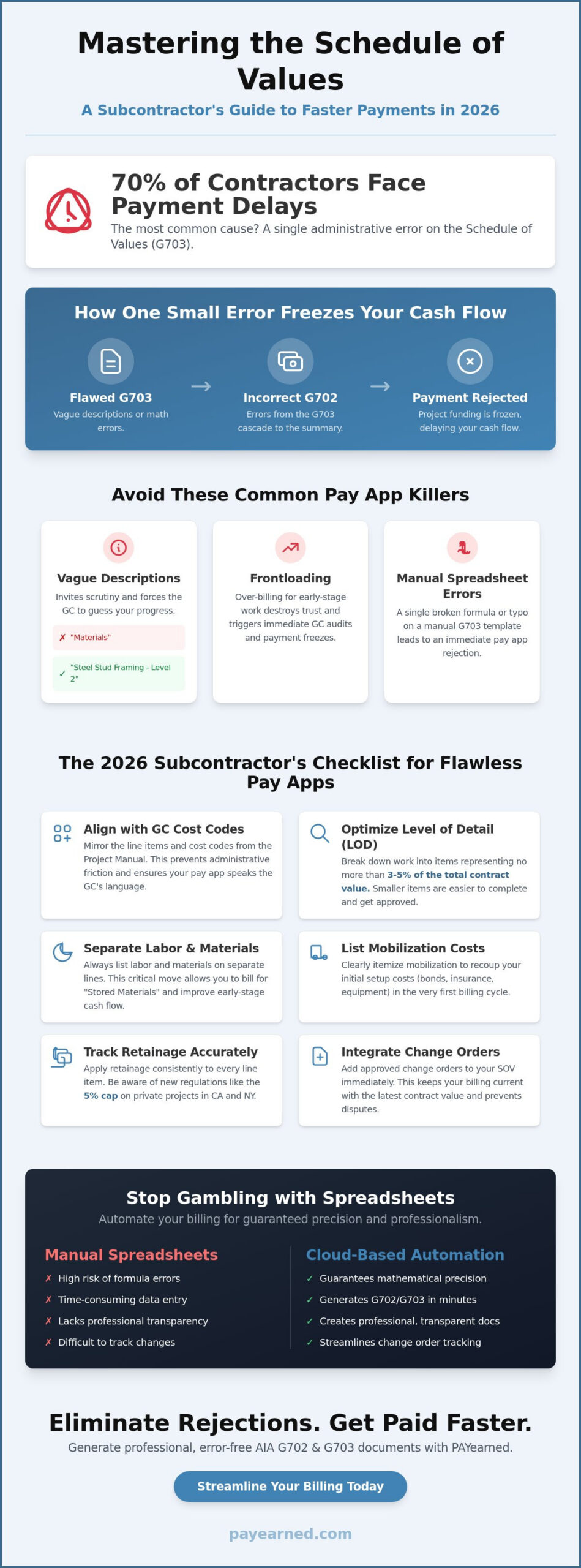
In 2026, 70% of construction contractors report experiencing regular payment delays, often triggered by a single administrative oversight on a continuation sheet. You’ve likely felt the sting of a rejected pay app because of a minor error in your labor and material breakdown. It’s a high-stakes game where administrative precision determines your cash flow. Mastering schedule of values best practices for subcontractors is the only way to protect your liquidity, especially with evolving industry regulations that cap retainage and impose heavy interest penalties on late payments.
We’ll help you master the G703 Schedule of Values to eliminate pay app rejections and accelerate your billing cycle. You’ll learn how to structure your costs for immediate approval, track change orders with total transparency, and produce professional-grade AIA-style documentation. This guide provides the pragmatic framework you need to navigate 2026’s strict prompt payment regulations. We’ll show you how to ensure you get paid for every dollar earned without the administrative headache of manual, error-prone spreadsheets.
Key Takeaways
- Understand why the G703 continuation sheet acts as the critical yardstick for progress billing and how a flawed breakdown can freeze your project funding.
- Implement schedule of values best practices for subcontractors to align your line items with the project manual and meet specific general contractor cost codes.
- Find the perfect balance between granular detail for progress tracking and high-level summaries to keep your administrative workflow lean and manageable.
- Protect your liquidity by identifying common manual spreadsheet liabilities where formula errors lead to immediate pay app rejections.
- Streamline your documentation with automated G702 and G703 generation to ensure mathematical precision and professional-grade transparency for every billing cycle.
Why Your Schedule of Values is the Key to Subcontractor Cash Flow
The G703 Continuation Sheet is the true engine of your billing process. It’s not just a list; it’s the financial map for the entire project. Implementing schedule of values best practices for subcontractors ensures this map is readable and accurate from day one. If your breakdown is vague or disorganized, your payment remains at the mercy of a skeptical project manager.
Think of the SOV as your progress yardstick. If the yardstick is broken, you won’t get paid. The most common reason for a rejected pay application isn’t bad math. It’s a lack of detail that makes GCs doubt your progress. Adhering to schedule of values best practices for subcontractors means providing the transparency GCs need to release funds without hesitation.
To better understand how this document functions in the real world, watch this helpful video:
Contrast lump sum billing with itemized billing. A single line for “Electrical” invites scrutiny and delays. Breaking it down into “Rough-in,” “Conduit,” and “Fixtures” builds immediate trust. Transparency proves you’ve earned the money you’re requesting.
The Link Between the G703 and G702
The G703 provides the granular data that populates the summary on your G702 Application and Certificate for Payment: The Definitive Reference Guide. An error in the G703 Schedule of Values cascades into a mathematical failure on the G702. This synchronization is why precision matters at the line-item level.
Common Subcontractor Pitfalls
Avoid the “Frontloading” trap. While it’s tempting to over-bill early for mobilization, it often triggers GC audits and immediate payment freezes. Another hazard is using vague descriptions. Labeling a line as “Materials” tells the GC nothing. Using “Steel Stud Framing – Level 2” provides the clarity required for instant approval.
The 2026 Subcontractor Checklist: Schedule of Values Best Practices
Start your project by aligning your line items with the Project Manual. Your G703 must mirror the GC’s expected cost codes to prevent administrative friction. Following schedule of values best practices for subcontractors means translating your internal estimate into the language your GC understands. If your codes don’t match theirs, your pay app will likely sit at the bottom of the pile.
Balance your detail with manageability. You need enough specificity to prove progress but not so much that your monthly accounting becomes a burden. Separate labor and materials on every line. This allows you to bill for “Stored Materials” sitting in the warehouse before they are even installed on-site. It’s a critical move for maintaining positive cash flow. Using a cloud-based billing platform ensures these line items stay organized across multiple cycles without manual calculation errors.
Level of Detail (LOD) Standards
Breakdown your work by phase, floor, or specific trade to simplify inspections. Smaller line items are easier to “finish” in the eyes of an inspector. Proving 100% completion on a $50,000 item is difficult; proving it on five $10,000 items is simple. Successful subcontractors break down work into items representing no more than 3-5% of the total contract value to ensure steady progress billing.
Retainage and Mobilization Best Practices
List mobilization costs clearly to recoup setup expenses in your first billing cycle. This covers your initial bond costs, insurance, and equipment delivery. You must also ensure retainage percentages are applied consistently across every line item on the G703. As of January 1, 2026, California SB 61 caps retainage at 5% for most private projects. Similarly, New York’s Prompt Payment Act now voids any contract requiring more than 5% retention. Understanding What is Retention? A Comprehensive Guide to its Meaning and Role in Construction helps you track these funds accurately as they accumulate. Finally, integrate approved change orders into your SOV immediately to keep your billing current and undisputed.
Optimizing Your G703 Workflow: From Manual Templates to Automated Billing
Relying on manual spreadsheets is a high-stakes gamble. The “Excel Liability” is real; one broken formula in a hidden cell can delay a $100k payment for weeks. GCs don’t have the time to debug your math. If your totals don’t tick and tie, your application is rejected immediately. Transitioning to automated billing is one of the most impactful schedule of values best practices for subcontractors aiming for consistent liquidity.
Automation does more than just basic math. It acts as a primary risk mitigator by auto-calculating retainage and progress percentages across every line item. Submitting clean, AIA-style documents also sends a powerful signal. It positions you as a Tier-1 subcontractor who values precision. This professional transparency builds long-term trust with project owners and general contractors alike.
Eliminating Administrative Redundancy
Specialized platforms like PAYearned generate G702 and G703 documents simultaneously. You don’t have to enter data twice. Cloud-based storage also provides a “Search and Retrieve” advantage, allowing you to find historical project data or previous continuation sheets instantly. For a deeper look at these tools, read our AIA Billing Software: The Contractor Guide to G702 & G703 Automation in 2026.
Securing Your Next Payment
Before you hit submit, run through a final checklist to ensure your application is airtight:
- Verify that your stored materials are documented with current invoices.
- Ensure all change orders are fully approved and integrated into the SOV.
- Confirm that schedule of values best practices for subcontractors are applied to every line item without exception.
If a GC provides feedback, an automated system lets you revise the SOV without starting from scratch. This agility keeps your billing cycle moving forward even when adjustments are required. Don’t let manual errors dictate your cash flow. Precision in your documentation is the difference between a funded project and a financial bottleneck. Ready to stop fighting with spreadsheets? Streamline your G703 Schedule of Values with PAYearned.
Take Control of Your 2026 Billing Cycle
Your project’s liquidity depends on the precision of your financial documentation. By adopting schedule of values best practices for subcontractors, you transform a tedious administrative chore into a strategic tool for project success. You’ve learned how granular itemization builds trust with GCs and how automation eliminates the mathematical errors that often stall your payments. In a market governed by strict 2026 retainage caps and prompt payment laws, your ability to submit flawless documentation is non-negotiable.
It’s time to eliminate the “Excel Liability” and secure your next payment with confidence. Start generating professional AIA-style pay apps today with PAYearned to access specialized G702 and G703 generation. Our platform offers automated retainage and change order tracking with built-in search for instant project data retrieval. Take control of your financial destiny and ensure your business remains the preferred choice for every general contractor. Your next approval is just a few clicks away.
Frequently Asked Questions
What is the difference between a project budget and a schedule of values?
A project budget is an internal document used to track your actual costs and profit margins, while a schedule of values is a formal billing document provided to the GC. The SOV translates your contract sum into a series of line items that represent the value of work to be performed. It doesn’t show your overhead or profit as separate items. Instead, it allocates those costs across the work activities to facilitate progress payments.
Can I change my schedule of values after the project has started?
You can modify your schedule of values after a project begins, but it typically requires formal approval from the general contractor or architect. Once you’ve submitted your first pay application, changing the original line items is difficult because it disrupts the historical billing data. The most common way to adjust the total value is through approved change orders. These are added as new line items to your G703 continuation sheet rather than altering the initial entries.
How detailed should a subcontractor’s schedule of values be for AIA billing?
Your breakdown should be granular enough to show clear progress without overwhelming your accounting team with hundreds of tiny entries. Following schedule of values best practices for subcontractors suggests breaking the work into phases, floors, or specific trades. This level of detail allows an inspector to verify completion easily. If a line item is too large, a GC might hesitate to approve a high percentage of completion, which slows down your cash flow.
What happens if my schedule of values doesn’t match my contract amount?
Your pay application will be rejected immediately if the total of your schedule of values doesn’t exactly match the contract sum on your G702. The G703 continuation sheet acts as the mathematical proof for the summary on the G702. If there’s even a one-cent discrepancy, the GC’s software or accounting department will flag it as an error. Always verify that your line item totals align perfectly with your signed contract before submission.
PAYearned is an agnostic workflow platform that helps teams manage pay applications
PAYearned is an independent software product and is not developed, endorsed, approved, sponsored or affiliated with the American Institute of Architects (AIA). AIA®, G702®, G703®