

Eighty-five percent of construction projects suffer from cost overruns, and a disorganized construction change order approval process is usually the primary culprit. It’s a common trap: you perform extra work based on a verbal agreement to keep the schedule on track, only to find that work missing from your next payment. On major projects, change orders represent 10% to 15% of total contract value. Leaving that much revenue to chance isn’t just a risk; it’s a threat to your company’s financial liquidity.
You likely agree that chasing signatures and disputing scope creep is the most draining part of project management. This article promises to help you move from manual, error-prone methods to a streamlined system where every adjustment is documented and billed. We’ll explore how to integrate changes directly into your G703 Schedule of Values and how to navigate new standards like California’s SB 440 to ensure undisputed amounts are paid within 60 days. It’s time to turn administrative chaos into a predictable, automated workflow that protects your bottom line.
Key Takeaways
- Treat every change order as a legal and financial amendment to your original contract to safeguard your company’s liquidity.
- Formalize your construction change order approval process by issuing a Notice of Change (NOC) as soon as scope adjustments are identified.
- Protect your profit margins by quantifying the exact impact of labor and materials before work begins, rather than relying on verbal promises.
- Link approved changes directly to your G703 Schedule of Values to ensure all extra work is accurately documented and billed in your next pay app.
- Transition to cloud-based tracking to gain real-time visibility into pending approvals and eliminate the risk of forgotten invoices.
The Financial Anatomy of the Change Order Approval Process
A change order is much more than a simple field request; it’s a formal legal and financial amendment to your original contract sum. When you understand What is a Change Order?, you recognize it as a high-stakes instrument that redefines your project’s financial boundaries. For a change to be valid, it must address three critical pillars: the revised scope of work, the adjusted cost, and the specific impact on the project timeline. Without these elements, your construction change order approval process lacks the mathematical precision required for a successful financial audit.
Adopting a “protective expert” stance is essential for maintaining subcontractor liquidity. You must view every handshake or verbal “go-ahead” as a direct threat to your cash flow. If the adjustment isn’t documented, it effectively doesn’t exist in the eyes of an owner’s accounting department or a construction lender. Clean financial operations depend on converting every field observation into a paper trail immediately.
From Field Observation to Formal Notice
The transition from a site issue to a billable event begins with the Notice of Change (NOC). This document is vital because it triggers the contractual approval clock. It’s also the time to categorize the work correctly. “Extra Work” involves tasks entirely outside the original contract, while “Additional Work” refers to an increase in the quantity of work already specified. Proper categorization ensures that your construction change order approval process moves quickly through the General Contractor’s review without unnecessary clarification delays. For more on maintaining professional documentation, see our guide on Mastering the Payment Application.
The Impact of Verbal vs. Written Approvals
Proceeding with work based on verbal approval is a gamble you can’t afford to take. Unapproved changes create massive “red flags” on your G702 Application and Certificate for Payment. When an architect or owner sees costs on a pay app that don’t match the approved contract sum, they often reject the entire application. This stalls payment for the work you’ve already completed. Under regulations like California’s SB 440, having a written process is even more critical, as it mandates that owners respond to claims within 30 days and pay undisputed amounts within 60 days. A written signature is your only guarantee that the extra labor and materials you’ve invested will actually result in a deposit in your bank account.
Standardizing the 5-Step Construction Change Order Workflow
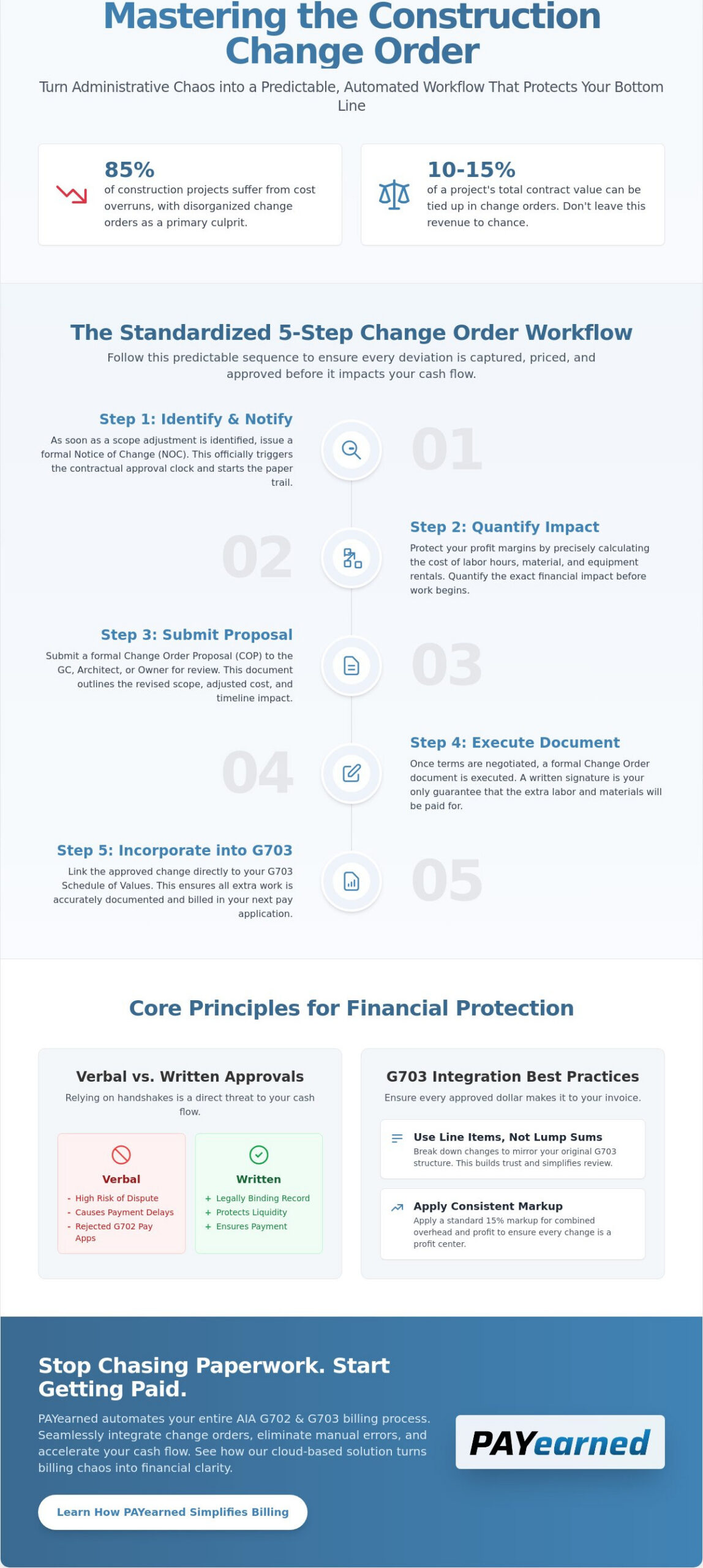
To maintain project velocity and financial accuracy, your construction change order approval process must follow a predictable, standardized sequence. Haphazardly documenting changes leads to disputes and delayed payments. A rigorous workflow ensures that every deviation from the original contract is captured, priced, and approved before it impacts your bottom line. Follow these five essential steps to secure your revenue:
- Step 1: Identify the change and issue a formal Notice of Change (NOC) to trigger the contractual clock.
- Step 2: Quantify the impact by calculating labor hours, material costs, and equipment rentals.
- Step 3: Submit a formal Change Order Proposal (COP) for review by the Architect or Owner.
- Step 4: Execute the formal Change Order document once terms are negotiated and finalized.
- Step 5: Incorporate the approved change into your G703 Schedule of Values for the next billing cycle.
Quantifying the Change for the Schedule of Values
Once a change is approved, it shouldn’t just be added as a lump sum. Break the change down into specific line items that mirror your original G703 continuation sheet structure. This transparency builds trust with architects and simplifies the progress billing review. Apply a consistent markup of 15% for combined overhead and profit to ensure every change order remains a profit center rather than a cost recovery exercise. Using a cloud-based solution for AIA G702 Pay Apps allows you to automate this integration, ensuring no approved change is left off your invoice.
Navigating the Approval Chain
The approval chain typically moves from the Subcontractor to the General Contractor, then to the Architect, and finally the Owner. Each stakeholder has a different priority, from budget control to design integrity. You may occasionally encounter “Conditional Approvals,” which allow work to proceed while final pricing is settled. While these keep the project moving, they are risky for billing. Always push for a fully executed document before the next pay application deadline to avoid “pending” status traps that stall your cash flow.
Optimizing Change Order Billing with G702 and G703 Automation
A signed change order is only the beginning of the revenue cycle. The real challenge lies in ensuring that every approved adjustment actually makes it onto your next invoice. Many subcontractors lose revenue because they fail to reconcile their field documents with their accounting records. While it is tempting to search for free versions of fillable G702 and G703 forms, these static documents often break the link between the field and the office. Automated software eliminates this risk by integrating the construction change order approval process directly into your billing workflow. By using a cloud-based system, you gain real-time visibility into which changes are “Approved” and ready for billing versus those still in “Pending” status.
PAYearned simplifies the generation of AIA-style documents by allowing you to reflect contract changes instantly. Instead of manually re-calculating the entire Schedule of Values, the platform auto-populates the necessary fields. This ensures that your G702 and G703 forms are always in sync with the current contract sum. For a deeper look at how technology is reshaping this field, explore The 2026 Evolution of Change Order Management Software.
Closing the Gap Between Approval and Payment
The G702 Application and Certificate for Payment features a dedicated summary section for change orders. This area tracks the original contract sum, the net change by change orders, and the new contract sum to date. Accuracy here is non-negotiable. Automated math ensures that retainage is correctly calculated on both original and changed work, preventing the common error of under-billing for withheld funds. This precision protects your liquidity and ensures that your financial audits remain clean and undisputed throughout the project lifecycle.
Digital Tracking vs. Manual Spreadsheet Errors
Manual Excel templates are prone to calculation errors that can stall your entire payment application. A single typo in a line item can lead to an architect rejecting your G703 continuation sheet. Transitioning to a dedicated billing platform provides the mathematical precision that manual methods lack. We encourage users to visit the PAYearned tutorials to master digital change order entries and streamline their monthly billing cycles. Moving away from manual entry isn’t just about speed; it’s about the security of knowing your numbers are right every time.
Securing Your Revenue Through Process Precision
Mastering the construction change order approval process is the difference between a profitable project and a cash flow crisis. By standardizing your workflow from the initial Notice of Change to the final G703 update, you eliminate the ambiguity that leads to unpaid extra work. You don’t have to settle for the risks of manual spreadsheets or the anxiety of forgotten billable items. Relying on a structured, written system ensures that every adjustment is documented, approved, and accurately reflected in your next pay application.
Transitioning to an automated solution provides the peace of mind that comes with mathematical certainty. PAYearned offers automated AIA-style G702 and G703 generation combined with cloud-based change order tracking. Our dedicated US-based support team is here to help you navigate complex billing requirements with ease. Stop chasing signatures and start protecting your liquidity with a system built for precision. Streamline your change order billing with PAYearned today and take control of your project’s financial future. You’ve earned the money; it’s time to ensure you get paid for it.
Frequently Asked Questions
Who is responsible for initiating the change order approval process?
The party requesting a deviation from the original contract scope is responsible for initiating the construction change order approval process. In most scenarios, a subcontractor identifies a field condition or receives an owner request and must issue a formal Notice of Change (NOC). Taking this proactive step ensures the financial clock starts ticking and protects your right to payment for extra labor and materials. It’s your responsibility to move the request from a field observation to a formal administrative record.
Can I bill for a change order before it is fully signed?
You should generally avoid billing for a change order until you have a fully executed, signed document. Including unapproved work on your G702 Application for Payment often results in the entire application being rejected by the architect or owner. If the project requires immediate action to stay on schedule, ensure you have a written Construction Change Directive (CCD). This specific document allows you to proceed with progress billing while the final pricing is still under negotiation.
How does a change order affect the G703 Schedule of Values?
An approved change order modifies your G703 Schedule of Values by adding new line items or adjusting the scheduled value of existing tasks. These adjustments update your Total Contract Sum to ensure that your progress billing percentages remain mathematically accurate. Automated platforms streamline the construction change order approval process by appending these totals to your continuation sheet. This prevents manual entry errors and ensures your financial audits remain clean and undisputed throughout the project lifecycle.
What happens if a change order is rejected after the work is performed?
Performing work before receiving a signed approval puts your company at significant financial risk. If a change order is rejected after the fact, you may be forced to file a formal claim or absorb the costs of labor and materials yourself. This high-stakes scenario is exactly why verbal approvals are dangerous for your liquidity. A rigorous approval workflow prevents you from performing work based on informal promises that won’t hold up when it’s time to process the final payment application.
PAYearned is an agnostic workflow platform that helps teams manage pay applications
PAYearned is an independent software product and is not developed, endorsed, approved, sponsored or affiliated with the American Institute of Architects (AIA). AIA®, G702®, G703®