

Financial stress in the construction industry isn’t usually a result of poor craftsmanship; it’s almost always a direct symptom of administrative friction. Implementing proactive financial stress management for contractors is the only way to stop a mountain of paperwork from eating into your project time. When unmanaged retainage and pending change orders pile up, the resulting anxiety feels heavier than the materials on your job site. Most professionals accept delayed payments and minor billing errors as an unavoidable part of the trade, but this constant state of worry shouldn’t be your baseline.
You deserve a predictable billing cycle where mathematical precision replaces the guesswork of manual entry. This guide will show you how to identify and eliminate the specific procedural hazards that cause payment delays and administrative headaches. We’ll explore how to move from outdated, error-prone methods to a streamlined system that prioritizes liquidity and accuracy. By the end of this article, you’ll have a roadmap to reduce administrative errors and gain the mental clarity needed to focus on project execution rather than fluctuating bank balances.
Key Takeaways
- Identify why the gap between project expenses and realized revenue creates a “Cash Flow Crunch” that threatens even the healthiest firms.
- Implement effective financial stress management for contractors by performing a document audit to pinpoint exactly where administrative friction is stalling your payments.
- Build a reliable 12-month cash flow forecast to move your business from a reactive state to proactive project planning.
- Eliminate the anxiety of end-of-project retention tracking by transitioning from manual, error-prone spreadsheets to automated billing systems.
- Streamline your G702 and G703 generation to ensure mathematical precision and consistent liquidity throughout the project lifecycle.
Understanding the Root Causes of Financial Stress for Contractors
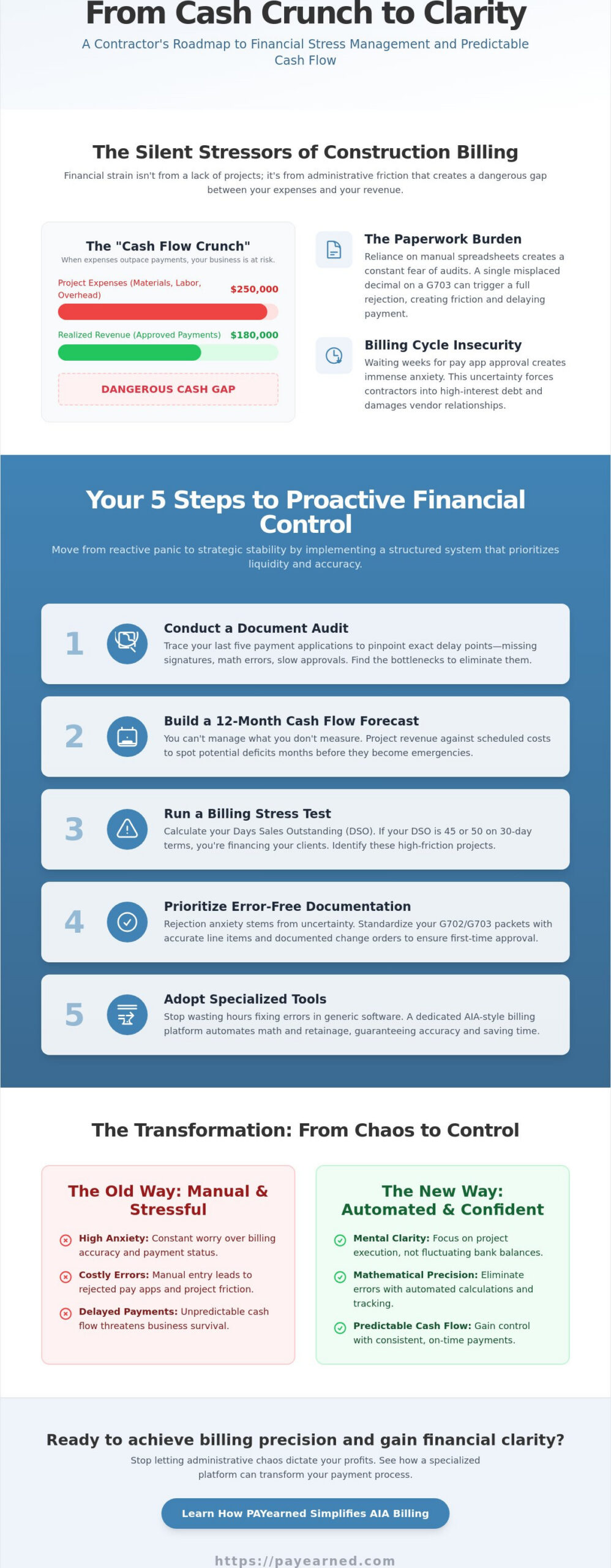
Financial stress for contractors is rarely about a lack of talent or a shortage of projects. Instead, it is the measurable gap between project expenses and realized revenue. This disparity creates the “Cash Flow Crunch,” which remains the leading cause of failure for otherwise healthy construction firms. While market-driven factors like inflation are external pressures, administrative-driven stress stems from preventable internal errors. Effective financial stress management for contractors requires recognizing that slow receivables aren’t just a nuisance; they are a systemic threat to your business’s survival.
When you are Understanding Financial Distress, it becomes clear that the psychological toll of unpredictable payment timelines often outweighs the physical demands of the job site. This constant state of financial insecurity prevents project managers from focusing on quality and safety. You can find more strategies for maintaining stability on our blog.
The ‘Paperwork Burden’ as a Silent Stressor
Relying on manual entry in Excel spreadsheets creates a persistent fear of the audit. One misplaced decimal point on a G703 continuation sheet can trigger a full rejection of your payment application. These errors don’t just delay your cash; they create friction with general contractors and owners who value precision. Messy documentation signals a lack of professional control, making every billing cycle a high-stakes gamble rather than a routine procedure.
Identifying Insecurity in the Billing Cycle
The billing cycle is the heartbeat of contractor liquidity. When you submit a pay app and wait weeks for approval, that silence creates immense anxiety for your accounting team. This insecurity often forces contractors to take on high-interest debt or delay vendor payments, further complicating their financial standing. Managing this cycle effectively is the cornerstone of sustainable growth and long-term financial stress management for contractors who want to scale without the constant fear of insolvency.
5 Practical Steps for Financial Stress Management
Moving from reactive panic to proactive stability requires a structured approach. Effective financial stress management for contractors isn’t a one-time fix; it’s a series of operational changes that prioritize liquidity. Start with a rigorous document audit. Trace your last five payment applications from submission to funding. Identify the exact moment delays occurred. Was it a missing signature, a math error on a continuation sheet, or a slow approval from the project owner? Pinpointing these bottlenecks is the first step toward eliminating them.
Next, establish a 12-month cash flow forecast. You can’t manage what you don’t measure. Use your existing backlog to project revenue and cross-reference it with scheduled material costs and labor. For deeper insights into maintaining fiscal health, consult the SBA Financial Management Guide. This baseline allows you to spot potential deficits months before they become emergencies, giving you time to adjust your strategy.
Conducting a Billing Stress Test
Calculate your average Days Sales Outstanding (DSO). If your contract terms specify 30 days but your actual DSO is 45 or 50, you’re effectively acting as a bank for your clients. Identify “red flag” projects where documentation is consistently rejected. These high-friction jobs are often the primary source of administrative anxiety and require immediate process standardization to protect your profit margins.
Prioritizing Error-Free Documentation
Rejection anxiety stems from uncertainty. Mastering the payment application reduces this stress by ensuring every packet meets industry standards the first time. A rejection-proof billing packet typically includes a signed G702 Summary, a detailed G703 Continuation Sheet with accurate line-item progress, and fully documented change orders. Standardizing these components eliminates the need to “reinvent the wheel” each month.
Finally, adopt specialized tools designed for the trade. Stop using general accounting software for niche construction tasks. Using a dedicated AIA-style billing platform ensures your math is perfect and your retainage is tracked automatically, providing the reliability you need to focus on project execution.
Eliminating Administrative Chaos to Protect Your Profit
The most common objection to upgrading billing systems is a perceived lack of time. Contractors often believe they’re too busy to learn new software, yet they spend hours fixing manual errors on Excel sheets. This trade-off is a primary obstacle to effective financial stress management for contractors. When you calculate the cost of a single rejected pay application, the investment in a streamlined system pays for itself immediately. Accuracy isn’t just about accounting; it’s about protecting your profit from the erosion of administrative friction.
Tracking project end-life financials often leads to significant anxiety. Understanding what is retention is vital, but managing it manually is a recipe for disaster. Retention is frequently the last piece of the liquidity puzzle. Losing track of these funds across multiple projects creates a massive hole in your balance sheet. Standardized Continuation Sheets (G703) provide the necessary transparency to ensure both you and the owner are aligned on these totals, building a foundation of trust that accelerates the approval process.
Managing Change Orders Without the Headache
Change orders are notorious for causing financial leaks and disputes. If they aren’t linked directly to your schedule of values, they become administrative liabilities. Modern workflows, such as the 2026 evolution of change order management, emphasize real-time integration. This ensures that every modification to the scope is reflected in your progress billing, preventing the “lost” revenue that plagues disorganized firms.
The Peace of Mind in Automated Calculations
There is profound peace of mind in automated calculations. Manual math is a liability that invites human error and subsequent payment delays. When a system calculates your totals, retainage, and progress percentages, the personal burden of mathematical accuracy vanishes. You no longer need to double-check every cell before hitting send. To regain control over your billing cycle, explore how automated pay apps can stabilize your cash flow.
Building a Sustainable Future with Automated Billing
Transitioning your firm from a reactive stance to a proactive strategy requires more than just better habits; it requires better tools. Implementing specialized AIA billing software is the most effective way to ensure long-term financial stress management for contractors. By standardizing the generation of G702 and G703 forms, you remove the variability that leads to payment rejections. PAYearned acts as a stabilizing force, providing a structured environment where mathematical precision is the default rather than a manual goal. This system autonomy allows you to retrieve critical project data instantly through built-in search functions, making internal or external audits a routine task rather than a crisis. The ultimate result is the elimination of “billing dread,” allowing you to end your work week with confidence in your bank balance.
Scaling Without Increasing Administrative Stress
A system-driven approach is essential for scaling. It allows your team to take on larger, more complex projects without the need to hire additional administrative staff. PAYearned offers a low-friction entry point, allowing you to move away from error-prone manual methods without a steep learning curve. This specialized SaaS platform focuses on the critical task of payment applications, ensuring your cash flow remains steady as your project volume increases. It is a personality rooted in competence and precision, appealing to professionals who value stability over general-purpose tools.
Your Next Steps Toward Financial Stability
Achieving financial stability starts with a commitment to better documentation. Follow this checklist to begin your transition from manual templates to automated workflows:
- Identify your most frequent billing rejection reasons from past projects.
- Migrate your schedule of values into a standardized digital format.
- Automate your retainage and change order tracking to prevent financial leaks.
- Establish a recurring submission schedule to maintain a predictable billing cycle.
Don’t let manual math dictate your firm’s future. Reclaim your time and sanity by delegating the complex calculations to PAYearned. You can explore our tutorials to see how easily you can transform your workflow and improve your construction cash flow today.
Take Control of Your Construction Cash Flow
Financial stability isn’t a byproduct of luck; it’s the result of precise administrative control. You’ve seen how identifying the root causes of billing friction is the first step toward reclaiming your project time. By implementing standardized documentation, you transform your firm from a reactive operation into a proactive leader. This transition is the foundation of effective financial stress management for contractors who want to protect their profit margins and eliminate the “billing dread” that plagues manual workflows.
Precision in your payment applications ensures that every submission is accurate, reducing the anxiety of rejections and delayed revenue. PAYearned provides specialized AIA-style document generation, automated retainage and change order tracking, and built-in search for instant project data retrieval. These tools remove the personal burden of manual math and audit preparation, allowing you to focus on execution rather than administrative chaos.
Start automating your G702 and G703 forms with PAYearned today and experience the relief of a predictable billing cycle. You have the power to stabilize your cash flow and build a more resilient business. It’s time to delegate the math and reclaim your peace of mind.
Frequently Asked Questions
What is the biggest cause of financial stress for subcontractors?
The most significant cause of financial stress is the “Cash Flow Crunch,” which occurs when project expenses outpace realized revenue. This gap is often exacerbated by administrative friction, such as delayed payments due to minor billing errors or unmanaged retainage. For many firms, these procedural inaccuracies are more damaging than market conditions because they are entirely preventable with the right systems in place.
How does automated billing software reduce contractor anxiety?
Automated billing software reduces anxiety by replacing manual, error-prone entry with mathematical precision. It removes the personal burden of calculating complex retainage and progress percentages on G702 and G703 forms. When you know your documentation is accurate and standardized, the fear of a rejected pay application vanishes. This provides the peace of mind needed to focus on field execution rather than bank balances.
Can better documentation really speed up my payment cycle?
Yes, error-free documentation is the most effective way to accelerate your payment cycle. Most delays happen because a general contractor or owner finds a discrepancy in the continuation sheet or a mismatch in change order totals. Providing a clean, standardized billing packet on the first submission eliminates the back and forth communication that often stalls funding for weeks. Accuracy builds the trust necessary for faster approvals.
What is a financial stress test in construction?
A financial stress test is an assessment of your firm’s liquidity and its ability to withstand payment delays. It involves calculating your Days Sales Outstanding (DSO) and identifying “red flag” projects where documentation friction is high. Performing this test helps in financial stress management for contractors by highlighting exactly where your cash flow is most vulnerable to administrative bottlenecks. It allows you to adjust before a crisis occurs.
Is it worth paying for a subscription to manage G702 and G703 forms?
Investing in a subscription is highly cost-effective when compared to the expense of a single rejected payment application. The time saved on manual math and the reduction in administrative errors directly improve your bottom line. Specialized platforms like PAYearned offer a low-friction entry into financial stress management for contractors, ensuring your billing process is a stabilizing force rather than a constant source of chaos.
PAYearned is an agnostic workflow platform that helps teams manage pay applications
PAYearned is an independent software product and is not developed, endorsed, approved, sponsored or affiliated with the American Institute of Architects (AIA). AIA®, G702®, G703®