

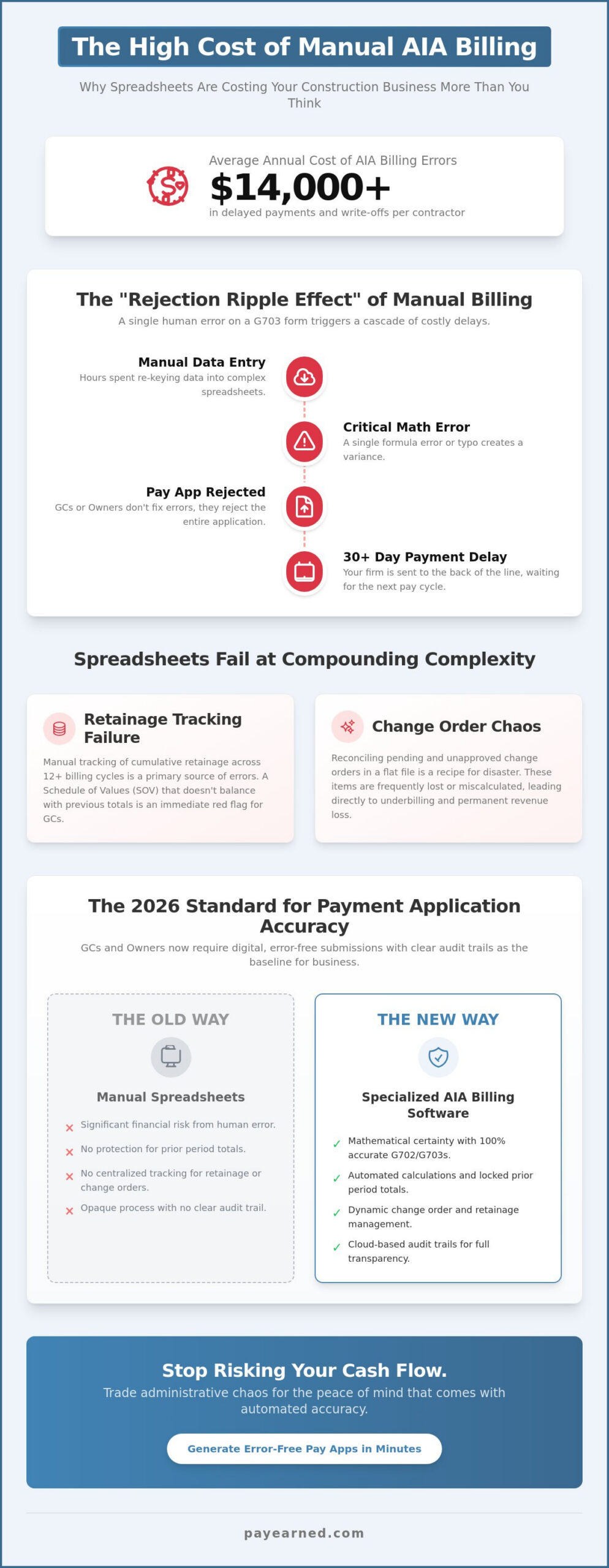
Did you know that AIA billing errors cost the average commercial contractor over $14,000 annually in delayed payments and write-offs? It’s a frustrating reality when a single math error on a G703 continuation sheet leads to a rejected pay app and another 30-day wait for funds. If you’re searching for aia billing software, you’ve likely spent hours re-keying change order data or struggling to track retainage across dozens of billing cycles. We understand the pressure of maintaining mathematical precision when your project liquidity is on the line.
Finding the right solution shouldn’t mean overhauling your entire accounting system or paying for heavy project management features you’ll never use. You can eliminate manual Excel errors and significantly accelerate your cash flow by moving to a specialized, automated system. This guide reviews the top-rated AIA-style billing platforms for 2026. We’ll focus on tools that deliver 100% accurate G702 and G703 documents, centralized retainage tracking, and the faster approval cycles your business requires to stay profitable. It’s time to trade administrative chaos for the peace of mind that comes with automated accuracy.
Key Takeaways
- Stop risking your cash flow on manual spreadsheets that trigger rejected pay apps and identify the hidden costs of human error in your current billing cycle.
- Master the core requirements of high-performance aia billing software, from automated G702/G703 generation to dynamic change order management.
- Navigate the difference between official forms and compliant AIA-style documents to optimize your administrative budget while maintaining professional standards.
- Evaluate whether your firm needs a complex ERP system or a specialized billing tool that focuses on speed and mathematical precision.
- Streamline your workflow with a dedicated platform designed to generate accurate payment certificates in minutes rather than hours.
The High Cost of Manual AIA Billing in 2026
Construction finance relies on standardization to maintain order across complex projects. The American Institute of Architects (AIA) established the framework for progress-based payments decades ago, creating a system that remains the industry benchmark. Today, G702 and G703 documents are the primary language of trust between contractors and owners. These forms ensure that every dollar requested is backed by completed work or stored materials. However, the method you use to generate these documents determines your financial stability in an increasingly digital market.
Relying on manual spreadsheets in 2026 is a significant liability for any commercial firm. A single formula error in a G703 continuation sheet creates a “rejection ripple effect.” When a General Contractor or Owner spots a math variance, they don’t just fix it for you. They reject the entire pay application. This forces your firm back to the start of the approval cycle, often delaying essential cash flow for thirty days or more. Implementing specialized aia billing software acts as a stabilizing force, replacing manual risk with mathematical certainty and project-wide transparency.
To see how automation transforms this workflow, review this brief demonstration:
Why Spreadsheets Fail at Retainage and Change Orders
Managing a project over twelve or more billing cycles introduces compounding complexity that basic spreadsheets aren’t designed to handle. Tracking cumulative retainage accurately across long durations requires rigorous data integrity. Manual entry often results in a Schedule of Values (SOV) that doesn’t balance with the previous period’s totals, triggering immediate red flags. Additionally, reconciling unapproved change orders in a flat file is a recipe for administrative disaster. Without a dynamic system, these pending items often get lost or miscalculated, leading to underbilling and direct revenue loss for the contractor.
The 2026 Standard for Payment Application Accuracy
General Contractors and Owners now demand digital, error-free submissions as the baseline for doing business. They require cloud-based audit trails that provide clear visibility into every project adjustment and retainage release. This transparency is vital for dispute resolution and long-term project health. For a deeper look at creating these documents correctly, read our mastering the payment application guide. Modern aia billing software ensures that your G702 and G703 documents meet these high standards every month, protecting your reputation and your bottom line.
Essential Features of Top-Tier AIA Billing Software
High-end aia billing software does more than just fill out digital forms. It acts as a central nervous system for project cash flow. While basic templates focus on the visual layout, professional-grade platforms prioritize data integrity and mathematical precision. These tools are built to handle the rigorous demands of commercial construction where accuracy is the only way to ensure liquidity.
One feature that distinguishes premium solutions from general tools is the inclusion of a specialized internal search engine. Project managers often need to retrieve historical data from previous billing cycles or archived projects to verify past trends. Instead of sifting through nested folders or massive spreadsheet workbooks, a built-in search tool provides instant access to every G703 line item and change order approval. This capability is essential for fast-paced environments where information retrieval shouldn’t be a bottleneck.
G702 and G703 Automation: The Core Engine
The core utility of any platform is the automated generation of the G702 summary and G703 continuation sheets. The system must auto-calculate work completed this period, materials presently stored, and the remaining balance to finish. Protecting “prior period” totals is equally critical. A common spreadsheet failure occurs when a user accidentally overwrites a cell from month three while working on month six. Professional solutions lock these historical figures to maintain a rigid audit trail. For a technical breakdown of these forms, refer to this G702 definitive reference guide.
Change Order Integration and Retainage Management
Dynamic change order integration is where top-tier software separates itself from basic templates. When a change order is approved, the software should automatically update the Schedule of Values (SOV) without requiring manual data re-entry. This automation prevents the mathematical imbalances that lead to rejected pay apps. Precision also extends to retainage management. Software helps you track the difference between “Retention” and “Retainage” accurately to protect your final profit margins. You can explore the nuances of this process in our comprehensive guide to retention.
This level of accuracy isn’t just about internal efficiency. It’s about compliance. Federal and private regulations, such as the Prompt Payment for Construction Contracts, mandate specific timelines and accuracy for payment requests. If your documentation is flawed, your right to prompt payment is compromised. Using specialized aia billing software ensures that every submission meets these legal and professional standards. If you’re ready to stop fighting with broken formulas, you can explore how specialized platforms automate these workflows.
AIA-Style vs. Official AIA Forms: Navigating Compliance
The term “AIA-style” often causes confusion among contractors. It refers to the specific layout and calculation logic of the G702 and G703 forms rather than the physical paper purchased from the institute. In 2026, most commercial contracts require the data to be presented in this standardized format to ensure uniformity across the project. Choosing aia billing software that generates these style-compliant documents provides a significant cost benefit. You avoid the high per-form fees of official paper while delivering the professional, mathematically sound documents that GCs and Owners expect.
The misconception that only “official” paper forms are valid is outdated. Modern construction law recognizes digital documents and electronic signatures as fully legally binding. Using automated software enhances document validity by creating a permanent, time-stamped record of every submission. This digital trail is far more defensible than a stack of physical papers that can be lost or altered. Cloud storage ensures these records are accessible for years, providing a secure foundation for any future audits or disputes. It’s about moving from a manual, error-prone method to a stabilizing, high-end automated solution.
Understanding the G702/G703 Layout Requirements
The G702 acts as the summary page, providing a high-level view of the contract sum, total completed to date, and the current payment due. The G703 provides the granular line-item detail, breaking down the Schedule of Values (SOV) into specific tasks and material costs. Consistency in this formatting is vital. When your administrative staff uses a standardized layout, it prevents the friction that occurs when reviewers have to hunt for data. For a deeper dive into these requirements, see our AIA billing software contractor guide. Precision in these documents signals deep domain expertise to your clients.
Security and Cloud Accessibility
Cloud-based solutions provide a distinct advantage over local software by enabling multi-user access from any location. Field managers can update progress percentages on-site, while office staff review the totals in real-time. This collaboration eliminates the lag time associated with emailing spreadsheets back and forth. Data integrity is further protected through role-based permissions. You can ensure that only authorized personnel can approve change orders or modify the SOV. This structure creates a high-end, automated environment that provides peace of mind for the entire project team. Reliability is the ultimate goal, and cloud accessibility delivers it without the bloat of unnecessary features.
How to Evaluate AIA Billing Solutions for Your Firm
Evaluating aia billing software requires a clear-eyed look at your firm’s actual administrative needs. Many contractors make the mistake of purchasing a full Enterprise Resource Planning (ERP) suite when their primary pain point is simply the monthly payment application. This “feature bloat” leads to high costs and wasted training hours. Focus on tools that solve the G702/G703 problem with mathematical precision first. Reliability in a specialized task is always more valuable than a dozen features you’ll never use.
A critical factor is the learning curve. You should be able to generate your first pay app in minutes, not weeks. Look for a “Built-in Search” feature as an evaluation baseline. This allows for the instant retrieval of previous draws, lien waivers, and historical project data without digging through old folders. Finally, prioritize the support model. When a deadline is looming and a calculation seems off, you need human-centric assistance. Real-time professional support beats a global ticketing system every time. In an industry where 82% of contractors report payment delays exceeding 30 days, you can’t afford to wait for a support ticket to be resolved.
Scalability and Project Volume
Reliable software must handle 5 projects as efficiently as 50. As your volume increases, the burden on your accounting staff should decrease through automated totals and consistent formatting. You shouldn’t be penalized for your success. Avoid platforms that charge “per-user” fees that punish your firm for growing. Instead, seek out solutions that allow your entire team to collaborate without inflating your monthly overhead. This ensures your administrative costs remain predictable even as your project list expands.
Integration and Financial Workflow
Decide whether you truly need a direct sync to your accounting software or if clean, professional PDF exports are sufficient. For many subcontractors, the priority is a compliant document that the GC will approve on the first try. A standalone pillar of any worthy system is robust Change Order Management. This functionality ensures that every project adjustment is captured and billed correctly, preventing revenue leakage. To understand the shifting landscape of these tools, explore the evolution of change order management.
Don’t let administrative complexity drain your project profits or delay your cash flow. If you’re ready to streamline your financial operations with a tool built for precision, start using the PAYearned platform today.
Why PAYearned is the Specialized Choice for 2026
The construction market in 2026 demands tools that excel at specific, high-stakes tasks rather than general-purpose platforms. PAYearned positions itself as a focused partner for contractors who need to master the G702/G703 workflow without the distraction of a full ERP suite. While competitors often push complex project management systems, this platform prioritizes the mathematical precision required for progress billing. It’s a stabilizing force that eliminates the administrative chaos of manual entry and ensures your financial liquidity remains protected. By focusing on one critical operation, the software provides a level of reliability that general tools simply can’t match.
Data retrieval is a common bottleneck in traditional workflows. PAYearned solves this with a proprietary search engine designed specifically for construction project data. You can instantly locate historical line items, previous retainage amounts, and approved change orders without sifting through archived spreadsheets. This level of system autonomy provides the relief of moving from outdated processes to a high-end, automated solution. Every calculation for totals, retainage, and progress billing is mathematically validated, providing the peace of mind that your submissions are accurate before they reach the GC’s desk.
The subscription model is designed for transparency and low-friction entry. Contractors don’t have to worry about hidden fees or complex licensing agreements that fluctuate with project size. Instead, you get a straightforward, professional tool that bridges the gap between complex accounting requirements and the reality of field operations. This pragmatic approach allows firms to scale their billing operations without increasing their administrative overhead. It’s an honest, upfront proposition for professionals who value stability and specialized knowledge over flashy, unnecessary features.
Purpose-Built for Subcontractors and GCs
PAYearned is a no-nonsense tool that respects your time and focuses on the utility of the software. You won’t find unnecessary fluff or unrelated modules here. Instead, you get a robust system for managing contractor pay apps that projects a persona of competence and precision. This specialization is backed by localized, human-centric assistance. In a digital market dominated by impersonal global platforms, having access to real-time professional support is a primary trust signal. It suggests a brand that’s grounded, accessible, and deeply invested in your firm’s success.
Getting Started: The Path to Faster Payments
The onboarding process is designed for maximum efficiency. You don’t need a weeks-long implementation phase or a dedicated IT team to get started. The platform’s logical flow guides you through project setup, allowing you to generate your first AIA-style G702 summary and G703 continuation sheet in minutes. This simplicity reduces the administrative burden on your staff and accelerates the entire approval cycle. Stop letting manual errors delay your revenue. Start your PAYearned subscription today and secure your firm’s cash flow with the industry’s most reliable aia billing software.
Secure Your Project Liquidity with Precision Billing
Managing construction payments in 2026 requires a shift from manual, error-prone spreadsheets to specialized, automated systems. We’ve explored how the high cost of billing errors and rejected pay apps can drain your firm’s profitability. By prioritizing mathematical precision and specialized functionality, you protect your project’s cash flow and maintain professional standards with every submission. The right aia billing software acts as a stabilizing force, providing the reliability you need to focus on the build rather than the paperwork.
PAYearned delivers this precision through automated G702 and G703 generation, integrated change order tracking, and a built-in project search engine for instant data retrieval. These features ensure that your documentation is always accurate, compliant, and ready for approval. You don’t have to settle for the bloat of an expensive ERP or the hazards of a broken Excel formula. It’s time to move toward a high-end solution that provides genuine peace of mind.
Streamline Your Billing with PAYearned Today and experience the relief of a professional, automated workflow. Your business deserves a partner that excels at the critical task of project finance. Take control of your progress billing and start getting paid faster.
Frequently Asked Questions
What is the difference between AIA G702 and G703?
The G702 is the summary document that serves as the official Application and Certificate for Payment. It provides a high level view of the contract sum, total completed to date, and the current payment due. The G703 is the continuation sheet that breaks down the project into specific line items. It provides the granular detail for the Schedule of Values, showing exactly where progress has occurred across different tasks or materials.
Does using AIA billing software require an accounting degree?
No, you don’t need an accounting degree to operate specialized aia billing software. These platforms are designed for project managers and administrative staff who understand construction workflows but want to avoid manual math. The software automates the complex calculations for retainage and progress billing. This ensures accuracy without requiring advanced financial training or the risk of broken spreadsheet formulas that lead to rejected pay apps.
Can I use AIA-style software instead of buying official paper forms?
Yes, you can use AIA-style software for the vast majority of commercial construction projects. Most General Contractors and Owners accept digital documents that mirror the layout and calculation logic of the standard G702 and G703. This approach eliminates the recurring cost of purchasing official paper forms. It provides identical professional results that meet industry standards for progress payments while maintaining a digital audit trail for your records.
How does AIA billing software handle retainage release?
The software automates retainage release by tracking the specific amounts withheld across every billing cycle. When you reach the project milestone for a release, the system calculates the precise dollar amount to be paid out and updates the G702 summary accordingly. This prevents the mathematical errors and tracking oversights that often occur when using manual spreadsheets for long term projects. It ensures your final profit is captured accurately.
Will this software integrate with my existing change order process?
Specialized aia billing software typically manages change orders as a core pillar of the billing workflow. When a change order is approved, you enter it into the system, and it automatically updates your Schedule of Values on the G703 continuation sheet. This ensures that your new line items are reflected in the current billing period correctly. You don’t have to re-key data into multiple files or worry about imbalances.
How do I calculate the ‘Work Completed’ percentage for a G703 continuation sheet?
You calculate the percentage by dividing the value of the work finished to date by the total scheduled value for that specific line item. The software simplifies this by allowing you to enter either the dollar amount or the percentage directly. It then auto-calculates the remaining balance and ensures the totals align with your G702 application summary page. This automation removes the risk of minor math variances that trigger rejections.
Is cloud-based billing software secure for sensitive construction financial data?
Cloud-based platforms provide robust security through encrypted data transmission and role-based access permissions. Unlike local spreadsheets that can be easily lost or shared via unsecure email, cloud systems maintain a permanent, time-stamped record of all transactions. This ensures that only authorized personnel can view or modify sensitive project totals. It protects your firm’s financial integrity while allowing for real-time collaboration between the field and the office.
Can I track stored materials on an AIA G702 form using software?
Yes, tracking stored materials is a standard feature in professional billing platforms. The software provides dedicated columns on the G703 continuation sheet to distinguish between work completed and materials currently stored on-site or in a bonded warehouse. These values are then automatically summarized on the G702 form. This ensures you’re billed accurately for all project assets while providing the transparency that Owners require for material payment approvals.
PAYearned is an agnostic workflow platform that helps teams manage pay applications
PAYearned is an independent software product and is not developed, endorsed, approved, sponsored or affiliated with the American Institute of Architects (AIA). AIA®, G702®, G703®