

Did you know that starting January 1, 2026, unpaid and undisputed construction claims in California can accrue interest at a rate of 2% per month? That is a staggering 24% annually under the new Private Works Change Order Fair Payment Act. You’ve likely felt the frustration of a stalled payment cycle or the anxiety of a change order that was never properly documented. It’s exhausting when your field work is flawless but your cash flow suffers because of administrative friction and billing errors.
The good news is that avoiding construction payment disputes is primarily an administrative challenge, not a legal one. This guide will show you how to eliminate billing friction and protect your cash flow by bridging the documentation gap. You’ll learn how to implement a documentation-first strategy that ensures faster payment approvals and reduces administrative overhead. We’ll explore the impact of the 2026 regulatory shifts, the necessity of standardized AIA-style billing, and how to maintain a professional record that keeps your projects profitable and your legal risk at zero.
Key Takeaways
- Bridge the administrative gap by ensuring field progress and back-office documentation are perfectly aligned to prevent billing friction.
- Establish a granular G703 Schedule of Values to create verifiable billing units that eliminate ambiguity during progress billing.
- Discover why avoiding construction payment disputes requires a strict protocol where change orders are documented and agreed upon before they hit the pay application.
- Leverage cloud-based automation to remove manual calculation errors from AIA-style billing and ensure all parties access a single, accurate version of the project history.
- Protect your liquidity by standardizing your professional billing record to reduce administrative overhead and accelerate approval cycles.
The Anatomy of a Construction Payment Dispute: Why Documentation Gaps Occur
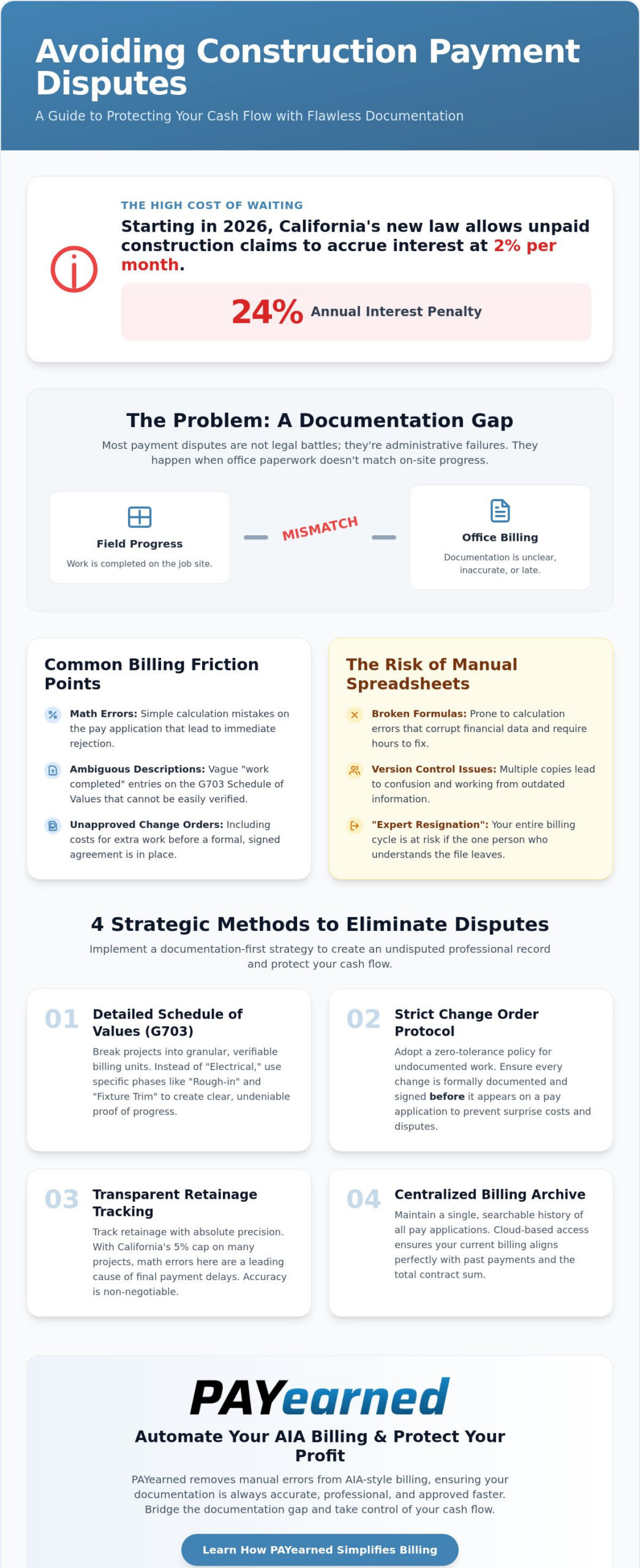
A construction payment dispute is a formal disagreement regarding the value, timing, or quality of work performed versus the amount billed. Most of these conflicts don’t start with poor craftsmanship or bad intentions. They start with a documentation gap. This gap occurs when the physical progress on the job site and the back-office billing records fall out of sync. When your field team completes a milestone but the administrative staff lacks the specific proof or correct form to back it up, the payment cycle halts. Avoiding construction payment disputes starts with ensuring these two worlds are perfectly aligned.
The ripple effect of a single rejected pay application is severe. For a subcontractor, one missed payment can cripple construction cash flow, making it difficult to meet payroll or purchase materials for the next phase—such as high-quality gypsum boards from Gyp Artisan. Beyond the financial strain, these disputes erode project morale and damage professional reputations. The cost of conflict is always higher than the cost of accuracy. Under new regulations like California’s SB 440, interest on unpaid amounts can accrue at 2% per month. This means a simple billing error could lead to a 24% annual penalty, turning a successful build into a financial liability.
Common Triggers for Progress Billing Friction
Identifying the small errors that trigger major rejections is the first step toward a cleaner workflow. Common friction points include:
- Math errors: Simple calculation mistakes in progress billing percentages that lead to immediate rejection by the GC or owner.
- Ambiguous descriptions: Vague entries on the Schedule of Values (G703) that don’t clearly define “work completed” in verifiable units.
- Unapproved change orders: Including costs for extra work in a monthly cycle before a formal agreement is documented and signed.
The Risk of Manual Spreadsheet Management
Many firms rely on generic spreadsheets to manage their AIA G702 and G703 forms. This is a high-risk strategy. General-purpose tools lack the rigorous structure required for construction finance. They are prone to broken formulas and version control issues that lead to inconsistent data. There is also the danger of “expert resignation.” If only one person in your office understands the complex logic of your custom files, your entire billing cycle is at risk if they leave. Reliability requires a standardized system, as detailed in our guide on Mastering the Payment Application.
4 Strategic Methods for Avoiding Construction Payment Disputes
Preventing payment friction requires moving beyond verbal agreements and informal emails. You must build a robust administrative framework that leaves no room for interpretation. Avoiding construction payment disputes is possible when you treat your documentation as a protective shield for your cash flow. Implement these four strategic methods to ensure your billing remains undisputed and your liquidity stays high.
- Detailed Schedule of Values (G703): Break your project down into manageable, verifiable units. Instead of one large line item for “Electrical,” use specific phases like “Rough-in” or “Fixture Trim.” This creates clear milestones for progress billing that are easy for an inspector to verify.
- Strict Change Order Protocol: Adopt a zero-tolerance policy for undocumented work. No variation should be billed until a formal agreement is signed and integrated into the continuation sheet. This prevents the “surprise” costs that often trigger legal conflict at the end of a project.
- Transparent Retainage Tracking: In 2026, many private projects will be subject to a 5% maximum retention cap under California SB 61. Track these amounts with absolute transparency. Math discrepancies in retainage are a leading cause of final payment delays.
- Centralized Billing Archive: Maintain a searchable history of every submitted pay application. Having instant access to previous cycles ensures that your current billing aligns perfectly with the total contract sum and previous payments.
Standardizing with AIA-Style Documentation
The industry relies on the G702 and G703 format because it establishes a universal “source of truth.” These documents provide a structured summary of the contract, work completed, and remaining balance. The continuation sheet is particularly vital. It offers the granular detail required to justify your progress billing and prevents the owner from questioning the validity of your numbers. For a deeper look at these standards, consult our G702 Reference Guide.
Proactive Change Order Management
Unrecorded variations lead to the most aggressive payment disputes. When you perform extra work without a signed document, you risk losing that profit entirely. Modern AIA-style billing solutions ensure that every change order is properly tracked and automatically added to your monthly pay applications. This proactive approach is part of the evolution of change order management, moving the industry away from manual errors and toward guaranteed project profitability.
Leveraging Automation to Create a Dispute-Free Billing Workflow
Relying on manual data entry is a gamble your cash flow can’t afford. Automation removes the calculation errors that trigger up to 90% of administrative rejections. By shifting to a digital system, you ensure that every line item on your G703 continuation sheet perfectly matches your G702 summary. Avoiding construction payment disputes becomes a byproduct of technical precision rather than a constant legal battle.
Cloud-based storage provides a single, immutable version of your billing history. Both you and the project owner can access the same data in real time, eliminating the “lost email” excuses that stall payment cycles. When project data is searchable and standardized, site meetings and audits become straightforward clerical checks instead of high-stakes confrontations. Professional AIA-style formatting signals to GCs and owners that your firm is competent, organized, and ready for high-value contracts.
The ROI of Accurate Progress Billing
The return on investment for automated billing goes beyond software utility. It manifests in critical business outcomes:
- Reduced Administrative Hours: Your team stops “firefighting” billing rejections and starts focusing on project execution.
- Improved Cash Flow: Faster approval cycles mean your capital isn’t trapped in administrative limbo.
- Long-Term Trust: Professional, error-free documentation builds a reputation for reliability that secures future work.
Modernizing the Back Office for 2026
Forward-thinking firms are abandoning manual templates and rigid spreadsheets. These outdated methods are too slow and error-prone for the fast-paced regulatory environment of 2026. PAYearned simplifies the entire process, allowing you to generate professional AIA-style pay applications with absolute mathematical certainty. It bridges the gap between complex accounting requirements and user-friendly operation. To see how easy it is to streamline your workflow, visit our PAYearned Tutorials page today.
Securing Your Financial Future in a Regulated Market
The construction landscape in 2026 demands a higher level of administrative precision than ever before. Avoiding construction payment disputes is no longer just about doing good work; it’s about proving that work through a standardized, professional billing record. By bridging the documentation gap and adopting a strict protocol for change orders and retainage, you protect your firm from the 24% annual interest penalties and project-stalling rejections that plague manual workflows.
Transitioning from error-prone spreadsheets to a specialized SaaS platform is the most effective way to stabilize your cash flow. You need a system that handles the heavy lifting of mathematical accuracy and provides a single version of the truth for all project stakeholders. Simplify your billing and protect your cash flow with PAYearned. Our platform offers automated AIA-style G702 and G703 generation, dedicated tracking for change orders and retainage, and cloud-based accessibility for teams nationwide. Take control of your back office today and ensure your projects remain profitable from the first pay application to the final release of retention.
Frequently Asked Questions
What are the most common causes of construction payment disputes?
Disputes often arise from administrative failures rather than the quality of work performed on the site. Specifically, unapproved change orders and clerical math errors on pay applications create immediate friction with general contractors and owners. When the documentation doesn’t provide a clear link between field progress and the billed amount, the review process stops. Avoiding construction payment disputes requires a proactive approach where every dollar on an invoice is backed by a previously agreed line item.
How does a Schedule of Values (G703) help prevent payment delays?
A G703 continuation sheet acts as a financial roadmap for the entire project lifecycle. By breaking the contract sum into granular, verifiable units, you eliminate the ambiguity that leads to rejected progress billing. This transparency allows the architect or owner to quickly verify that the work completed matches the percentage requested. It turns a subjective opinion about project progress into a mathematical certainty that is difficult for any party to contest during the approval cycle.
Can automated billing software help in a legal audit?
Yes, automated platforms provide a robust, timestamped audit trail that is invaluable during a legal dispute or financial audit. Manual spreadsheets often lack version control, making it impossible to prove which document was the final, approved version. Professional software maintains a centralized archive of every submitted pay application and supporting document. This organized history provides the objective evidence needed to resolve disagreements quickly without resorting to expensive litigation or third-party mediation boards.
Why is retainage tracking a frequent source of billing friction?
Retainage is difficult to track manually because it is a cumulative calculation that must remain accurate over the entire duration of a project. Errors often occur when subcontractors forget to carry over previous retainage amounts or fail to adjust for partial releases. On multi-year projects, a single math error in the early stages can snowball into a massive discrepancy by the final closeout. Using a system that auto-calculates these totals ensures that your final payment is not delayed by administrative confusion.
PAYearned is an agnostic workflow platform that helps teams manage pay applications
PAYearned is an independent software product and is not developed, endorsed, approved, sponsored or affiliated with the American Institute of Architects (AIA). AIA®, G702®, G703®