

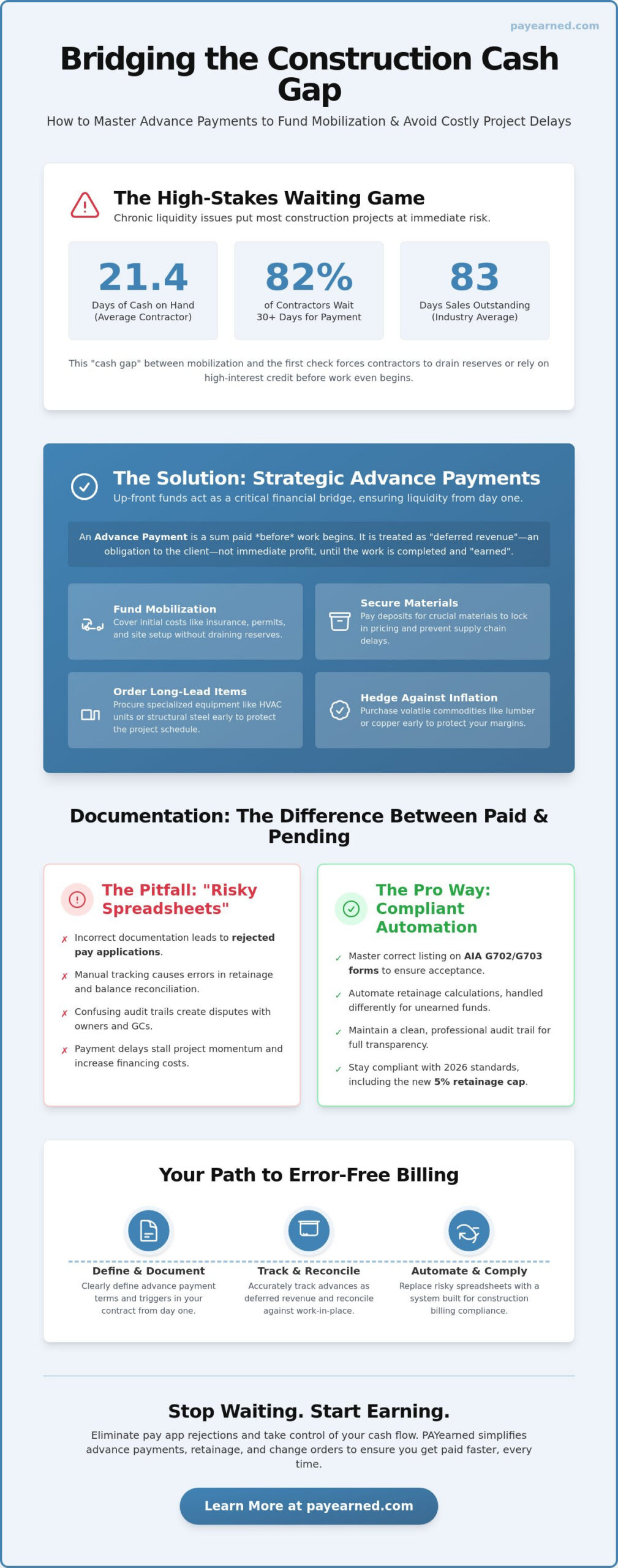
The average construction contractor operates with only 21.4 days of cash on hand, making the period between groundbreaking and the first check a high-stakes waiting game. Securing an advance payment is the most effective way to fund mobilization and material deposits without draining your reserves. However, an incorrectly documented advance is a fast track to a rejected pay app and a stalled project.
You know that maintaining a healthy cash flow is the difference between a profitable job and a financial crisis. It’s frustrating when administrative errors or “risky spreadsheets” cause delays, especially when 82% of contractors are already waiting 30 days or more for payment. This guide shows you how to define, document, and manage these up-front funds to improve your liquidity while staying compliant with 2026 standards. You’ll learn how to secure your funding, maintain a professional audit trail, and ensure your AIA-style G702 and G703 forms are error-free from day one.
Key Takeaways
- Learn how to leverage an advance payment to bridge the “cash gap” between project mobilization and your first progress check.
- Discover why retainage is handled differently for unearned funds compared to standard “work in place” billing to keep your audit trail clean.
- Master the correct way to list mobilization costs on AIA-style G703 continuation sheets to avoid common pay app rejections.
- Simplify your financial tracking by replacing risky spreadsheets with automated tools that handle retainage and change orders.
- Stay compliant with 2026 regulations, including the new 5% retainage cap, while ensuring your up-front billing is fully documented.
What is an Advance Payment? Defining Up-Front Capital in Construction
An advance payment is a sum of money paid to a contractor before work begins or any services are rendered on a project. In construction, an advance payment is a contractual tool for managing the high-risk financial burden of project starts. While these funds provide immediate liquidity, you shouldn’t view them as immediate profit. Until the work is “earned” through physical progress on-site, these funds remain an obligation to the owner, not a realized gain for the contractor. You must track these funds with precision to ensure your future pay apps reflect the correct balance and maintain your billing compliance.
To better understand this concept and how these payments are secured in the industry, watch this helpful video:
The Legal and Accounting Basis
Accountants treat an advance payment as “deferred revenue” on a contractor’s balance sheet. This classification acknowledges that while the cash is in your bank account, you still owe the client the equivalent value in labor or materials. Your construction contract acts as the governing document. It defines the specific “trigger” for the payment, such as a notice to proceed or the execution of a purchase order. You must also clarify the status of the funds; a refundable deposit carries different legal weight than a non-refundable advance intended to cover immediate mobilization expenses. Clear documentation prevents disputes when it’s time to reconcile the advance against future progress billings on your continuation sheets.
Common Advance Payment Scenarios in 2026
The 2026 construction market demands proactive financial planning. Contractors use up-front funds to secure long-lead items like specialized HVAC units or structural steel, where delivery schedules can impact the entire project timeline. For large-scale national infrastructure projects, mobilization costs for heavy equipment and temporary site facilities often require significant capital before the first shovel hits the dirt. Advances also provide a hedge against inflation. By using these funds to purchase materials early, you lock in pricing for volatile commodities like copper or lumber. This protects your estimated margins and ensures your cash flow remains predictable throughout the project lifecycle.
Why Contractors Require Advance Payments: Risk and Cash Flow
The construction industry faces a chronic liquidity crisis. With an average Days Sales Outstanding (DSO) of 83 days, most contractors are forced to finance project starts out of their own pockets. An advance payment serves as a critical bridge over this “cash gap.” It ensures that mobilization, which often requires significant up-front capital for insurance, permits, and site setup, doesn’t deplete your operating reserves before the first progress billing is even submitted. This financial cushion is essential for maintaining a steady workflow during the most volatile phase of the project.
For subcontractors, the pressure is even more acute. You typically pay your labor force weekly, yet you might wait months to see a return on those man-hours. Securing up-front capital acts as a “gating event.” It establishes a clear boundary: work commences only after the project’s financial foundation is secure. This protects the project schedule by ensuring that essential materials are on-site exactly when needed. It prevents the costly delays that occur when a contractor’s credit limit is maxed out at the supply house, keeping the job moving without interruption.
Mitigating Financial Exposure
Using an advance reduces your reliance on high-interest lines of credit, which is vital in a fluctuating economic environment. It also provides the project owner with “skin in the game,” fostering a more collaborative relationship where both parties are financially invested from day one. When managing these funds, you must follow established standards like the Federal Acquisition Regulation on Contract Financing, which outlines how these payments should be structured to protect both the owner and the contractor. Relying on a “risky spreadsheet” to track these balances is a recipe for disaster. Using automated billing software ensures your calculations remain accurate and compliant with your contract terms.
Mobilization vs. Profit
It’s a dangerous mistake to treat an advance payment as immediate profit. These funds are specifically allocated to startup costs and liabilities. If you spend this capital on overhead or other projects, you risk a “cash crunch” later in the job when you’ve already “spent” the money you’re supposed to be earning through progress. Maintaining a strict audit trail for every dollar is non-negotiable. You need to show exactly how the advance is being applied to mobilization and materials to satisfy project auditors. This discipline prevents the administrative chaos that often leads to rejected pay apps and strained relations with the general contractor or owner.
Advance Payments vs. Progress Billing: Key Differences for Subcontractors
The primary distinction between these two billing methods lies in the timing of the “earning” process. An advance payment is technically unearned revenue. It’s capital provided before you’ve performed the labor or installed the materials. In contrast, progress billing is strictly based on “work in place,” representing the value of the project you’ve physically completed. While progress billing follows the percentage-of-completion method, an advance is a lump-sum injection designed to kickstart your operations without the typical 83-day wait for industry-standard payment cycles.
Retainage treatment also differs significantly between these two types. Under 2026 regulations like California Civil Code § 8811, which caps retainage at 5%, owners typically withhold this percentage from progress billings to ensure project completion. However, an advance payment is usually paid out in full. Since no work has been “completed” yet, there’s no basis for withholding retainage. This provides you with 100% of the requested mobilization capital immediately, rather than having a portion of your startup funds locked away until the final punch list.
The Stored Materials Distinction
Many contractors confuse mobilization advances with payments for stored materials, but they require different documentation on your continuation sheets. Payments for materials stored on-site or in a bonded warehouse are based on physical inventory. To bill for these on a G703, you must provide proof of purchase, insurance certificates, and sometimes a bill of sale. An advance is more flexible, often covering broader “soft costs” like project management setup or temporary site utilities that don’t result in a physical product sitting in a warehouse. You must categorize these correctly to satisfy project auditors and avoid double-billing when those materials are eventually installed.
Recoupment Strategies
You don’t simply keep an advance in addition to your full contract draws; you must “pay it back” through a process called recoupment. There are two primary ways to handle this. The pro-rata method deducts a set percentage from every subsequent pay application until the advance is zeroed out. For example, if you received a 10% advance, you might reduce every future invoice by 10%. Alternatively, the lump-sum method applies the entire advance against your first few progress billings until the balance is exhausted. Whichever method you choose, your Schedule of Values must clearly show these deductions to maintain a professional audit trail and keep your cash flow predictable.
How to Document Advance Payments on AIA-Style G702 and G703 Forms
Documenting an advance payment requires more than just adding a lump sum to your total. You must integrate it into your Schedule of Values (SOV) to maintain a transparent, professional audit trail. This prevents the administrative friction that leads to rejected pay apps and delayed funding. Properly identifying the advance ensures that both the owner and the architect understand exactly how the capital is being allocated and recouped as the project moves forward.
Updating the Schedule of Values (G703)
On the G703 continuation sheet, you should create a dedicated line item titled “Mobilization” or “Project Advance.” Assign this item a fixed contractual value. As you execute the work, you’ll move values from this line item into specific “Work in Place” categories. This prevents you from double-billing for the same scope of work. It also provides a clear record of how the up-front capital is being “earned” over time. For a deeper look at form structure and line-item management, consult our G702 Definitive Reference Guide.
Handling Retainage and Advances
Most contracts treat the advance line item as exempt from standard retainage. If your project follows the 5% cap established for 2026 California private works, that percentage usually only applies to earned progress billings. Applying retainage to an advance is counterproductive; it defeats the purpose of providing the contractor with immediate mobilization capital. You must communicate clearly with the Architect or Owner about this distinction to ensure the “Total Completed and Stored to Date” remains accurate. Check our guide on what is retention to see how these specific calculations impact your bottom line.
The G702 summary page must reflect the total value of work completed, including the portion of the advance payment that has been earned. However, the “current payment due” calculation must account for the funds you’ve already received. This prevents overpayment while keeping your project totals aligned with the contract. Precision here is vital for a smooth closeout phase, as it eliminates disputes over remaining balances. Stop struggling with manual calculations and generate error-free pay applications using a specialized platform built for construction professionals.
Streamlining Construction Billing with PAYearned
Managing an advance payment on a project with a 24% annual interest rate for late payments leaves zero room for administrative error. Manual processes and “risky spreadsheets” often lead to math mistakes that stall your funding and damage your professional reputation. PAYearned replaces these outdated methods with a cloud-based, searchable platform built exclusively for construction pay applications. It provides the professional, compliant audit trail you need to justify up-front capital to owners who are increasingly cautious about project liquidity. By centralizing your documentation, you eliminate the chaos of hunting through folders for past continuation sheets or change order approvals.
Error-Free Calculations for Complex Billing
Our platform auto-calculates totals across your G703 continuation sheets, ensuring every deduction for an advance payment is mathematically sound. This automation significantly reduces the risk of pay app rejection, a critical benefit when the industry-standard Days Sales Outstanding (DSO) remains at a staggering 83 days. You can track “unbilled retainage” alongside your advances to maintain a complete, real-time picture of your project’s financial health. This level of transparency builds trust with project owners and architects alike. Discover the steps to get your AIA billing software paid and functional using our specialized platform.
Live US-Based Support for Your Toughest Billing Questions
General-purpose accounting tools weren’t built to handle the nuances of AIA-style G702 and G703 forms. They often lack the specific fields needed for complex recoupment or the ability to track change orders that haven’t yet been fully executed. When you’re navigating these high-stakes financial waters, you need more than a generic help article. PAYearned provides live, US-based support to help you resolve your toughest billing questions with a steady, expert hand. This specialized focus ensures your documentation remains professional, your calculations stay error-free, and your cash flow stays predictable. Simplify your construction billing with a PAYearned subscription today.
Secure Your Project Capital and Simplify Your Compliance
Managing your project’s financial foundation requires more than just a signed contract. You now have the tools to distinguish a contractual advance payment from standard progress billing. By implementing a clear recoupment strategy on your continuation sheets, you ensure your cash flow remains steady while meeting 2026 compliance standards. Professional documentation is your best defense against skeptical owners and administrative delays. It transforms a potential liability into a strategic mobilization tool that protects your project’s timeline and your bottom line.
Don’t let manual calculation errors or “risky spreadsheets” jeopardize your next funding cycle. Our platform provides the precision and reliability that general-purpose accounting tools simply can’t match. Start generating error-free G702 and G703 documents with PAYearned today. Because our solution is built exclusively for Pay Applications, you get specialized features and live, US-based support tailored to your unique workflow. It’s easy to get started since there’s no credit card required to begin your first application. Take control of your project billing and ensure your next mobilization is as profitable as it is efficient.
Frequently Asked Questions
Is an advance payment the same as a deposit in construction?
No, they are legally and functionally distinct. A deposit usually secures specific materials or a spot on a subcontractor’s schedule. An advance payment is a contractual tool that provides broad mobilization capital to be recouped against future progress billings. Deposits are often tied to purchase agreements, whereas an advance is an obligation that you must earn through physical project performance.
How do I reflect an advance payment on an AIA G702 form?
You reflect it by creating a dedicated line item on the G703 continuation sheet titled “Mobilization” or “Contract Advance.” On the G702 summary page, the “Total Completed and Stored to Date” will include this value. You must deduct the previously received amount to calculate the current payment due correctly. Using automated software prevents the common math errors associated with these manual adjustments on the summary sheet.
Can an owner refuse to pay an advance even if it is in the contract?
An owner cannot legally refuse payment if you’ve met the specific contractual triggers, such as submitting a bond or insurance certificate. However, 82% of contractors report waiting 30 days or more for payment due to administrative disputes. If the owner claims your documentation is insufficient or incorrectly formatted, they may withhold funds until the pay app is corrected. Professional documentation is your best defense against these delays.
Do I have to pay taxes on an advance payment immediately?
Tax treatment depends on whether your business uses the cash or accrual accounting method. Under the accrual method, you might defer taxes until the work is earned or the tax year ends. Because tax laws are complex and vary by jurisdiction, you should consult a certified professional to determine how these funds affect your specific 2026 tax liability. This ensures your cash flow remains predictable after tax obligations are met.
What happens to the advance payment if the project is cancelled?
If a project is cancelled, you are typically required to return the unearned portion of the funds. Your contract should specify that you can retain a portion to cover costs already incurred, such as non-refundable material deposits or mobilization labor. Failing to include a clear termination clause can lead to legal disputes over the remaining balance. Maintaining a clean audit trail makes this reconciliation process much faster.
Is retainage typically withheld from an advance payment?
Retainage is rarely withheld from an advance payment. Since no physical work has been completed, there is no earned amount to retain. Under 2026 regulations like California Civil Code § 8811, the 5% retainage cap applies to progress payments for work in place. Applying retainage to mobilization funds defeats the purpose of providing up-front capital, as it restricts the very liquidity the payment was intended to provide.
How does an advance payment affect my bonding capacity?
It can temporarily decrease your bonding capacity because sureties view unearned advances as a liability on your balance sheet. However, the increased cash on hand improves your liquidity ratios, which is a positive signal to most bond producers. Most sureties look for a strong current ratio to approve larger projects. A well-managed advance helps you maintain this financial balance during the high-risk mobilization phase of a new contract.
PAYearned is an agnostic workflow platform that helps teams manage pay applications
PAYearned is an independent software product and is not developed, endorsed, approved, sponsored or affiliated with the American Institute of Architects (AIA). AIA®, G702®, G703®