
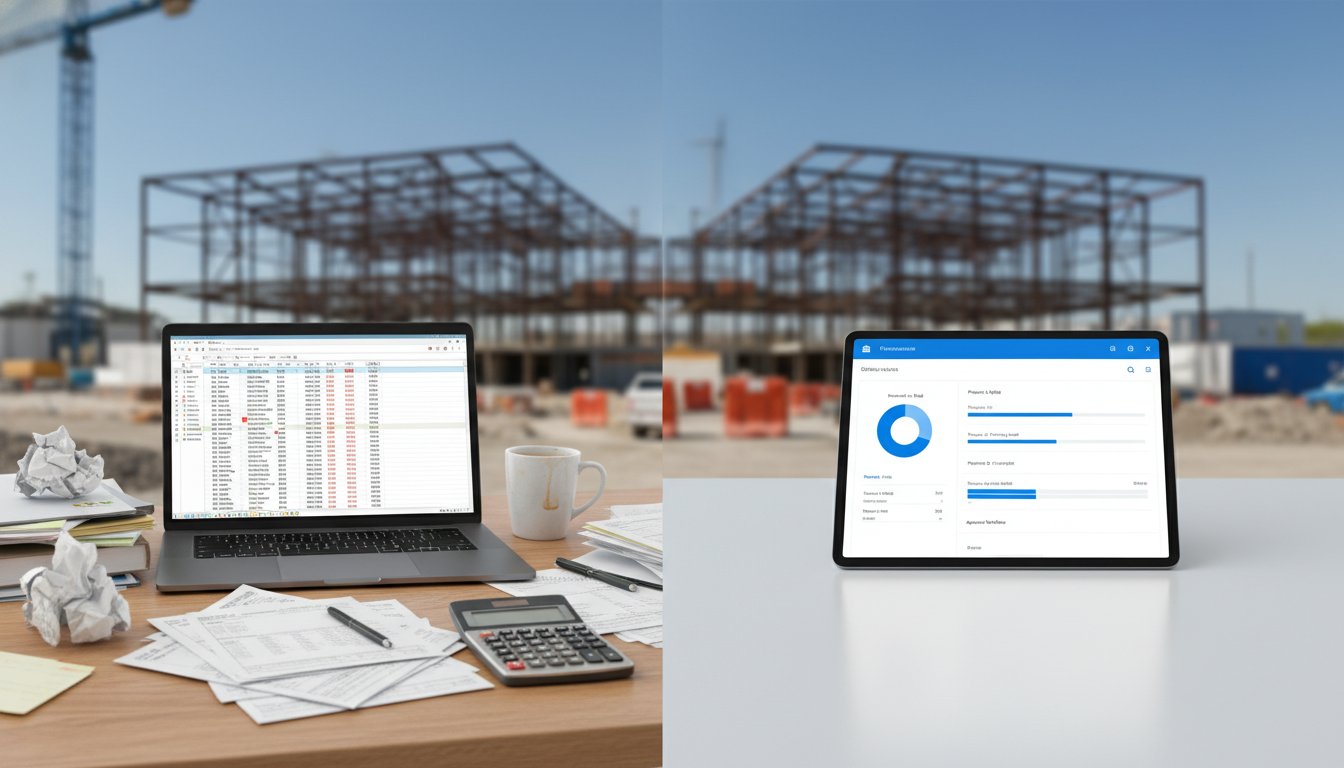
Relying on a free spreadsheet for your progress billing isn’t a cost-saving measure anymore. It’s a financial liability. You’ve likely felt the sting of a rejected pay application because of a single rounding error or a miscalculated retainage line. These manual mistakes do more than just create extra paperwork; they stall your cash flow and strain your professional reputation. If you’re still using a static aia billing template to manage complex commercial projects in 2026, you’re fighting a losing battle against administrative friction.
We understand that accuracy is the only thing that matters when it’s time to get paid. You need a system that handles the heavy lifting of G702 and G703 document generation without the constant risk of human error. This article breaks down the critical differences between manual Excel sheets and automated software solutions. You’ll discover how to achieve faster payment approvals, maintain zero mathematical errors, and stay compliant with new regulations like California’s 5% retainage cap. It’s time to move beyond the limitations of basic templates and embrace a streamlined, professional approach to your project finance.
Key Takeaways
- Master the fundamentals of the G702 Summary and G703 Continuation Sheet to ensure your progress billing meets strict industry standards.
- Evaluate the true cost of a manual aia billing template by identifying how broken formulas and administrative errors delay your project funding.
- Transition from static spreadsheets to dynamic SaaS solutions to automate complex math and eliminate the risk of rejected payment applications.
- Simplify change order management and retainage tracking across multiple billing cycles with a system built for mathematical precision.
- Learn why specialized billing software provides a higher return on investment than general-purpose accounting tools or one-time PDF purchases.
What is an AIA Billing Template? G702 and G703 Basics
An aia billing template is a standardized two-part system used to facilitate progress payments in the construction industry. This framework, developed by the American Institute of Architects (AIA), provides a uniform language for financial transparency between general contractors, subcontractors, architects, and owners. By using these documents, all parties can track the percentage of work completed against the total contract value, ensuring that payments remain proportional to actual project progress.
To better understand the mechanics of these forms, watch this helpful video breakdown:
While these forms are the industry gold standard, many contractors fall into the “Manual Trap.” Relying on static Excel templates often leads to math-error rejections. When an architect spots a single calculation discrepancy in your retainage or total completed work, the entire application is typically sent back. This stalls your cash flow and creates unnecessary administrative friction during critical project phases.
The Anatomy of G702: Application and Certificate for Payment
The G702 serves as the high-level summary. It includes critical header information, contract totals, and the “Summary of Work” section. This page tracks the original contract sum, net changes from change orders, and the total amount earned to date. It concludes with the architect’s certification. Consistency in layout is vital. Any deviation from the expected format can trigger immediate scrutiny and potential rejection by the project owner’s financial team.
The Anatomy of G703: The Continuation Sheet
The G703 is the engine that drives the G702. It details the Schedule of Values (SOV), breaking the project down into specific line items. Each row represents a different task or material, with columns dedicated to work completed in previous periods, work completed this period, and materials presently stored. These granular details feed directly into the G702 totals. Accurate tracking here is essential for managing complex billing cycles without losing sight of your project’s financial health.
AIA Billing Template vs. Automated Software: A 2026 Comparison
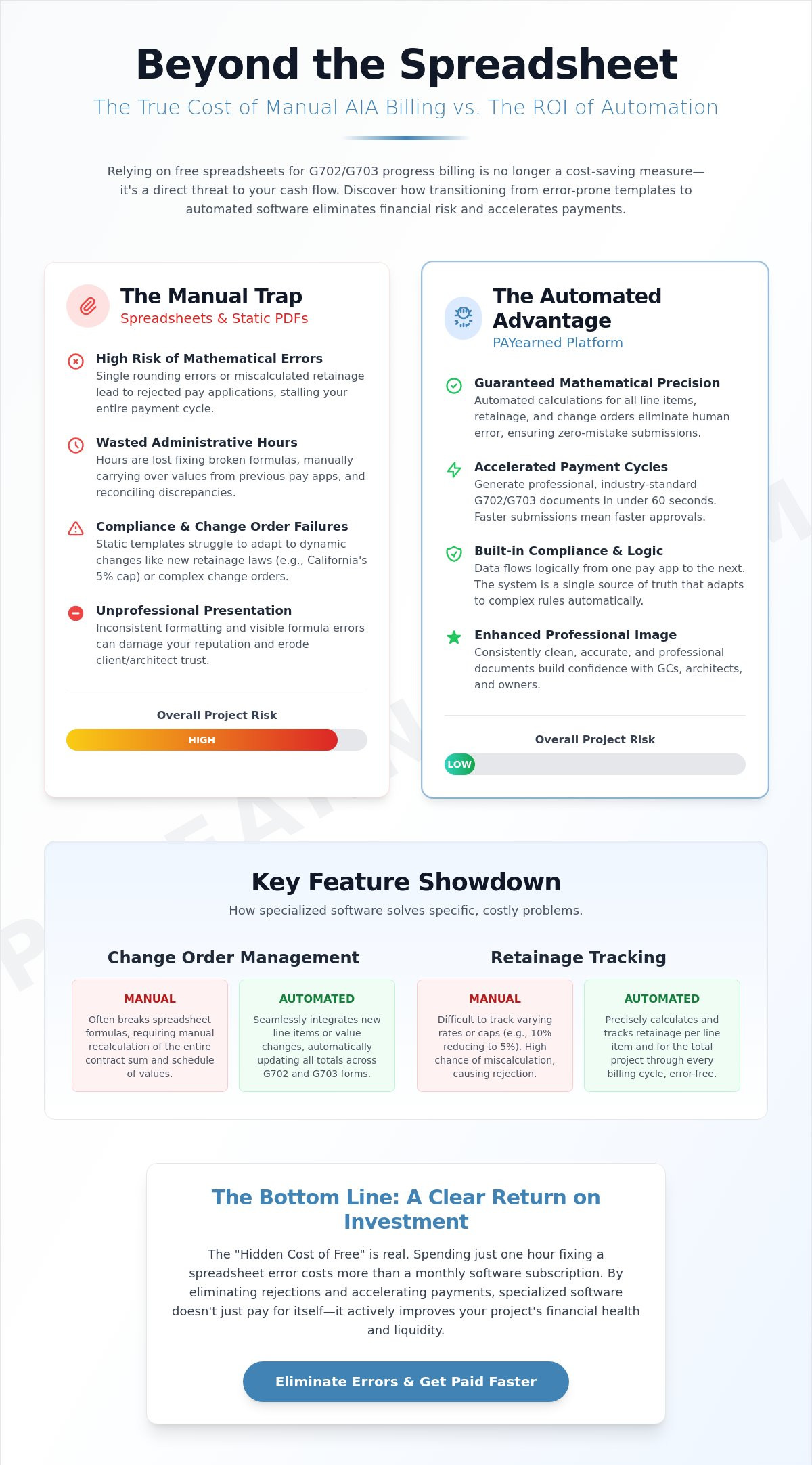
Choosing an aia billing template usually involves three distinct paths: buying one-time official PDFs, using a manual Excel sheet, or implementing specialized SaaS. Each choice impacts your administrative overhead and cash flow differently. While official PDFs provide a standard look, their static nature makes them difficult to update. Excel templates are common but dangerous. The “Hidden Cost of Free” is a real threat to your bottom line. Spending just one hour fixing a broken formula or reconciling a rounding error in a manual aia billing template costs more than a professional subscription.
Data integrity is the primary victim of manual processes. The manual carry-over of values from Pay App #1 to Pay App #2 is a major failure point. If your previous totals are wrong, your current application will be rejected. Automated software ensures that your data flows logically from one cycle to the next without human intervention. This results in a cleaner, more professional document that instills confidence in architects and owners. Precision isn’t a luxury. It’s a requirement for maintaining liquidity.
The Limitations of Excel and Word Templates
Spreadsheets struggle with the dynamic nature of construction finance. For example, manual templates often fail when tracking retainage shifts, such as the 5% cap mandated by California’s SB 61 for private projects. Change orders also present a challenge; they frequently break standard formulas, leading to mathematical discrepancies that delay your payment. You can find more data on these risks in our AIA billing software vs. Excel comparison.
The Benefits of Moving to Dedicated Billing Software
Specialized software provides a single source of truth for every project. It eliminates the need to cross-reference multiple files or hunt for the most recent version of a continuation sheet. You can generate a G702 style form in under 60 seconds, allowing your team to focus on project execution rather than data entry. This efficiency translates directly into faster approvals and more predictable cash flow. Automated systems handle the complex math of retainage and cumulative totals, providing peace of mind that your billing is accurate every time.
Why PAYearned is the Best Alternative to a Manual AIA Template
PAYearned functions as a specialized partner for your firm, focusing exclusively on the critical task of construction billing. Unlike over-engineered project management suites that carry high price tags and steep learning curves, our platform does one thing perfectly: it generates accurate payment applications. It replaces the outdated aia billing template with a dynamic, automated math engine. This system handles complex cumulative totals and retainage calculations without requiring a single manual entry from your team.
Reliability is built into the core of the software. A centralized search engine allows you to retrieve any past pay application instantly, eliminating the need to dig through folders of old Excel files. Because the platform is cloud-based, you can manage your billing from the job site or the office with equal ease. This mobility ensures that your administrative workflow never stalls, regardless of where your project team is located.
Advanced Change Order and Retainage Management
Handling modifications to the contract sum shouldn’t break your billing cycle. PAYearned integrates change orders directly into your Schedule of Values (G703), ensuring that every dollar is accounted for from the moment it is approved. Understanding the importance of error-free payment applications is vital for maintaining steady cash flow and professional credibility. Precise retainage tracking serves as the ultimate safeguard for protecting your project profit at the end of the job.
Getting Started: From Template to Automation
Setup is designed to be low-friction and transparent. We don’t require long-term contracts or massive implementation phases that disrupt your daily operations. You can begin generating professional, AIA-style documents that are widely accepted by architects and owners across the industry immediately. It is time to secure your financial liquidity and eliminate the hazards of manual data entry. Stop fighting with Excel and start billing with PAYearned today.
Protect Your Profit with Automated Precision
The construction industry requires absolute mathematical precision. Relying on a static aia billing template is a risk that often results in stalled cash flow and administrative rework. You now understand the critical difference between the manual trap of spreadsheets and the security of a dynamic billing engine. Transitioning to an automated system ensures your G702 and G703 documents meet the highest industry standards every single time.
PAYearned has focused on construction financial technology since 2020. Contractors nationwide trust our platform for reliable document generation that prioritizes 100% mathematical accuracy. We strip away the bloat of general project management software to provide a specialized tool that does one thing perfectly: it gets you paid faster. It is time to replace your outdated spreadsheets with a high-end solution that provides real peace of mind.
Generate Your First AIA-Style Pay App for Free with PAYearned
Take the first step toward streamlined billing and secure your project liquidity today. Your team deserves a system that works as hard as they do on the job site.
Frequently Asked Questions
Is an AIA billing template the same as a G702 form?
An aia billing template typically refers to the combined system of the G702 Application and Certificate for Payment and the G703 Continuation Sheet. While the terms are often used interchangeably, the G702 is specifically the one-page summary and certification document. The G703 provides the essential backup data through the Schedule of Values. Using only the G702 without its accompanying G703 is insufficient for most commercial progress billing requirements.
Can I use a free Excel AIA template for commercial projects?
You can use a free Excel spreadsheet, but doing so introduces significant risk to your project’s financial liquidity. Manual templates lack the automated guardrails necessary to prevent rounding errors and formula breaks that lead to rejected pay apps. Many architects and owners scrutinize manual submissions more heavily because they are prone to inaccuracies. Automated software is a safer alternative that ensures your calculations remain consistent across every billing cycle.
What is the difference between an AIA template and a payment application?
An AIA template is the standardized document format used to present financial data, while a payment application is the actual request for funds submitted by a contractor. The pay app includes the completed forms, lien waivers, and any required supporting receipts or photos. Think of the template as the empty vehicle and the payment application as the vehicle loaded with the specific data required to trigger a bank draw or owner payment.
How do I calculate retainage on a G702 billing template?
Retainage is calculated by taking a set percentage of the total work completed and materials stored to date. On a manual aia billing template, you must subtract this amount from the total earned to determine the current payment due. You also need to track cumulative retainage held from previous periods to ensure the math reconciles perfectly. Failure to account for these shifts accurately is a primary cause for payment delays in commercial construction.
Do I need to purchase a license from the AIA to use an AIA-style billing format?
You must purchase a license to use official, trademarked AIA documents. However, many contractors use specialized software to generate “AIA-style” forms that follow the same G702 and G703 layout without being direct copies of the copyrighted AIA originals. These industry-standard formats are widely accepted because they provide the same level of transparency and structure. Always verify the specific document requirements in your contract to ensure your billing format remains compliant with the owner’s expectations.
PAYearned is an agnostic workflow platform that helps teams manage pay applications
PAYearned is an independent software product and is not developed, endorsed, approved, sponsored or affiliated with the American Institute of Architects (AIA). AIA®, G702®, G703®