

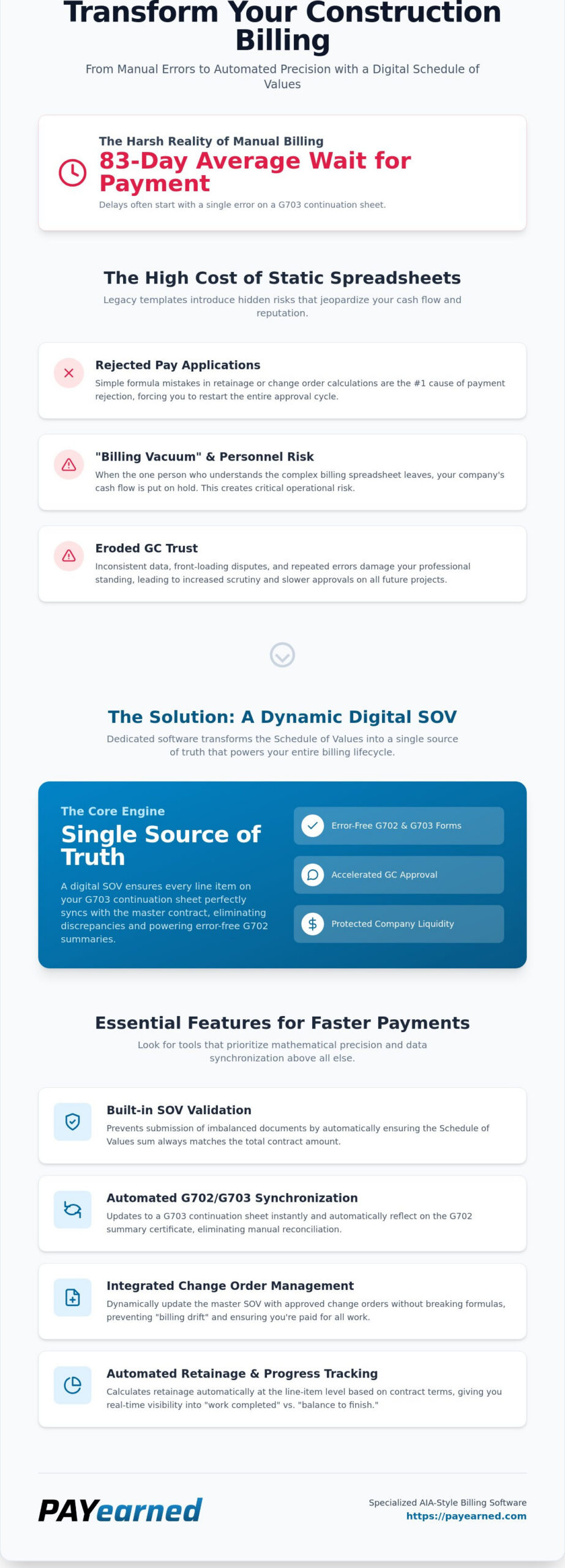
The average construction firm waits 83 days to receive payment, a delay that often starts with a single manual calculation error on a G703 continuation sheet. You’ve likely felt the frustration of a rejected pay application because a retainage calculation was off or a change order wasn’t tracked correctly across billing cycles. Relying on legacy spreadsheets isn’t just slow; it’s a direct risk to your company’s liquidity. Implementing dedicated software for schedule of values creation transforms this essential document from a static list into a dynamic engine that powers your entire billing lifecycle.
You understand that mathematical precision is the only way to keep project cash flow moving and maintain professional standing with General Contractors. This article demonstrates how specialized tools automate the generation of G702 and G703 forms while providing a central source of truth for every project value. We’ll look at how moving away from manual entry reduces the risk of billing delays when key staff members leave and ensures your approval cycles are faster and more reliable. It’s time to stop fighting with broken formulas and start using a system designed for the high-stakes reality of construction finance.
Key Takeaways
- Learn how a digital Schedule of Values acts as the itemized engine for error-free AIA-style billing and faster payment cycles.
- Discover why adopting software for schedule of values creation is the most effective way to automate totals and sync data across G702 and G703 forms.
- Identify the essential features that allow you to retrieve project data instantly through centralized search engines rather than hunting through local folders.
- Understand the benefit of personnel independence, ensuring your company’s billing continues smoothly regardless of administrative staff turnover.
- See how moving away from manual spreadsheets to a cloud-based “source of truth” reduces rejection risks and speeds up GC approval times.
The Role of Digital Schedule of Values in Modern Construction Billing
A Schedule of Values (SOV) is the foundational itemized breakdown of the total contract sum. It assigns specific financial weight to every phase of work. In 2026, maintaining a digital SOV is the primary requirement for accurate AIA-style billing. Without this structured itemization, your AIA billing cycle becomes an inefficient manual task prone to scrutiny and rejection.
Relying on a generic fillable form or a basic free download found online often leads to “front-loading” disputes with General Contractors. GCs are increasingly cautious about subcontractors overstating early-phase costs to boost initial cash flow. Using specialized software for schedule of values creation ensures a defensible distribution of values. This transparency helps your submissions move through approval chains without being flagged for manual adjustment or audit.
Why Static Templates Fail in 2026
Static Excel templates carry significant hidden costs. While a free download seems cost-effective initially, manual formula errors often lead to rejected pay applications. These errors create a “billing vacuum” when specialized staff resign. Automated software mitigates this by standardizing the process across the entire company. It moves your data from isolated spreadsheets into a reliable, cloud-based environment that protects your financial standing.
Standardizing Your G703 Continuation Sheets
There is an unbreakable link between your master SOV and your G702 and G703 forms. The G703 continuation sheet acts as the detailed roadmap for progress billing, tracking completion percentages against the original values established in the SOV. Standardizing these sheets through automation ensures that every line item remains perfectly synced with the contract. This consistency eliminates the discrepancies that frequently trigger payment delays.
Essential Features to Look for in SOV Creation Software
Selecting the right software for schedule of values creation requires a focus on functional utility over aesthetic flashiness. Your primary goal is financial liquidity. Therefore, the tool must prioritize mathematical precision. A critical feature is built-in validation that ensures the SOV sum always matches the contract total. This prevents the common administrative error of submitting an imbalanced document that GCs will immediately reject.
Reliable software also provides automated total calculations that sync seamlessly across G702 and G703 documents. When you update a value on a continuation sheet, it should reflect instantly on the summary certificate. This synchronization eliminates the manual reconciliation that often leads to payment delays. Additionally, centralized project search engines allow your team to retrieve past project data instantly. This creates personnel independence; your billing doesn’t stop if a key accounting staff member is unavailable.
Cloud-based accessibility is no longer optional. It allows for real-time collaboration between the field and the office, ensuring that progress percentages are accurate before the billing cycle closes. For those seeking a streamlined way to manage these complex documents, choosing a dedicated AIA-style billing platform can simplify your entire workflow.
Integrated Change Order Management
An SOV is rarely static. As project scopes shift, your software must allow for dynamic updates without breaking existing formulas. Utilizing change order management software for contractors ensures that every addition or deduction is tracked accurately. This prevents the “billing drift” that occurs when change orders aren’t properly integrated into the master schedule of values.
Automated Retainage and Progress Tracking
Managing what retention is requires granular control at the line-item level. High-end software for schedule of values creation calculates these holdbacks automatically based on your contract terms. You should be able to see “work completed” versus “balance to finish” in real-time, providing total visibility into your project’s financial health and pending cash flow.
Moving Beyond Templates: The PAYearned Approach to Automated SOVs
Enterprise suites often force trades into complex workflows that require weeks of training and high annual fees. PAYearned offers a specialized alternative, positioning itself as the “Easy for Less” solution for trades that need precision without the bloat. By focusing specifically on the needs of subcontractor billing, this software for schedule of values creation strips away unnecessary features to provide a lean, high-performance environment. It transforms the administrative burden of AIA-style documents into a repeatable, automated process.
The user-friendly interface is designed specifically for rapid payment application generation. You don’t need to be an accounting expert to navigate the system; the software guides you through the itemization of your contract sum to improve overall construction invoicing speed. All historical billing documents are stored in a secure, cloud-based repository, providing a permanent audit trail. This centralized access ensures you can retrieve project data from any device, whether you’re in the office or reviewing progress at the job site.
Protecting Your Cash Flow from Personnel Turnover
One of the most significant risks to construction cash flow is the “billing vacuum” that occurs when a key administrator resigns. If your billing logic is trapped in a complex Excel file only one person understands, their departure can cause immediate financial panic. PAYearned provides personnel independence by standardizing the workflow. New staff members can be onboarded in minutes because the logic is built into the system, not hidden in spreadsheet formulas. This ensures your pay applications go out on time, every time, regardless of staffing changes.
Affordable Accuracy for Every Trade
Accuracy shouldn’t be a luxury reserved for the largest firms. Whether you’re an electrical subcontractor or a plumbing outfit, our subscription model is built to scale with your business volume. You can eliminate the high overhead of manual processing and the risk of rejected applications for a fraction of the cost of enterprise software. Visit the PAYearned pricing page to see how you can secure your project values and streamline your administrative operations today.
Secure Your Project Liquidity with Automated Billing
Wait times for payment are already long enough without adding self-inflicted delays. Transitioning from manual spreadsheets to dedicated software for schedule of values creation is the most effective way to protect your company’s liquidity. Automation removes the risk of “billing drift” and ensures every G702 and G703 document matches your contract total exactly. You can’t afford to let a single calculation error stall your progress billing cycle.
Reliable systems handle the heavy lifting of automated retainage and change order tracking, leaving you with a clean, defensible audit trail. This cloud-based approach provides personnel independence, ensuring your billing continues smoothly even during administrative transitions. Accuracy is a requirement for professional standing with General Contractors; it’s the foundation of a stable construction business.
Stop fighting with broken Excel formulas and start using a platform built for the reality of construction finance. Simplify your construction billing today with PAYearned and experience the relief of automated, error-free pay applications. Your project’s cash flow is too important to leave to chance.
Frequently Asked Questions
What is the difference between an SOV and a G703 form?
An SOV is the initial itemized breakdown of the total contract sum, while the G703 is the continuation sheet used for recurring progress billing. You establish the SOV at the start of a project to define the value of each work activity. During the billing cycle, the G703 tracks work completed, materials stored, and retainage against those established values. While they share the same line items, the G703 is a dynamic tracking document used for pay applications.
Can I create a Schedule of Values without specialized software?
You can create a Schedule of Values manually using spreadsheets or paper forms, but this method introduces significant risk of mathematical error. Manual entry often leads to imbalanced documents where the line items don’t match the contract total exactly. Using dedicated software for schedule of values creation automates these calculations. It ensures your documents are error-free and protects your company from the cash flow delays caused by rejected applications.
How does SOV software handle change orders?
Specialized software integrates change orders directly into the master document as new line items or adjustments to existing values. This automation ensures the contract sum is always current and that retainage is calculated accurately for the new work scope. Instead of manually editing cell formulas in a spreadsheet, the system updates your G702 and G703 documents simultaneously. This maintains a clear audit trail for the General Contractor’s approval.
Is automated billing software compatible with AIA-style standards?
Automated billing software is specifically engineered to meet AIA-style standards for payment applications and continuation sheets. Most General Contractors require standardized G702 and G703 formats to process payments. High-end software for schedule of values creation generates these documents with the exact data fields and layouts required by industry standards. This interoperability ensures your submissions are familiar to the GC accounting team, which leads to faster approval cycles and more reliable cash flow.
PAYearned is an agnostic workflow platform that helps teams manage pay applications
PAYearned is an independent software product and is not developed, endorsed, approved, sponsored or affiliated with the American Institute of Architects (AIA). AIA®, G702®, G703®