

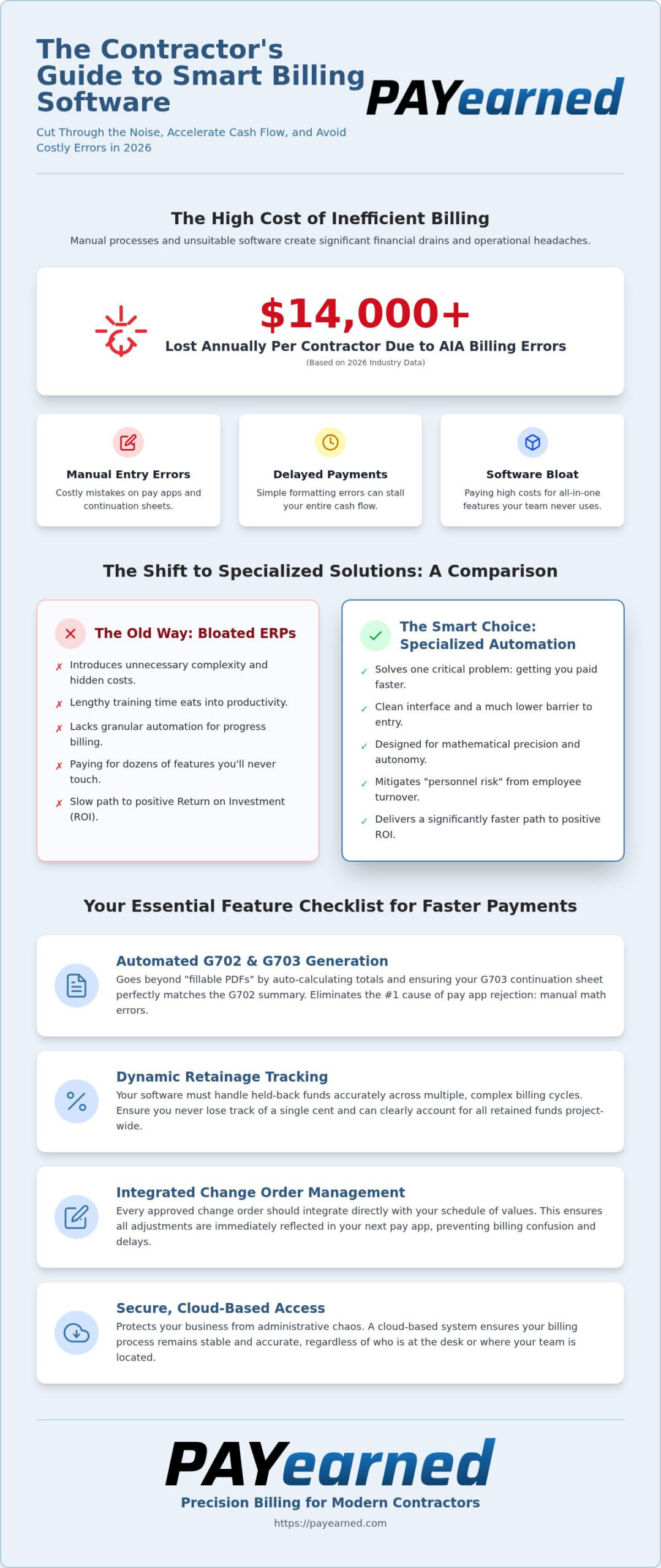
The average commercial contractor loses over $14,000 annually due to AIA billing errors, according to 2026 industry data. When you spend hours scrolling through construction billing software reviews, it’s easy to feel overwhelmed by massive platforms that promise to do everything but fail to solve your most basic cash flow problems. You’re likely tired of manual entry errors in your pay apps and the high cost of all-in-one software that your team barely uses. It’s frustrating to face delayed payments just because of a formatting error on a continuation sheet.
You deserve a system that works as hard as your crew does. This guide will show you how to cut through the marketing noise to find specialized tools that actually accelerate your cash flow. We’ll examine the shift toward niche automation and provide a checklist of the essential features you need to ensure your AIA G702 and G703 forms are accurate, professional, and paid on time every single month. By focusing on mathematical precision and system autonomy, you can protect your business from the risks of personnel turnover and administrative chaos.
Key Takeaways
- Learn to distinguish between general accounting tools and specialized platforms when reading construction billing software reviews to find the best fit for your trade.
- Discover why AIA-style G702 and G703 automation is a non-negotiable standard for accelerating cash flow in commercial construction.
- Understand how dynamic retainage tracking prevents funds from being lost or miscalculated across complex, multi-month billing cycles.
- Find out how moving to a cloud-based solution mitigates the risk of billing panic when a key administrative employee leaves your team.
Evaluating Construction Billing Software Reviews in 2026
Reading construction billing software reviews in 2026 requires a discerning eye for utility over hype. The industry is moving away from bloated ERP systems that try to handle everything from scheduling to payroll. For most subcontractors, these massive platforms introduce unnecessary complexity and hidden costs. Training time alone can eat up weeks of productivity, and you often end up paying for dozens of features your team will never touch. Practical reviews now prioritize niche-specific software that solves one critical problem: getting you paid faster.
Genuine user feedback focuses on the day-to-day reality of the back office. You should look for reviews that mention ease of setup and the reliability of automated calculations. If a review sounds like a sales brochure, it probably is. True feedback highlights how the tool handles the messy reality of change orders and mismatched totals. Focus on reviews from contractors in your specific trade to ensure the tool handles your unique billing requirements.
Specialized Billing vs. Full Accounting Suites
A specialized platform like PAYearned is often more efficient for payment applications than a general ERP. Full accounting suites are designed for broad financial tracking, but they often lack the granular automation needed for complex progress billing. You only need a full ERP if your business requires deep integration across massive logistics chains. For standard Construction management tasks, a dedicated billing tool provides a cleaner interface and a much lower barrier to entry. It’s about using the right tool for the job rather than a Swiss Army knife that’s too dull to cut through the paperwork.
The ROI of Software Specialization
Return on Investment (ROI) in billing automation is defined as the total financial gain from reduced labor hours and eliminated error penalties minus the software cost. Specialized tools provide a faster path to positive ROI because they require less training and fewer billable hours to maintain. They also mitigate “personnel risk.” If your entire billing process lives in one person’s head or a complex manual spreadsheet, your cash flow is in danger if they resign. Automated systems ensure that the process remains stable and accurate regardless of who is sitting at the desk.
Top Features to Look for in Construction Billing Reviews
Commercial billing is a high-stakes environment where a single math error on a continuation sheet can stall your entire cash flow. When scanning construction billing software reviews, look for mentions of automated G702 and G703 generation. These documents are the non-negotiable standard for commercial work. A platform that merely provides a template isn’t enough. You need a system that handles the complex math of progress billing; it must ensure that every calculation from previous applications carries over perfectly to the current one.
Automating the G702 and G703 Workflow
Pay application rejection is most commonly caused by manual calculation errors. While some reviews praise “fillable PDF” options, these are often just digital versions of the same manual problems. A true SaaS solution auto-calculates totals and ensures that your G703 continuation sheet matches your G702 summary exactly. This level of automation provides peace of mind and keeps your payments on schedule. You can see how this works by exploring our software tutorials.
Retainage and Change Order Precision
Understanding what is retention and how it impacts your liquidity is vital for long-term stability. Your software must handle held-back funds across multiple billing cycles without losing track of a single cent. Similarly, your change order management software for contractors should integrate directly with your schedule of values. This ensures that every approved change is immediately reflected in your next pay app, preventing the billing panic that occurs when specialized staff leave. Real-time data retrieval via cloud accessibility allows your team to use built-in search engines to pull up historical billing data instantly. It provides a stabilizing force in a potentially chaotic administrative environment.
Finding a tool that excels at these specific, critical tasks is easier than you think. You can simplify your progress billing today with a platform designed for mathematical precision and system autonomy.
Why PAYearned is the Practical Choice for 2026 Billing
PAYearned is the “Easy for LESS” alternative to the cumbersome manual processes that plague the industry. Many construction billing software reviews focus on expensive, high-end platforms that provide more features than a typical subcontractor will ever need. These bloated systems often create an administrative headache rather than solving one. Our platform provides a streamlined path to accurate documentation. It simplifies aia billing software requirements without the overhead of a full ERP implementation.
Our cloud-based, subscription-driven model is designed for scaling construction firms. You don’t need to worry about massive implementation fees or long-term contracts that don’t fit your project cycle. This flexibility allows you to maintain mathematical precision and financial liquidity without a heavy upfront investment. By focusing on the core task of generating error-free pay apps, we help you secure your cash flow with minimal friction.
Reducing Human Error and Personnel Dependency
A critical factor often overlooked in construction billing software reviews is the risk of personnel dependency. When your billing process lives in a complex, manual spreadsheet managed by a single employee, your business is one resignation away from a financial crisis. We champion the concept of software autonomy. Our automated workflows ensure that your billing remains consistent and accurate, regardless of who is in the office. This system autonomy makes your business resilient to staff turnover and prevents the “billing panic” that occurs when specialized knowledge leaves the room.
Getting Started with Modern Billing
Transitioning to a modern billing system shouldn’t be a months-long project. You can access our PAYearned tutorials to see how quickly your team can master the platform. These guides are designed to get you up and running in minutes, not days. Stop struggling with manual entry errors and formatting mistakes that delay your payments. Choose the specialized tool that solves your specific billing bottleneck today. It’s the most pragmatic way to protect your margins and ensure your crew gets paid on time, every time.
Secure Your Construction Cash Flow with Specialized Billing
Finding the right solution among endless construction billing software reviews comes down to one goal: ensuring you get paid on time without the administrative burnout. You’ve seen how niche specialization outperforms bloated ERPs by focusing on the exact mathematical requirements of progress billing. Moving toward an automated system isn’t just about saving time; it’s about building a resilient business that isn’t dependent on a single billing expert. By prioritizing tools that handle the specific complexities of commercial work, you protect your margins and stabilize your back-office operations.
It’s time to move past manual spreadsheets and error-prone PDFs. PAYearned offers a pragmatic, cloud-based solution that automates AIA-Style G702 and G703 document generation with precision. With built-in change order and retainage tracking, you can manage every project dollar through an affordable subscription model that scales with your needs. Stop letting formatting errors stall your revenue and focus on growing your business with confidence.
Start Streamlining Your Pay Apps with PAYearned today and experience the relief of an error-free workflow. Your team deserves a system that works as hard as they do.
Frequently Asked Questions
Is specialized construction billing software better than Excel for AIA forms?
Specialized software is significantly more reliable than Excel because it eliminates the risk of broken formulas and manual entry errors. While spreadsheets are flexible, they lack the built-in logic required to ensure continuation sheets match summary pages perfectly every time. Automated platforms act as a stabilizing force, providing mathematical precision that manual files simply cannot guarantee. This transition from outdated processes to automation provides the peace of mind necessary for high-stakes commercial projects.
How much does construction billing software typically cost in 2026?
Pricing for construction billing solutions in 2026 varies significantly based on your company’s annual construction volume and the specific modules you require. Large enterprise systems often use opaque models that scale with revenue; these often include substantial implementation fees and annual price increases. Many construction billing software reviews emphasize that specialized, cloud-based tools offer a more accessible entry point. These focused platforms allow subcontractors to automate their pay applications without the financial burden of unnecessary ERP features.
Can I use PAYearned if I already have a separate accounting program?
You can absolutely use PAYearned alongside your existing accounting software. The platform is designed for interoperability, allowing you to generate professional AIA-style documents while maintaining your current financial records elsewhere. This approach allows you to solve the specific bottleneck of progress billing without the risk and cost of migrating your entire accounting system. It is a pragmatic way to gain specialized functionality while keeping your established administrative workflows intact.
Does construction billing software help with retainage tracking?
Automated billing software is essential for accurate retainage tracking across multiple billing cycles. It ensures that held-back funds are calculated correctly on every application, preventing the financial leaks that often occur with manual tracking. By automating this process, you optimize your financial liquidity and ensure that every cent of your retention is accounted for. This level of organization is a frequent highlight in construction billing software reviews for teams focused on risk mitigation and mathematical precision.
PAYearned is an agnostic workflow platform that helps teams manage pay applications
PAYearned is an independent software product and is not developed, endorsed, approved, sponsored or affiliated with the American Institute of Architects (AIA). AIA®, G702®, G703®