

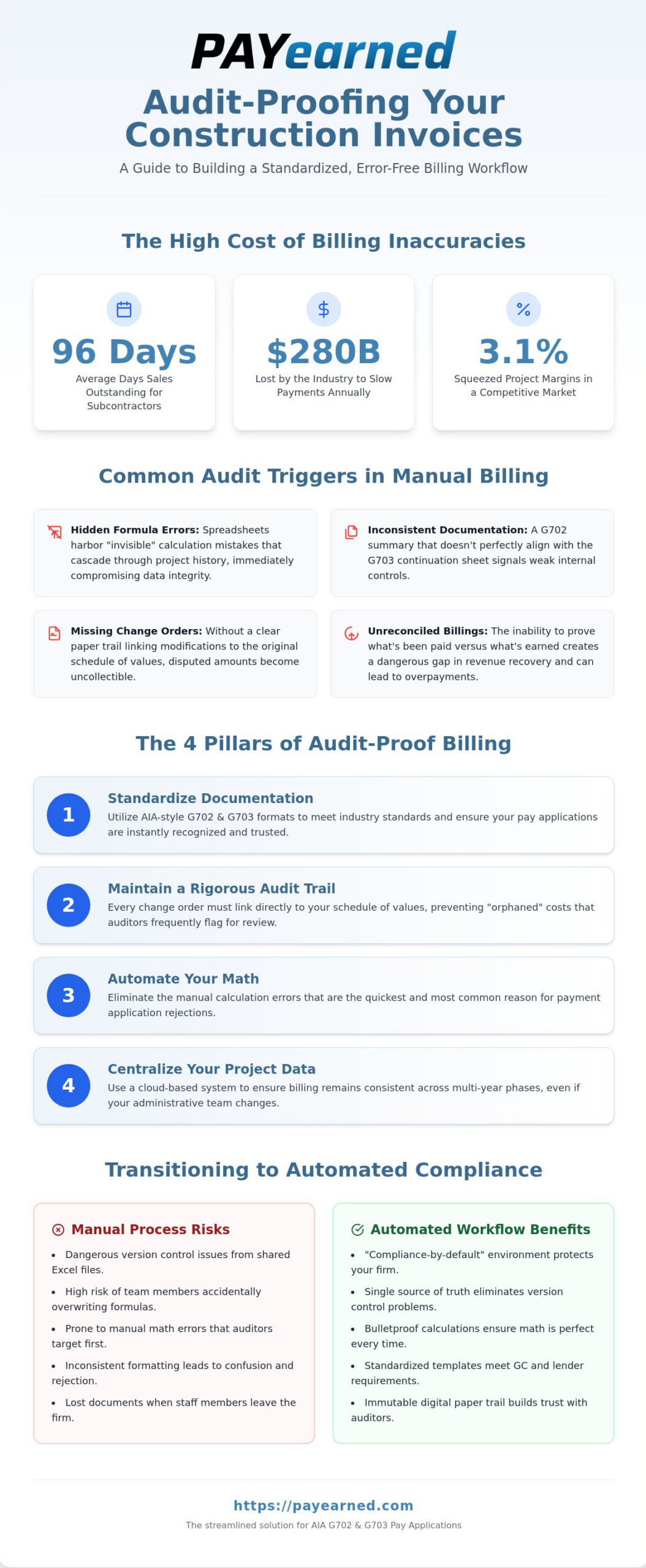
Did you know the average days sales outstanding for subcontractors has climbed to 96 days, while the industry lost a staggering $280 billion to slow payments? In a 2026 market where project margins have squeezed to 3.1 percent, audit proofing your construction invoices is no longer optional. You already know that a single manual entry error on a G702 or G703 form can trigger a rejection and stall your cash flow for weeks. It’s exhausting to track complex retainage or hunt down change order documentation when an auditor is breathing down your neck.
You deserve a billing process that acts as a stabilizing force for your firm. This guide shows you how to protect your liquidity and satisfy auditors by building a standardized, error-free billing workflow from day one. We will explore how to automate your progress billing to comply with the new 5 percent retention caps under SB 61 and ensure every pay application is defensible. You’ll learn how to move from administrative chaos to a steady, reliable system that secures your payments and provides total peace of mind.
Key Takeaways
- Identify why manual spreadsheets and hidden formula errors are the primary targets for financial auditors during project reviews.
- Adopt standardized AIA-style G702 and G703 formats to ensure your documentation meets industry expectations and remains professional.
- Build a clear audit trail by linking every change order directly to your schedule of values for total transparency.
- Discover how cloud-based automation simplifies audit proofing your construction invoices by eliminating version control issues and manual math errors.
- Protect your project liquidity and speed up payment approvals with an error-free, automated progress billing workflow.
Why Manual Construction Invoicing is an Audit Risk
Construction audits serve as a rigorous evaluation of your firm’s financial health and operational efficiency. Stakeholders, from lenders to project owners, rely on these reviews to ensure project viability and fiscal responsibility. When you rely on manual processes, you’re inviting unnecessary scrutiny. Adhering to Construction accounting principles requires a level of precision that manual entry rarely achieves. Static spreadsheets are a liability; they often harbor “hidden” formula errors that go unnoticed until an auditor flags them. A single broken link in an Excel file can cascade through your entire project history. These mathematical discrepancies are immediate red flags, signaling to auditors that your data integrity is compromised. Audit proofing your construction invoices starts with eliminating these invisible hazards.
Inconsistency is another major trigger for financial reviewers. If your G702 summary doesn’t align perfectly with your G703 continuation sheet, it suggests weak internal controls. This lack of standardization makes it difficult for reviewers to verify progress accurately. Beyond simple math, missing or poorly documented change orders remain the top cause of audit delays. Without a clear paper trail that links every modification back to the original schedule of values, disputed amounts often become uncollectible. In a high-stakes environment, these procedural gaps suggest a chaotic administrative culture that auditors will want to investigate further.
The High Cost of Billing Inaccuracies
Unreconciled billings create a dangerous gap in your revenue recovery. If you can’t prove exactly what’s been paid versus what’s earned across multi-year projects, you risk significant overpayments or lost income. A single mathematical error can invalidate an entire payment application, forcing you to restart the approval cycle and delaying your cash flow. For a deeper dive into avoiding these pitfalls, read our guide on Mastering the Payment Application. Audit proofing your construction invoices requires moving beyond manual guesswork to ensure every line item stands up to professional review.
4 Pillars of Audit-Proof Construction Billing
Establishing a defensible billing system relies on four foundational pillars that protect your firm from financial scrutiny. First, standardize your documentation. Utilizing AIA-style G702 and G703 formats ensures your pay applications meet industry standards and are instantly recognized by architects and project owners. Second, maintain a rigorous audit trail. Every change order must link directly to your schedule of values to prevent “orphaned” costs that auditors often flag. Third, automate your math. Manual calculations are the quickest way to trigger a rejection. Fourth, centralize your project data. This ensures your billing remains consistent across multi-year phases, even if your administrative team changes. Audit proofing your construction invoices requires this level of structural discipline from the start of every project.
Reconciling Change Orders and Retainage
Auditors focus heavily on the transition between original contract sums and the final adjusted totals. To satisfy a detailed financial review, every change order must have a corresponding continuation sheet entry that reflects its impact on the specific project scope. Similarly, you should calculate retainage on a per-line-item basis rather than applying a flat percentage to the final total. This granular approach proves you’re tracking work completed and materials stored with mathematical precision. If you’re unsure about how these withholdings affect your bottom line, our guide on What is Retention? explains its role in professional progress billing.
The Importance of a Digital Paper Trail
A digital paper trail is your strongest defense during a financial review. Digital storage ensures that critical invoices and lien waivers aren’t lost when project managers or accountants transition out of the firm. Searchable data retrieval allows you to answer an auditor’s question in seconds instead of digging through physical filing cabinets for hours. By adopting a cloud-based solution for AIA-style billing, you create an immutable record of every transaction. This level of organization builds immediate trust with stakeholders and proves that your internal controls are robust and reliable.
Transitioning to Automated G702 and G703 Compliance
Moving to an automated system creates a “compliance-by-default” environment that manual processes simply can’t match. While professional accounting advice is valuable, your daily choice of software is what actually drives audit outcomes. Cloud-based platforms eliminate the dangerous version control issues inherent in shared Excel files. You won’t have to worry about a team member accidentally overwriting a formula or using an outdated version of a continuation sheet. Automated total calculations prevent the manual math errors that auditors target first. This ensures your math is bulletproof before the pay application ever leaves your desk.
Standardized templates ensure your pay apps meet the strict requirements of GCs and lenders without requiring hours of manual formatting. Digital storage provides a permanent, searchable record for every project billing cycle. This level of organization is vital for audit proofing your construction invoices. It allows you to present a complete history of progress billing and retainage at a moment’s notice, proving your firm’s administrative competence.
Why Automation Beats Excel Templates
Excel lacks the built-in search engines required for rapid data retrieval during a financial review. When an auditor asks for a specific change order from six months ago, you shouldn’t have to hunt through nested folders. Manual templates also fail to update continuation sheets automatically when change orders occur. This disconnect leads to unreconciled balances that trigger immediate red flags. For a detailed breakdown of these risks, see our comparison of AIA Billing Software vs. Excel.
Implementing a Defensible Billing Workflow
Start your transition by migrating your current schedule of values into a dedicated billing platform. This creates a clean slate for all future pay applications and ensures your starting balances are accurate. Establish a routine of monthly reconciliation to catch discrepancies before they reach the auditor’s desk. By centralizing your subcontractor billing and change order tracking, you build a workflow that is naturally resistant to errors. This proactive approach protects your cash flow and ensures your firm remains a preferred partner for project owners and lenders alike.
Secure Your Financial Future with Precision Billing
Protecting your firm’s liquidity requires more than just careful accounting. It demands a system that eliminates the inherent risks of manual data entry and broken spreadsheet formulas. You’ve learned that standardizing your documentation through AIA-style formats is the first step toward professional credibility. By moving away from outdated manual methods, you reduce the danger of rejections and ensure your progress billing remains consistent across every project phase. Audit proofing your construction invoices is ultimately about creating a transparent, defensible record that satisfies even the most rigorous financial reviews.
Automation is the stabilizing force that allows your team to focus on project execution rather than administrative troubleshooting. With automated AIA-style G702 and G703 generation, you can be certain your math is correct every time. Cloud-based digital storage ensures your pay applications are always accessible, while a built-in search engine makes rapid data retrieval a reality during audits. Take the next step toward a zero-error workflow today. Streamline your billing and audit-proof your business with PAYearned to gain the peace of mind your hard work deserves.
Frequently Asked Questions
What is the difference between a construction audit and a financial review?
A construction audit is a granular, project-specific investigation that verifies contract compliance and job costing accuracy. It focuses on the minute details of individual transactions to ensure funds were spent according to the agreement. A financial review is a broader assessment of a company’s overall financial statements to provide limited assurance that the data is free from material misstatements. Audits are much more rigorous and target the specific math behind your pay applications.
How does AIA-style billing help during a project audit?
AIA-style billing provides a standardized, industry-recognized format that auditors and project owners already trust. By using G702 and G703 formats, you present data in a logical, chronological order that links the schedule of values directly to actual progress. This transparency simplifies audit proofing your construction invoices because it makes it easy for reviewers to track retainage and change orders across the entire project lifecycle without searching through disconnected files.
Can I audit-proof my invoices using a free Excel template?
Free Excel templates are often the weakest link in a construction firm’s internal controls. These manual tools lack the automated reconciliation and search functions needed to provide a reliable paper trail during a high-stakes financial review. Mathematical errors or broken links in a spreadsheet can invalidate months of work. While a free download is tempting, it doesn’t offer the security or accuracy required for audit proofing your construction invoices effectively.
What records should I have ready before a construction audit begins?
You should have a complete set of executed contracts, every approved change order, and all submitted pay applications organized by date. Be prepared to provide lien waivers, updated insurance certificates, and detailed documentation for any materials stored off-site. Centralizing these records in a searchable digital environment ensures you don’t lose critical evidence during personnel changes or administrative transitions, allowing you to answer auditor questions in seconds.
PAYearned is an agnostic workflow platform that helps teams manage pay applications
PAYearned is an independent software product and is not developed, endorsed, approved, sponsored or affiliated with the American Institute of Architects (AIA). AIA®, G702®, G703®