

Imagine it’s the 25th of the month and your lead billing manager just handed in their resignation. Suddenly, the complex web of spreadsheets and manual math used to generate your pay apps feels like a ticking time bomb. If those G703 continuation sheets contain even one small rounding error, the general contractor will reject the entire package. This leads to the “panic mode” that stalls cash flow and puts your project margins at risk. Adopting dedicated construction progress billing software is no longer just a luxury. It’s a critical safeguard for your business’s financial health.
You’ve likely spent years wrestling with manual entry and the constant fear of a rejected application. You deserve a process that’s as reliable as your field crew. This guide shows you how to eliminate manual math errors and automate your AIA-style billing to secure payments faster. We’ll explore how to handle 2026 regulatory updates, such as California’s 5% retention cap, while ensuring your documentation remains error-free. Discover why a specialized tool that focuses on one critical task can transform your administrative workflow from a source of stress into a steady engine for liquidity.
Key Takeaways
- Learn how systematic progress billing acts as a stabilizing force for your project liquidity and overall risk management.
- Discover why automated AIA-style G702 and G703 generation is the most effective way to eliminate the manual math errors that cause rejected pay apps.
- Understand how cloud-based construction progress billing software ensures your back-office team stays productive and synchronized from any location.
- Identify the steps to transition your workflow from error-prone spreadsheets to a secure, automated platform that protects your project margins.
- Build a resilient billing process that remains functional and accurate even if your primary accounting staff or billing experts leave the company.
The Critical Role of Construction Progress Billing Software in Project Finance
Progress billing is the systematic invoicing of work completed during a specific period. It’s a cornerstone of construction accounting principles and serves as a primary driver of liquidity. For many firms, using dedicated construction progress billing software is the difference between a liquid business and one that is technically insolvent while waiting for a single large check. It provides a stabilizing force by ensuring that cash enters the business at the same rate that labor and material costs are incurred.
This method offers significant cash flow advantages over lump-sum invoicing. In a lump-sum model, you might wait until the end of a project to receive payment, effectively providing a “free loan” to the owner. Contractors who float these costs out of pocket risk their project margins if a single payment is delayed. Progress billing mitigates this risk by breaking the contract value into manageable, periodic payments based on the percentage of completion.
Why AIA-Style Billing is the Commercial Standard
Commercial construction requires absolute transparency. Standardized formats like G702 and G703 are the industry benchmark because they provide a clear, undeniable audit trail for general contractors and owners. When you submit a professional payment application, you are providing a snapshot of the project’s financial health. These forms track original contract sums, change orders, and retainage, ensuring all parties stay aligned on the remaining balance to finish.
The High Cost of Manual Billing Errors
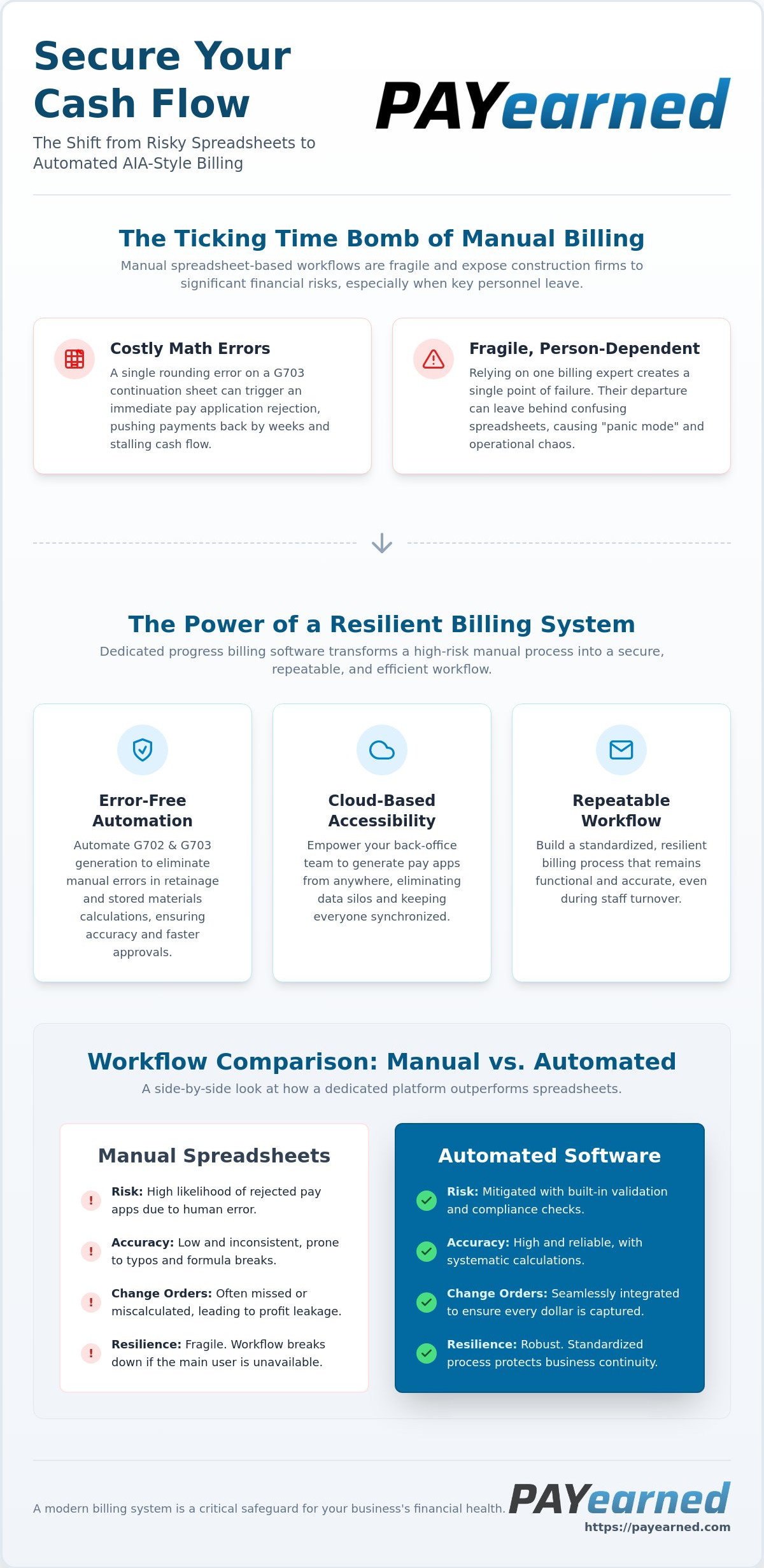
Precision is not optional in construction finance. A single math error on a continuation sheet can trigger an immediate rejection, pushing your payment date back by weeks. Manual entry errors in construction billing are not just typos; they are direct threats to a firm’s monthly cash flow. Using construction progress billing software eliminates these hazards by automating the complex calculations behind retainage and stored materials. This automation protects the office from the “panic mode” that occurs when billing experts resign, leaving behind a trail of confusing, error-prone spreadsheets.
Essential Features of Modern Progress Billing Software
Modern construction progress billing software does more than just digitize paper. It provides a structured, automated environment where data flows seamlessly from the project site to the back office. Cloud-based accessibility is a primary requirement. It ensures that your administrative team can generate pay apps without being tethered to a local server or a specific office desktop. This accessibility eliminates data silos and ensures that the latest version of a project’s financial status is always available to authorized users.
Accuracy in calculating “total completed and stored to date” is where most manual spreadsheets fail. These calculations are governed by strict standards, such as the Federal Progress Payments regulation, which establishes the legal framework for how these values are reported on government and large-scale commercial contracts. Dedicated software ensures that your totals, including materials currently stored on-site but not yet installed, are mathematically sound and compliant with these standards. Built-in search engines further simplify this by allowing teams to retrieve historical data for audits in seconds rather than hours.
Automating the Schedule of Values (G703)
Tracking the percentage of completion across hundreds of line items is a logistical nightmare in standard spreadsheets. Specialized software automates this by carrying over values from previous periods and calculating current progress against the original contract sum. This ensures that you never overbill or miss a specific line item. For a deeper look at this process, check out our AIA billing software guide to see how automation transforms the G703 workflow.
Managing Change Orders and Retainage
Profit leakage often happens because change orders aren’t integrated into the monthly billing cycle. Modern tools allow you to append approved change orders directly to your G703 continuation sheet, ensuring every dollar of extra work is captured. Simultaneously, tracking retainage automatically prevents the common error of calculating retention on the wrong subtotal. If you want to streamline these complex tasks, you can explore PAYearned’s automated features to simplify your monthly workflow and protect your margins.
Implementing an Efficient Billing Workflow for 2026
Moving away from error-prone Excel templates is the first step toward securing your firm’s future. Manual spreadsheets are fragile. They rely on the memory of the user rather than a standardized system. By adopting construction progress billing software, you create a repeatable workflow that scales with your project volume. This transition isn’t just about buying a new tool; it’s about shifting your administrative staff from data entry clerks to project auditors. A user-friendly interface ensures that even non-technical staff can navigate the billing cycle with confidence, boosting overall employee productivity and business growth.
Protecting Your Firm Against Staff Turnover
One of the greatest hidden risks in construction finance is the “billing silo.” This happens when a single employee holds all the specialized knowledge required to navigate complex pay apps. If that expert resigns, the office often enters a state of panic. Standardized software prevents this by automating the expertise. It stores the specific rules for retainage, change orders, and continuation sheets in a centralized, cloud-based system. This “Personnel Independence” means a new hire can step in and generate an accurate AIA-style document on day one without deciphering a predecessor’s cryptic formulas or manual notes.
The Path to Faster Approvals
Clean, accurate documentation is the fastest way to reduce friction during the general contractor’s review process. When your pay apps are professional and mathematically perfect, they move through the approval chain without the back-and-forth typical of manual submissions. Rejected applications are almost always the result of simple math errors or missing data from previous periods. By using construction progress billing software to automate these calculations, you ensure that your cash flow remains uninterrupted and your project margins stay protected. Ready to see how simple this transition can be? You can explore PAYearned pricing to see how affordable automated billing can be for your trade business.
Securing Your Financial Future with Automated Billing
Moving into 2026, the construction industry demands a level of administrative precision that manual spreadsheets simply cannot provide. You’ve seen how specialized construction progress billing software acts as a safeguard against personnel turnover and the “panic mode” of rejected pay apps. By automating the complex math of G702 and G703 forms, you protect your firm’s liquidity and ensure your project margins remain intact. Standardizing your workflow through a cloud-based platform allows your remote back-office teams to collaborate without data silos. It removes the need for specialized expertise, making your financial operations resilient and scalable. When your documentation is professional and error-free, you reduce the friction of the GC review process and secure payments faster.
It’s time to trade the stress of manual entry for the peace of mind that comes with system autonomy. Start Automating Your Pay Apps with PAYearned today. You can achieve accurate AIA-style G702 and G703 generation with a tool designed specifically for the high stakes of your trade. Build a more stable business and focus on what you do best: building the future with confidence.
Frequently Asked Questions
What is the difference between progress billing and regular invoicing?
Progress billing invoices are based on the percentage of work completed during a specific period rather than a total project delivery. Standard invoicing typically requests payment for a single service or product after delivery. In commercial projects, construction progress billing software ensures that you receive incremental payments as milestones are met. It’s a system that prevents you from floating the entire project’s costs until the final walkthrough.
Can I use progress billing software for small residential projects?
Yes, you can use this software for residential projects to provide a professional structure for milestone payments. While AIA-style forms are the commercial standard, they offer transparency that residential owners appreciate. Using construction progress billing software for smaller jobs helps you track work accurately and manage homeowner expectations. It ensures that both parties are aligned on the value of work completed before the next payment is released.
How does progress billing software handle retainage and change orders?
The software automates the complex math required to track withheld funds and contract adjustments. It calculates retainage based on your specific contract percentage and applies it to each period’s earnings. Change orders are integrated directly into the Schedule of Values so that every approved modification is billed correctly. This eliminates the mathematical errors that lead to underbilling or rejected pay applications.
Is progress billing software the same as construction accounting software?
No, progress billing software is a specialized tool designed specifically for generating payment applications and continuation sheets. General construction accounting software handles broad financial tasks like the general ledger, payroll, and accounts payable. Dedicated billing tools focus on the mathematical precision of the G702 and G703 workflow. It’s a specialization that ensures your pay apps are compliant and professional without the complexity of a full ERP system.
PAYearned is an agnostic workflow platform that helps teams manage pay applications
PAYearned is an independent software product and is not developed, endorsed, approved, sponsored or affiliated with the American Institute of Architects (AIA). AIA®, G702®, G703®