

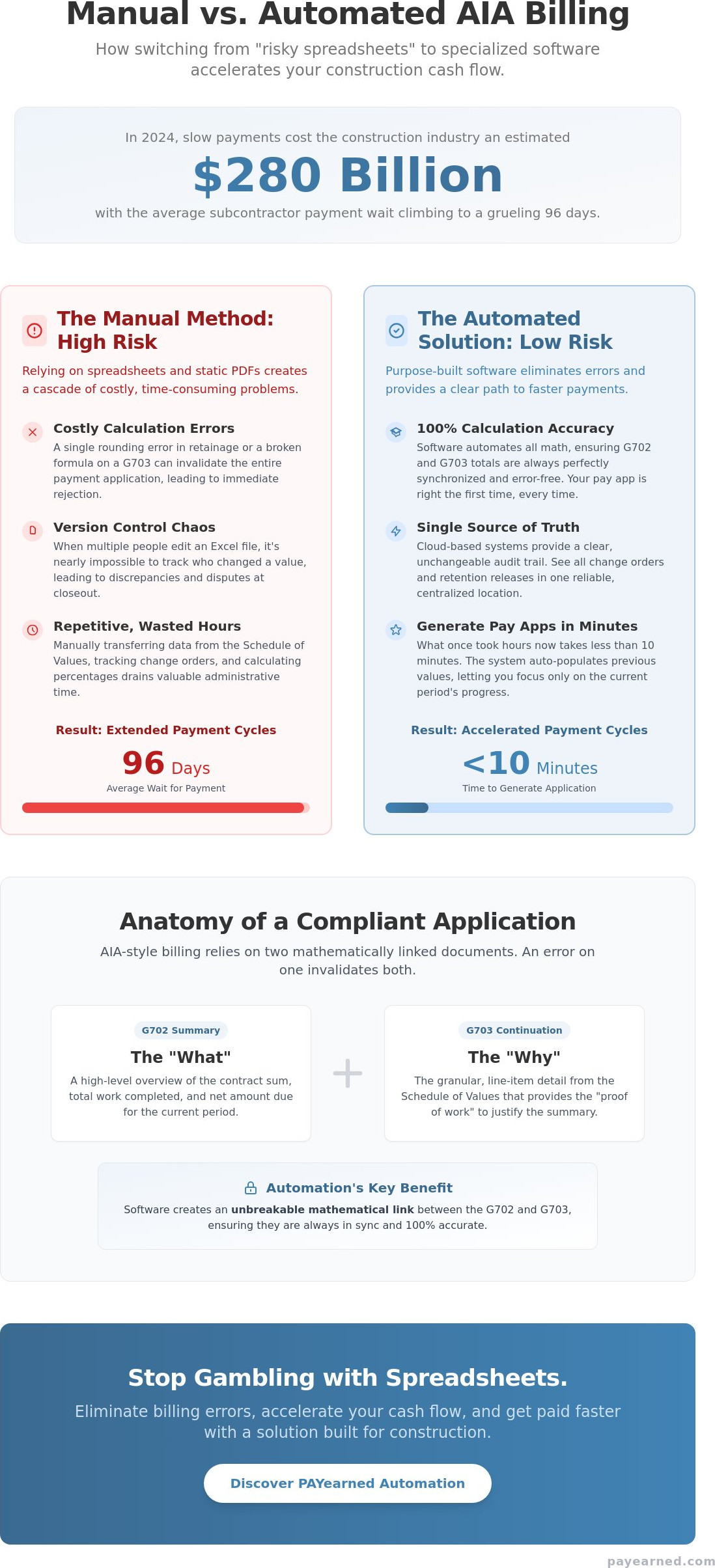
In 2024, slow payments cost the construction industry an estimated $280 billion, while the average wait for subcontractor payment has climbed to a grueling 96 days. When you are staring at a complex aia payment application, every minute spent wrestling with a spreadsheet is a minute your cash is locked away. You likely know the frustration of having a G702 rejected because of a single rounding error in the retainage column or a typo on a continuation sheet. It’s a high-stakes administrative burden that drains your time and delays your funding.
We’ll show you the critical differences between manual AIA billing and automated software to eliminate these errors and accelerate your construction cash flow. You’ll learn how to move past risky spreadsheets to achieve 100% accurate G702 and G703 style documents. This guide compares the true cost of $59.99 manual forms against premium automation, providing a clear path to faster payment cycles and easier tracking of change orders and retention.
Key Takeaways
- Understand why the construction industry is abandoning static PDFs and manual spreadsheets in 2026 to protect profit margins and improve cash flow.
- Master the foundational relationship between the G702 summary and the G703 continuation sheet to ensure every aia payment application is submission-ready.
- Compare the long-term ROI of one-time licensing fees against automated SaaS subscriptions that eliminate repetitive data entry and calculation errors.
- Identify the five critical criteria for evaluating billing software, including the ability to handle complex retainage releases and change order logic in under 10 minutes.
- Discover how specialized, cloud-based tools provide a reliable, independent alternative to traditional forms for faster payment cycles and better audit trails.
The Evolution of the AIA Payment Application: From Paper to Automation
The aia payment application has served as the backbone of construction finance for decades. It provides a structured framework for progress billing, ensuring that contractors get paid for work completed while owners verify every dollar spent. While the industry relied on physical paper and ink for years, the shift toward digital automation in 2026 is no longer a luxury. It’s a survival mechanism in a market where margins are thin and administrative speed is everything. Contractors who stick to old-school methods find themselves buried in paperwork while their competitors secure funding faster.
To better understand how these documents function in a real-world setting, watch this helpful video:
Transitioning away from static PDFs and physical mailings is about more than just saving trees. It’s about eliminating the “billing friction” that occurs when data is trapped in silos. When you’re mastering the payment application, you realize that transparency is your greatest asset. Automated systems allow for real-time visibility, ensuring that the work reported on the job site matches the numbers on the page. In 2026, the construction industry is moving away from static files because they lack the intelligence required for modern project demands.
Why Standardized Billing Matters in 2026
Standardized billing ensures that the General Contractor, Owner, and Architect all speak the same financial language. This alignment is critical for maintaining the project’s Schedule of Values (SOV), which acts as the roadmap for all future payments. By using a recognized format, you reduce the likelihood of legal disputes over work-in-place percentages. Lenders and stakeholders also require these clear audit trails to release funds. Using a consistent aia payment application format provides the professional documentation that banks need to maintain project liquidity without unnecessary delays.
The Hidden Dangers of “Risky Spreadsheets”
Spreadsheet risk is the single greatest cause of billing rejections and cash flow delays in the construction industry today.
A single broken formula in an Excel file can create cumulative errors that go unnoticed for months. These mistakes often lead to massive financial discrepancies at project closeout. Version control is another massive liability. When multiple people edit a pay app, it’s nearly impossible to track who changed a retainage percentage or a stored material value. These manual processes are “risky spreadsheets” that jeopardize your reputation and your bank account. Relying on them in a high-stakes environment is a gamble that most modern firms can no longer afford to take.
Anatomy of a Compliant AIA-Style Application: G702 and G703 Essentials
A compliant aia payment application is a two-part document system that functions as a single financial unit. The G702 serves as the summary sheet, providing a high-level overview of the contract sum, total work completed to date, and the net amount due for the current period. It acts as the legal certification where the contractor swears to the accuracy of the numbers and the architect or owner signs off to release funds. Without a signed G702, your billing is just a request; with it, it’s a certified entitlement to payment.
The G703, or the continuation sheet, provides the granular detail that supports every number on the summary. This document breaks the project down into specific line items based on your initial agreement. It’s essentially the “proof of work” that justifies your invoice. Because these documents are mathematically linked, any error on a single G703 line item will automatically invalidate the entire summary. Using aia billing software eliminates this risk by hard-linking the two forms, ensuring that totals always flow correctly from the detail sheet to the certification page.
Mastering the Schedule of Values (G703)
The Schedule of Values (SOV) is the foundation of your billing cycle. To avoid rejections, you must accurately allocate the total contract sum across logical line items that reflect the project’s physical progress. This breakdown allows you to track “Work Completed” separately from “Materials Presently Stored,” which is a standard requirement for maintaining transparency in construction finance. Each period, your G703 totals must match the G702 summary exactly, line by line. If your “total completed and stored to date” on the G703 doesn’t align with line 4 of your G702, the application will be rejected immediately.
Managing Change Orders and Retainage
Change orders are the most common source of calculation errors in a manual aia payment application. When a change order is approved, it modifies the “Original Contract Sum” on line 1 of the G702, creating a “Net Change by Change Orders” on line 3. You must also add these as new line items at the bottom of your G703 to maintain a clear audit trail. This ensures that your billing remains transparent even as the project scope evolves.
Retainage adds another layer of complexity. If you’re wondering what is retention, it is a percentage of your earned revenue held back by the owner to ensure project completion. You must track “Retainage Held to Date” across every progress billing to ensure you recover the full amount at project close. Beyond retainage on completed work, understanding how to correctly bill for stored materials on AIA G702 pay app forms is equally critical, as long-lead items purchased out of pocket can create severe cash flow strain if not properly documented. Managing this math in a spreadsheet is a recipe for disaster, which is why many professionals automate their pay apps to keep these calculations 100% accurate without manual intervention.
Comparison: AIA Payment Application Software vs. Manual Excel Templates
The financial choice between manual templates and a dedicated aia payment application platform often comes down to perceived versus actual costs. Purchasing a single-use license for the G702 and G703 directly from the AIA costs $59.99 each, totaling nearly $120 for a single billing cycle. In contrast, a premium SaaS solution like PAYearned offers unlimited applications for $89 per month, or as little as $67 per month on an annual plan. Beyond the sticker price, the real drain is administrative overhead. Manual data entry is slow, prone to keystroke errors, and lacks the searchable audit trails that modern project managers require for rapid data retrieval.
Relying on software isn’t just about speed; it’s about reliability. Automated systems provide a built-in search engine for your project data, allowing you to pull up historical billing info in seconds. You don’t have to hunt through nested folders or paper files to find what you billed six months ago. The software maintains the integrity of your data, ensuring that every aia payment application you submit is backed by a consistent, digital record that GCs and owners can verify instantly.
The Real Cost of “Free” Templates
Many firms use Excel templates to avoid document fees, but they ignore the heavy labor burden. Manually updating a 50-line G703 continuation sheet involves re-calculating work completed, stored materials, and previous payments for every single line. If a project manager spends just three hours on this task at a standard labor rate, the cost far exceeds a monthly software subscription. This administrative drag is compounded by the risk of rejection. With the average days sales outstanding (DSO) for subcontractors reaching 96 days in 2026, a single rejected pay app due to a math error can delay your cash flow by another thirty days or more. Maintaining complex Excel macros also creates technical debt, as these “risky spreadsheets” often break when shared across different versions of Office.
Advantages of Cloud-Based Automation
Cloud-based software replaces manual input with one-click generation. It prevents math errors by auto-calculating every total, from the line-item level on the G703 to the summary totals on the g702 summary. This precision builds trust with General Contractors and Architects who expect standardized, professional formatting. Centralized storage ensures your billing history is accessible from any device on the job site or in the office. You get a searchable database of every change order and retention release, eliminating the need to dig through old email threads. This specialized approach provides the peace of mind that manual templates simply can’t offer.
5 Criteria for Evaluating Construction Billing Solutions
Choosing the right platform for your aia payment application shouldn’t be a guessing game. You need a clear framework that prioritizes financial security and administrative efficiency over flashy, unnecessary features. A premium solution isn’t just about the interface; it’s about the logic under the hood that protects your cash flow. If a tool doesn’t simplify your workflow while ensuring 100% accuracy, it isn’t the right fit for a high-stakes construction environment.
Evaluation starts with speed and ease of use. Can a project manager set up a new payapp in under 10 minutes? If the setup is cumbersome, the software becomes another administrative hurdle rather than a solution. The system must also handle complex retainage and change order logic automatically. You shouldn’t have to manually calculate unbilled retainage or double-check that change order totals flow correctly to the summary page. The software should do the heavy lifting for you.
Searchability is another non-negotiable criterion in 2026. You must be able to find a specific line item or a continuation sheet from a project six months ago with a single keyword. This level of organization is impossible with paper files or nested digital folders. Support and pricing transparency are the final pillars. When a billing deadline is looming, you need live, US-based assistance, not an impersonal chatbot. Demand predictable pricing without hidden “per-seat” or “per-project” fees that penalize your firm’s growth.
Scalability: From One Project to Fifty
Manual systems break down the moment your project volume increases. Managing five projects in Excel is stressful, but managing fifty is a recipe for disaster. As your firm grows, the risk of a “risky spreadsheet” error grows exponentially. Specialized software allows you to scale without hiring a small army of administrative staff. It provides a consistent, professional feel for all client presentations, ensuring your firm looks like the “Reliable Specialist” that owners and GCs want to work with. Your billing process should be a stable foundation for your growth, not a bottleneck.
The “Supportive Expert” Factor
Reliability is about more than just software uptime; it’s about the human element behind the technology. The end-of-month billing rush is a high-pressure period where every hour counts. Having a “Supportive Expert” available through live, US-based support ensures that a technical question doesn’t turn into a missed payment cycle. Moving beyond impersonal global platforms to dedicated specialist tools gives you peace of mind. You aren’t just buying a SaaS product; you’re securing a partner that understands the specific requirements of the aia payment application workflow.
Ready to eliminate billing errors and get paid faster? Create your first pay app for free and experience the difference of a platform built exclusively for contractors.
PAYearned: The Specialized Solution for AIA-Style Billing
PAYearned is the “Reliable Specialist” for contractors who need a professional aia payment application without the bloat of enterprise project management suites. We don’t try to be everything to everyone. Instead, we excel at one critical task: ensuring your progress billing is 100% accurate and submission-ready. Our platform provides a “Compatible but Independent” solution. This means you get the industry-standard G702 and G703 style documents you need to stay compliant while maintaining a distinct, user-friendly digital workflow.
Transparency is at the heart of our personality. In 2026, we offer a no-nonsense pricing model that includes a Free Limited Plan and an Unlimited Plan for $89 per month. If you prefer annual billing, the cost drops to $67 per month. There are no hidden fees, and you can start your first application without a credit card. It’s a low-friction way to experience the relief of automated billing without any upfront financial risk.
Why Focus Matters: Pay Apps vs. General Accounting
General accounting software is often too broad for the specific needs of a construction billing cycle. PAYearned explicitly excludes general accounting and payroll features to maintain technical precision. This specialized focus leads to a cleaner, faster user interface that doesn’t require a week of training to master. When you use a tool that does one thing perfectly, you eliminate the administrative noise that leads to mistakes. You get exactly what you need: error-free calculations for unbilled retainage, continuation sheets, and change order sheets.
Ready to Streamline Your 2026 Billing?
The transition from risky spreadsheets to automated software provides more than just speed. It gives you the peace of mind that comes with searchable audit trails and secure data storage. You’ll never have to worry about a broken Excel formula or a lost paper file again. By choosing a dedicated specialist, you protect your cash flow and your professional reputation. Every document you generate reflects the quality and precision of your work on the job site.
Stop wrestling with outdated templates and manual re-entry. It’s time to stabilize your administrative environment with a solution built specifically for the high-stakes world of construction finance. Start generating professional AIA-style pay apps with PAYearned today.
Secure Your Cash Flow with Modern Billing Standards
The construction industry is moving past the era of manual re-entry and calculation errors. As we have explored, the real cost of a manual aia payment application is measured in delayed payments and administrative strain. By adopting automated systems, you ensure your G702 and G703 style documents are 100% accurate every time. This transition doesn’t just save time; it protects your firm’s reputation with owners and architects who demand professional, standardized documentation.
Choosing a solution built exclusively for construction pay applications provides the specialized focus your business needs to scale. You deserve a partner that offers predictable pricing with no hidden fees and the peace of mind that comes with live, US-based support. It’s time to trade in those risky spreadsheets for a premium system designed to stabilize your financial operations. You can now move from administrative chaos to a steady, reliable billing cycle.
Simplify your construction billing and avoid risky spreadsheets with PAYearned.
Take control of your progress billing today and build a more reliable, profitable future for your firm.
Frequently Asked Questions
Do I need special software to create an AIA payment application?
You don’t strictly need specialized software to generate an aia payment application, but using manual templates increases your risk of rejection. While paper forms or Excel sheets are technically options, they lack the automated safeguards required for modern construction billing. A dedicated platform ensures your G702 and G703 style documents are mathematically sound and professionally formatted before they reach the architect’s desk.
What is the difference between an AIA G702 and a standard invoice?
An AIA G702 is a certified summary of progress billing that includes specific contract data, whereas a standard invoice is a simple request for payment. The G702 tracks the total contract sum, net changes by change orders, and retainage held to date. It requires a notarized signature from the contractor and certification from the architect, providing a level of financial transparency that standard invoices lack.
Can I use Excel to fill out AIA-style G702 and G703 forms?
You can use Excel to fill out these forms, but doing so exposes your firm to cumulative calculation errors and version control issues. Spreadsheets are static and don’t automatically sync the G703 continuation sheet with the G702 summary. A single broken formula can lead to an 8% increase in bid costs or significant payment delays, making automated software a more reliable alternative for high-stakes projects.
How do change orders affect my AIA payment application totals?
Change orders modify your original contract sum on the G702 summary and must be added as distinct line items on your G703 continuation sheet. Approved change orders update the “Net Change by Change Orders” field, which directly impacts the total amount of work completed and the remaining balance. Failing to track these accurately is a primary cause of billing rejections during the certification process.
Is retainage calculated on the total contract sum or work completed?
Retainage is typically calculated as a percentage of the work completed and materials presently stored, not the total contract sum. This percentage is held back to ensure project completion and is tracked as “Retainage Held to Date” on your progress billings. Automated software handles these complex calculations across multiple periods, ensuring you recover the full amount during the final closeout phase without manual math errors.
How long does it take to generate a pay app using PAYearned software?
You can set up and generate a new aia payment application in under 10 minutes using the PAYearned platform. Our streamlined interface eliminates the hours wasted re-typing data from continuation sheets. By automating the math for work-in-place and stored materials, you can move from project setup to a professional, submission-ready document faster than any manual template or complex spreadsheet allows.
What happens if my AIA payment application is rejected for a math error?
If your application is rejected for a math error, you must correct the document and restart the entire approval cycle, which often delays payment by 30 days or more. With average subcontractor payment wait times climbing to 96 days in 2026, a single error can create a severe cash flow gap. Rejections also damage your professional credibility with architects, making error-free automation a critical business strategy.
Is PAYearned compatible with the official AIA G702 and G703 formats?
PAYearned generates documents that are fully compatible with the standard AIA G702 and G703 formats used across the construction industry. We provide a “compatible but independent” solution that meets the professional requirements of architects and owners while offering a more efficient digital experience. Our platform focuses exclusively on pay applications to ensure every summary and continuation sheet meets high-quality presentation standards without enterprise software bloat.
PAYearned is an agnostic workflow platform that helps teams manage pay applications
PAYearned is an independent software product and is not developed, endorsed, approved, sponsored or affiliated with the American Institute of Architects (AIA). AIA®, G702®, G703®