

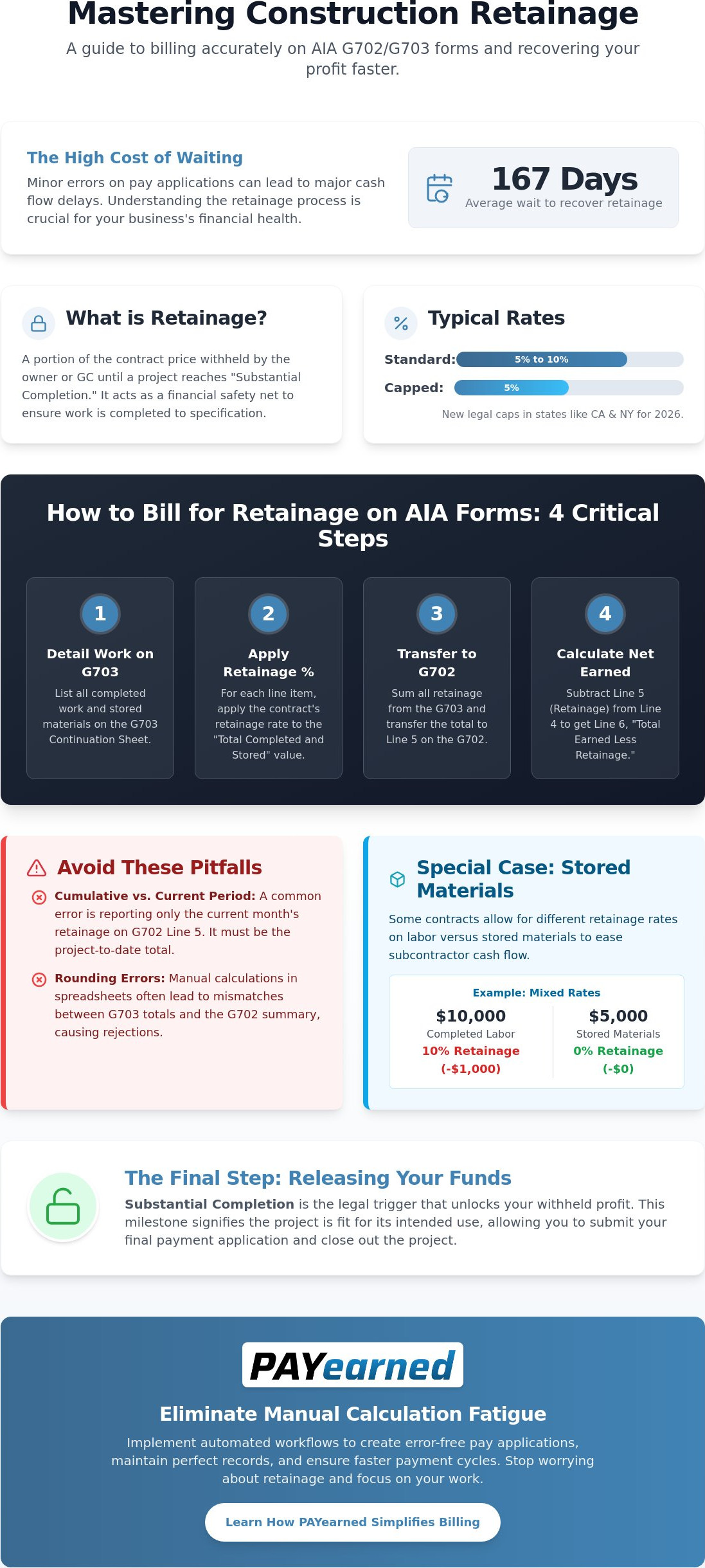
Did you know that the average subcontractor waits 167 days to recover their retainage after completing a project? In an industry where margins are thin, learning how to bill for retainage in construction correctly is the difference between a healthy bank balance and a cash flow crisis. You’ve done the work, yet your profit often sits in someone else’s account because of a minor math error on a G702 form or confusion over stored material percentages.
It’s understandable why many accounting teams feel manual calculation fatigue. Balancing work-in-place totals with varying retainage caps, such as the 5% limit now standard in California and New York for 2026, requires absolute precision. We’ll show you how to master the exact process of billing for retainage on progress applications to ensure accuracy and protect your project cash flow.
This guide provides a clear roadmap for submitting error-free pay apps and recovering your funds faster. You’ll learn the step-by-step workflow for 2026, from calculating continuation sheets to maintaining the clear financial records necessary for a successful project closeout.
Key Takeaways
- Understand the 2026 legal landscape, including new 5% retainage caps in key states that directly affect your progress billing.
- Learn how to bill for retainage in construction by accurately linking your Schedule of Values to the G703 Continuation Sheet.
- Discover the precise method for applying retainage to both work-in-place and stored materials to prevent payment application rejections.
- Master the transition from progress billing to final release by identifying the “Substantial Completion” triggers that unlock your withheld profit.
- Implement automated workflows to eliminate manual calculation fatigue and maintain the error-free records required for faster payment cycles.
Understanding Construction Retainage in Progress Billing
Retainage is a specific portion of the contract price that an owner or general contractor intentionally withholds until a project reaches substantial completion. This practice provides a financial safety net, ensuring that work is finished to specification and all punch list items are addressed. In 2026, the industry standard for this withholding typically ranges between 5% and 10% of every progress payment. While often used interchangeably, industry professionals distinguish between the specific dollar amount withheld and what is retention, which refers to the actual act of withholding those funds.
The primary risk in this process involves the complexity of the math. Learning how to bill for retainage in construction requires meticulous attention to detail. Even a minor manual calculation error can trigger a rejected pay application, stalling your cash flow and damaging your professional reputation. Because these funds represent a significant portion of your profit margin, accuracy isn’t optional; it’s a business requirement.
The Role of Retainage in the Billing Cycle
Retainage isn’t a one-time deduction at the end of a job. Instead, it’s calculated on each individual progress billing. As you submit your AIA-style G702 and G703 forms, you must account for the percentage withheld from current work and stored materials. This creates a “cash gap” for subcontractors, who must often pay for labor and materials upfront while waiting months for their full payment. Managing this gap effectively is essential for maintaining operational liquidity.
Fixed vs. Variable Retainage Rates
Construction contracts utilize different structures for withholding. A fixed rate applies the same percentage to the entire contract duration. Conversely, variable rates may shift. For example, some contracts reduce the percentage after the project is 50% complete. You must also account for state-specific statutes. In 2026, states like California and New York have enacted strict 5% caps on private projects. Failing to align your billing with these legal limits can lead to compliance issues and delayed approvals.
How to Bill for Retainage on AIA-Style G702 and G703 Forms
Executing a payment application requires a precise transition from the G703 Continuation Sheet to the G702 summary. To master how to bill for retainage in construction, you must follow a structured workflow that ensures your totals align perfectly across all documents. Manual entry often leads to discrepancies that delay payment, so following these steps is critical:
- Step 1: List all work completed and stored materials in the appropriate columns on the G703 Continuation Sheet.
- Step 2: Apply the contract’s retainage percentage to the “Total Completed and Stored to Date” column for every line item.
- Step 3: Transfer the sum of all retainage from the G703 to Line 5 of the G702 Application for Payment.
- Step 4: Subtract Line 5 (Retainage) from Line 4 (Total Completed and Stored) to reach Line 6, the “Total Earned Less Retainage.”
Accuracy on Line 5 is vital because it acts as the official record of withheld funds for the entire project. Since federal regulations on retainage often dictate strict conditions for progress payments on government sites, even a minor calculation error can trigger a formal rejection. Mastering these steps is the most effective way to learn how to bill for retainage in construction without the stress of manual math.
Calculating Retainage for Stored Materials
Contracts often treat labor and materials differently. Some agreements allow for 0% retainage on stored materials to help subcontractors manage upfront costs while maintaining 10% on labor. For example, if you have $10,000 in completed labor and $5,000 in stored materials, your G703 would show $1,000 withheld for labor and $0 for materials. Using a cloud-based billing solution ensures these mixed-rate calculations remain consistent across every billing cycle.
Avoiding Common Calculation Errors
Cumulative retainage is the total amount withheld for the life of the project, not just the current period. A common mistake is reporting only the current month’s retainage on Line 5, which breaks the logic of your cumulative totals and leads to immediate rejection. Additionally, manual rounding errors in Excel frequently cause the G702 summary to mismatch the G703 totals. For more help with error-free billing, check our guide on Mastering the Payment Application.
Releasing Retainage and Finalizing the Payment Application
Reaching the end of a project is a milestone, but securing your final payment requires one last administrative hurdle. Substantial Completion serves as the legal trigger for the release of most retainage. At this stage, the owner acknowledges the project is fit for its intended use, allowing you to finally access the profit withheld throughout the progress billing cycle.
To execute the release, you must understand how to bill for retainage in construction during the final phase. This involves reducing your retainage percentage to 0% on the final G702 and G703 forms. This action moves the total accumulated amount from Line 5 into your current payment due. The Final Pay App is rarely submitted in isolation; it must be accompanied by closeout documentation, including final lien waivers and warranties, to satisfy contractual obligations and trigger the final check.
The Process of Retainage Reduction
Some contracts allow for a partial release before the project is finished. This often occurs when a project hits the 50% completion mark, dropping the rate from 10% to 5%. When this happens, you must update your G703 Schedule of Values to reflect the new percentage immediately. Accurate tracking ensures that your remaining balance is never in question and that your final request for payment doesn’t trigger a math-based rejection due to cumulative inconsistencies.
Automating the Workflow with PAYearned
Managing these transitions manually is a significant risk, especially if your primary billing expert leaves the company. PAYearned acts as a stabilizing force by automating the calculation of Line 5 based on your specific project settings. It provides a secure digital audit trail of all past pay applications, proving exactly what is owed at any moment. This system autonomy protects your cash flow from human error and administrative turnover. Simplify your retainage tracking with PAYearned today to ensure you recover every dollar you’ve earned without the manual calculation fatigue.
Secure Your Profit with Error-Free Retainage Billing
Protecting your project cash flow requires more than just finishing the physical work; it requires administrative precision. You’ve learned that mastering how to bill for retainage in construction involves a careful synchronization between your G703 continuation sheet and the G702 summary. By understanding the 2026 legal caps and the specific triggers for substantial completion, you can prevent the manual calculation errors that frequently lead to rejected pay applications and stalled payments.
Don’t let manual spreadsheet fatigue or back-office staff turnover risk your hard-earned profit. Reliable billing is the foundation of a stable construction business. Moving from outdated, error-prone methods to a streamlined, automated workflow ensures that your financial records remain clear and your liquidity stays high throughout the project lifecycle.
Start Automating Your Pay Apps for LESS with PAYearned. Our platform provides specialized AIA-style G702 and G703 automation, secure cloud-based document storage, and built-in tracking for change orders and retainage. Transition to a high-end solution that provides peace of mind and keeps your focus on the job site. Take control of your cash flow and finish every project with financial confidence.
Frequently Asked Questions
Is retainage calculated on the gross or net amount of the invoice?
Retainage is calculated on the gross amount of the total work completed and materials stored to date. This figure represents the total value of progress before any previous payments are deducted. On a standard AIA-style G702 form, you apply the agreed percentage to Line 4 to determine the amount withheld on Line 5. This ensures the holdback accurately reflects the total contract value performed rather than a net figure that already excludes prior billing cycles.
When is the standard time for a contractor to release retainage to a subcontractor?
Standard release times depend on specific state laws and contract terms. In many jurisdictions for 2026, such as California, property owners must release retainage to general contractors within 45 days of project completion. General contractors are then typically required to pay subcontractors their portion within 10 days of receiving that payment. You should always verify your specific contract’s prompt payment clauses to ensure you understand the exact legal trigger for your funds.
Can I bill for retainage before the project reaches substantial completion?
You generally cannot bill for the full release of retainage before reaching substantial completion. However, you can request a partial release if your contract includes a retainage reduction clause. This often occurs when a project hits a major milestone, such as 50% completion, allowing the percentage to drop. Knowing how to bill for retainage in construction during these mid-project shifts is vital for maintaining cash flow without waiting for the final punch list.
What happens if there is a dispute regarding the quality of work and retainage?
If a dispute arises, the owner or contractor may continue to withhold retainage to cover the potential costs of correcting deficient work. Retainage serves as a security deposit against contractual defaults or liens. If the work is deemed unsatisfactory, the paying party can legally use these funds to hire a third party for repairs. Clear documentation and error-free pay applications are your best defense against such disputes during the high-stakes closeout phase.
PAYearned is an agnostic workflow platform that helps teams manage pay applications
PAYearned is an independent software product and is not developed, endorsed, approved, sponsored or affiliated with the American Institute of Architects (AIA). AIA®, G702®, G703®