

A single math error on your progress billing doesn’t just lead to a rejected pay app; it creates a cascading cash flow crisis that can halt work on-site. For years, the industry standard for withholding was a flat 10 percent, but as of January 1, 2026, new regulations like California’s SB 61 have capped retainage at 5 percent for most private projects. Mastering the nuances of calculating construction retainage on invoices is no longer just an administrative task. It’s a critical financial safeguard. You’ve likely felt the frustration of a general contractor returning your invoice because the retention on stored materials didn’t align with work completed.
We know that tracking withheld funds across a multi-year project is a manual nightmare that invites unnecessary risk. This guide will provide you with a clear formula to ensure your billing is error-free and your payments are approved faster. We’ll explore how to present these figures accurately on G702 and G703 style forms while navigating the latest 2026 legal requirements to keep your project liquidity high.
Key Takeaways
- Learn the standard mathematical formula for calculating construction retainage on invoices to ensure your progress billing remains accurate and professional.
- Distinguish between current and cumulative retention to track withheld funds across the entire project lifecycle without losing a cent.
- Align your G703 Schedule of Values with your G702 cover sheet by calculating retention for every line item with absolute precision.
- Identify the Substantial Completion trigger to successfully move funds from the held column to the due column for a smooth final payment.
- Adopt automated workflows that replace error-prone manual math with reliable, industry-standard billing documentation to protect your cash flow.
The Standard Formula: How to Calculate Construction Retainage on Invoices
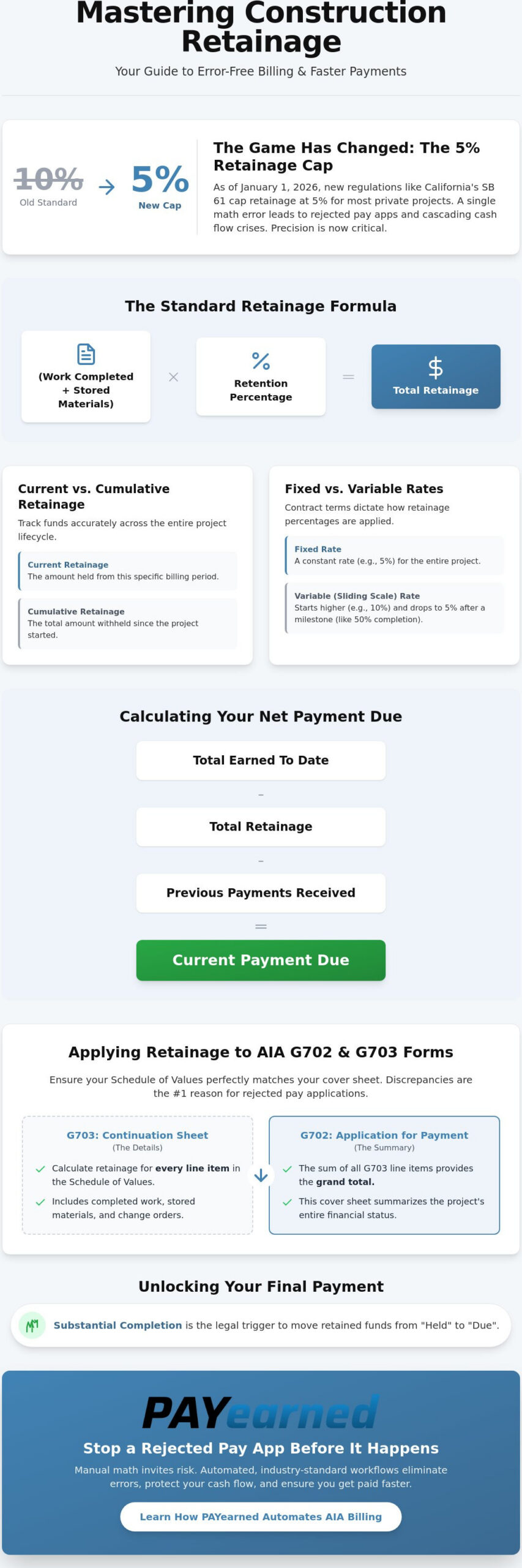
Financial precision is the foundation of construction cash flow. General contractors won’t tolerate math errors on your pay applications. When you’re calculating construction retainage on invoices, you’re essentially calculating the project owner’s security deposit against your performance. The core formula is straightforward: (Work Completed + Stored Materials) x Retention Percentage = Total Retainage. Getting this math wrong leads to immediate rejection and delayed payment cycles that your business can’t afford.
As of January 1, 2026, many jurisdictions have tightened the reins on these withholdings. For instance, California’s SB 61 now caps Retainage at 5 percent for most private projects. This is a significant shift from the historical 10 percent standard. You must distinguish between Current Retainage, which is the amount held from the specific billing period, and Cumulative Retainage, the total amount withheld since the project started. Keeping these figures separate ensures your progress billing remains transparent and auditable.
Fixed vs. Variable Retention Rates
Contract terms dictate how these percentages fluctuate. Fixed rates remain constant, such as a 5 percent hold for the entire project duration. Variable or “sliding scale” retention is more complex. It might start at 10 percent and drop to 5 percent once you reach 50 percent completion. Variable retention prevents excessive capital from being tied up unnecessarily as the project nears its final stages. If your project uses a sliding scale, your progress billing must reflect the exact moment the rate shifts to avoid over-withholding.
Calculating Net Amount Due
The final check amount depends on a logical sequence of deductions. Use this step-by-step logic: Total Earned minus Total Retainage minus Previous Payments equals the Current Payment Due. A common mistake occurs when subcontractors forget to subtract previous retainage when calculating the current period’s check. This error inflates the amount due and triggers an automatic rejection from the GC’s accounting team. Precision in calculating construction retainage on invoices ensures your cash flow stays protected and your project stays on schedule.
Applying Retainage to Progress Billing: The G702 and G703 Workflow
Standardizing your AIA-style billing requires mapping every calculation to the G702 and G703 workflow. While the cover sheet summarizes the project’s financial status, the Continuation Sheet is where you perform the technical work of calculating construction retainage on invoices for every line item. This granular approach ensures the grand total on your continuation sheet matches your cover sheet exactly. Any discrepancy in these figures is a primary reason for payment rejection by architects and owners.
Effective construction invoicing often involves materials stored on-site but not yet installed. Depending on your contract, retention rates for these stored materials might differ from rates applied to completed labor. For instance, the Federal Acquisition Regulation (FAR) provides specific oversight for how these withholdings are structured on federal projects. Understanding what is retention in the context of your specific trade agreement prevents you from over-billing and triggering an audit.
The Role of the Schedule of Values
Accurate subcontractor billing depends on line-item precision within the Schedule of Values. Tracking retainage at this level is essential for trades that complete their scope early in the project. If the foundation work is finished while the rest of the site is at 40 percent completion, a clear line-item record allows for a partial release of funds. Your “Total Completed and Stored to Date” column must always stay in sync with your retention percentage to maintain a reliable financial record.
Handling Change Orders and Retainage
Change orders are generally subject to the same retention percentage as the base contract. When you add these new line items to the continuation sheet, you must apply the retainage calculation immediately to keep your totals accurate. For a detailed map of how these figures flow through the documents, see our guide on the G702 Application and Certificate for Payment. To eliminate manual errors and ensure your totals sync perfectly, many project managers use automated pay application software to handle these complex calculations.
Managing Retention Release and Protecting Project Profitability
Substantial completion serves as the legal trigger to begin the final payment process. At this stage, the project owner or general contractor determines that the work is sufficiently complete for its intended use. This transition requires a shift in how you handle your accounting. You must move the accumulated funds from the “held” column to the “due” column. According to the Associated General Contractors of America, the punch list phase is often where disputes arise, potentially allowing owners to withhold 150 percent of the value of disputed items in certain states. Precision in calculating construction retainage on invoices throughout the lifecycle of the project ensures that these final negotiations are based on indisputable data.
Risk Mitigation: Beyond the Spreadsheet
Relying on manual logs creates a vulnerability known as the “Expert Resignation” trap. If a key staff member leaves your accounting department, your project billing history often goes with them. This loss of continuity leads to missed release deadlines and unrecovered funds. Automated pay applications eliminate this risk by establishing a permanent, searchable record of every dollar withheld. Your financial data stays accessible to the entire back-office team, protecting your long-term cash flow and preventing administrative bottlenecks.
Final Closeout and the Release Invoice
The final closeout invoice is unique because it typically shows zero percent work completed for the current period while requesting the release of 100 percent of the remaining balance. This document represents the final hurdle to project profitability. To ensure the check is cut without delay, you must submit all final lien waivers, warranties, and inspection sign-offs. Your final request for calculating construction retainage on invoices must align perfectly with previous progress reports to pass the final audit. If you want to simplify this process and reduce the risk of payment delays, consider how PAYearned helps with AIA G702-style billing by automating these complex calculations.
Secure Your Project Profitability for 2026
Precision in calculating construction retainage on invoices is the difference between a healthy cash flow and a project stalled by administrative rejections. As 2026 regulations tighten the limits on withholdings, your ability to track every cent across the G702 and G703 workflow becomes a competitive advantage. You’ve learned that mastering the math of work completed and stored materials protects your earned revenue from the start of the project through the final punch list.
Don’t let manual entry errors or staff turnover jeopardize your project closeout. Moving away from fragile spreadsheets ensures that your project billing history remains secure, searchable, and accurate. PAYearned provides a stabilizing force for your back-office team by offering automated AIA-style G702 and G703 generation with real-time retainage and change order tracking. Our cloud-based access ensures your entire team can manage complex progress billing with confidence.
Start generating error-free pay applications with PAYearned today. Your financial accuracy is the foundation of your professional reputation. Take control of your billing process and ensure every payment arrives on time.
Frequently Asked Questions
Is retainage calculated before or after tax on construction invoices?
Retainage is typically calculated on the gross value of work completed before sales tax is applied. Since retention is a deferral of the contract price rather than a discount, you calculate the percentage based on the Total Completed and Stored to Date figure. Once you’ve subtracted the held funds, you’ll then apply any applicable state or local taxes to the net amount to determine the final payment due for that period.
Can a General Contractor increase the retention percentage mid-project?
A General Contractor can’t unilaterally increase the retention percentage mid-project unless the original contract explicitly allows for it. Most agreements fix the rate at the start of the job. If a GC attempts to raise the rate without a signed change order or a specific performance default clause, it may violate prompt payment statutes. Always review your initial contract terms to ensure your process for calculating construction retainage on invoices remains compliant with the agreed-upon limits.
What happens to retainage if a subcontractor defaults before the project is finished?
Retainage serves as a security deposit that the General Contractor can use to cover the costs of completing a defaulted subcontractor’s scope of work. If you default, the held funds are typically forfeited to pay for replacement labor or to remediate defective installations. Any remaining balance after the work’s finished and all claims are settled would theoretically be returned. In practice, completion costs often exhaust the entire retained amount.
How do I show a partial release of retainage on a G702-style form?
You show a partial release on a G702-style form by adjusting the figures in the retainage section, specifically Line 5. To request these funds, you’ll decrease the percentage or the total dollar amount held, which moves that value into the Current Payment Due calculation. On the G703 continuation sheet, you must ensure the individual line items reflect this reduction so the grand total accurately supports your request for calculating construction retainage on invoices during that billing cycle.
PAYearned is an agnostic workflow platform that helps teams manage pay applications
PAYearned is an independent software product and is not developed, endorsed, approved, sponsored or affiliated with the American Institute of Architects (AIA). AIA®, G702®, G703®