
A single rejected pay application due to a math error can delay your cash flow by 30 days or more. In 2026, with the average wait for subcontractor payment reaching 96 days, you simply can’t afford a mistake on your G702 or G703 forms. One misplaced decimal point in your retainage calculation can stall your entire project’s funding.
You’re likely familiar with the monthly pay app panic that sets in when your billing specialist is out of the office or a complex change order throws off your continuation sheets. It’s a high-stakes administrative burden that keeps many business owners and project managers up at night. Relying on manual spreadsheets for specialized industry finance is a risk that often leads to rejected applications and strained relationships with general contractors.
Implementing specialized construction billing software eliminates these manual risks by automating your AIA-style documents and ensuring mathematical precision every time. You’ll discover how to move away from error-prone manual methods to a system that protects your liquidity and provides peace of mind. This guide covers how to generate error-free billing in minutes, manage change orders without the headache, and secure faster approvals to keep your projects moving forward.
Key Takeaways
- Understand how modern construction billing software replaces manual spreadsheets with cloud-based automation to eliminate calculation errors.
- Learn to transform your Schedule of Values into certified AIA-style G702 and G703 pay applications in minutes rather than hours.
- Discover the importance of automated retainage tracking and change order management for maintaining consistent project cash flow.
- Reduce operational risk by creating a standardized billing workflow that doesn’t rely on a single specialized employee’s knowledge.
- Evaluate the cost-effectiveness of specialized billing tools compared to the high overhead of full-scale ERP systems.
What is Construction Billing Software in 2026?
In 2026, construction billing software is defined as a specialized platform built to automate the intricate progress billing cycles unique to the building industry. Unlike general accounting tools that focus on simple line-item invoices, these systems manage the complex lifecycle of a project’s finances. Within the broader scope of Construction management, financial accuracy is the bedrock of project success. Modern standards now demand real-time data retrieval and integrated search functions. This allows project managers to pull up historical billing data or specific change order details instantly. The shift from manual, disconnected processes to cloud-based automation is no longer optional for firms that want to protect their cash flow.
The Core Purpose of Automated Pay Apps
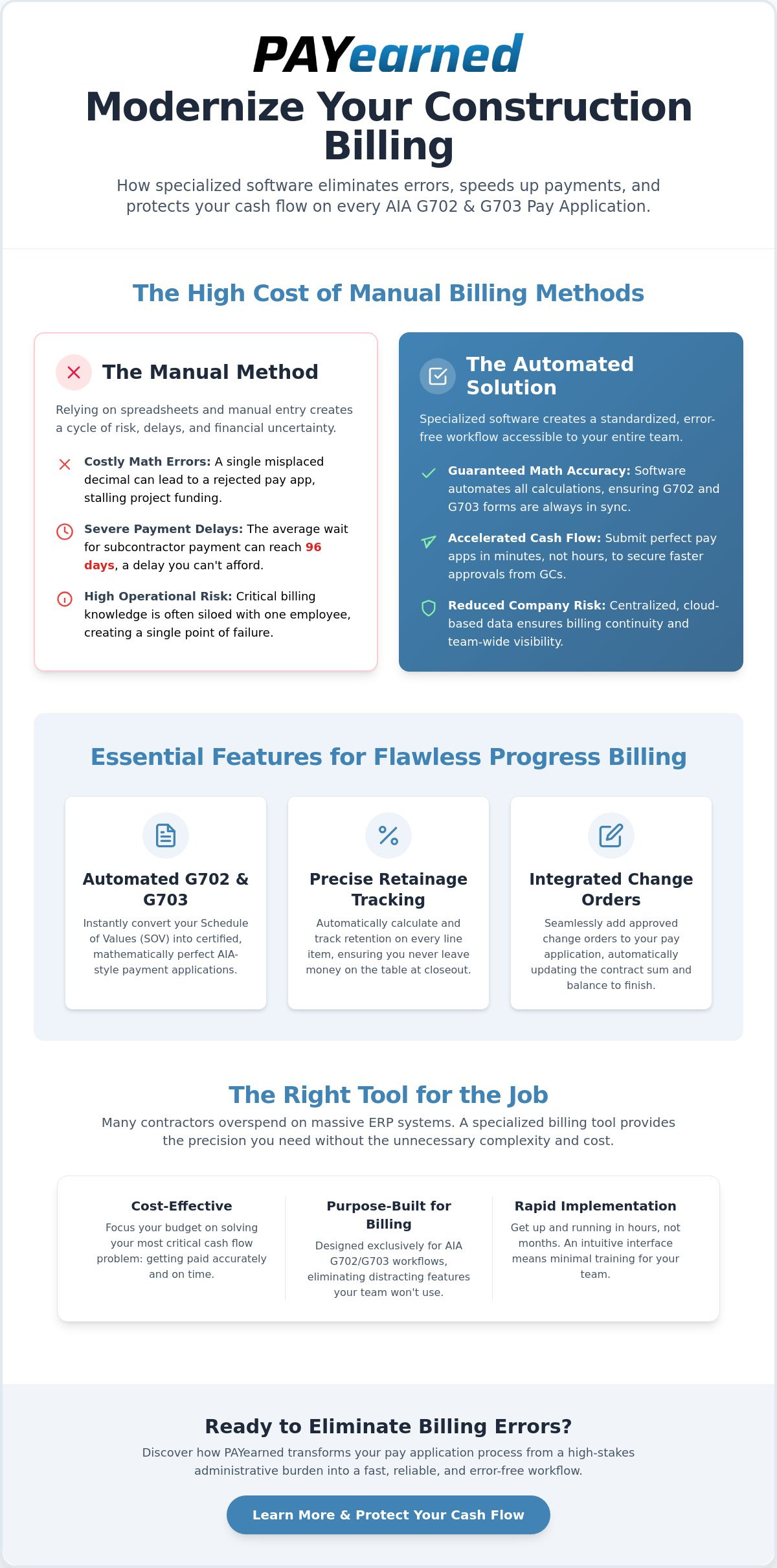
The primary function of this technology is the automated generation of AIA-style G702 and G703 documents. These forms are the industry standard for payment applications, yet they are notoriously difficult to complete manually. Software ensures that every figure on the G702 summary matches the detailed breakdown on the G703 continuation sheet perfectly. Math errors in progress billing are a leading cause of payment rejection, which can delay cash flow by 30 days or more. By automating these calculations, you ensure that totals, previous payments, and retainage amounts are always accurate. For a deeper look at these workflows, see our guide on Mastering the Payment Application.
Why Excel Templates are Falling Behind
Manual spreadsheets are a liability in a high-stakes financial environment. A single broken formula in a hidden cell can cascade through months of billing history, creating a reconciliation nightmare. Version control is another critical failure point; using an outdated “excel free download” template often leads to inconsistent formatting that architects and owners will reject. Dedicated construction billing software provides a secure cloud environment where your billing history is preserved and easily accessible. This eliminates the administrative panic that occurs when the only person who understands your custom spreadsheet leaves the company. It moves your firm away from the risks of manual entry and toward a system of mathematical precision.
Essential Features for Efficient Progress Billing
The transition from a Schedule of Values (SOV) to a certified payment application is the most critical workflow in subcontractor billing. High-quality construction billing software bridges this gap by importing your SOV and automatically calculating the percentage of work completed for each line item. This process ensures that your G703 continuation sheet remains a living document that mirrors the physical progress on the job site. It eliminates the need to cross-reference multiple spreadsheets, reducing the risk of administrative rejection from the general contractor.
Managing Retainage and Stored Materials
Retainage is a standard practice designed to ensure project completion, yet it’s often the source of major accounting discrepancies. Specialized software tracks retention percentages for every specific line item automatically. This prevents you from over-billing or under-calculating what’s owed. According to federal standards like the Prompt Payment for Construction Contracts, timely and accurate documentation is essential for maintaining your legal right to payment. Automated tracking prevents leaving money on the table at project closeout by ensuring every cent of withheld funds is accounted for. If you’re new to these terms, checking out our blog for a guide on retention can clarify how these withholdings impact your bottom line.
Automating Change Orders on G703 Sheets
Scope changes are inevitable. When a change order is approved, it must be reflected immediately in your next pay application to avoid funding gaps. Professional construction billing software integrates these changes directly into your G703 sheets without requiring manual data entry.
- Contract Adjustments: Automatic contract sum updates based on approved change orders.
- Searchable History: Built-in search engines to locate specific change order history by date or number.
- Mathematical Integrity: Real-time updates that ensure your “Balance to Finish” is always sound.
Cloud-based accessibility means your back-office team and project managers can collaborate on these updates from anywhere. This level of organization reduces the friction typically found in commercial billing. You can explore our platform features to see how this automation works in real-time.
Choosing Specialized Billing Tools vs. Full ERP Systems
Many contractors believe that professional AIA-style billing requires a massive Enterprise Resource Planning (ERP) system. This assumption often leads to overspending on features your team won’t actually use. Choosing specialized construction billing software allows you to solve the specific pain points of progress billing without dismantling your existing accounting workflow. If your current bookkeeping system works for payroll and general ledger tasks, adding a dedicated pay app tool is often the most pragmatic path forward. It keeps your financial stack lean and focused on the high-stakes task of securing payments.
Reducing Risk Through Automation
The “Personnel Independence” factor is a critical risk mitigation strategy that many firms overlook. In many offices, there is only one person who truly understands the complex formulas inside a “fillable form” or custom spreadsheet. If that employee leaves, your construction billing software needs are suddenly unmet, and your cash flow is at risk. Specialized software removes the need for “expert-only” knowledge by standardizing the workflow. Anyone on your administrative team can generate a professional G702 or G703 because the logic is built into the system. This ensures that your payment cycles remain consistent, regardless of staffing transitions.
The ROI of Specialized Construction Software
Implementation speed is where specialized tools truly outperform broad ERP suites. You can move from signup to your first generated pay application in minutes, not months. There is no need for expensive consultants or weeks of staff training. When you compare the time spent on manual fixes and rejected applications against automated generation, the return on investment is clear. It’s often less expensive to pay for a dedicated tool than to absorb the high subscription costs and implementation fees of a premium ERP. For a detailed breakdown of these efficiencies, read our analysis on AIA Billing Software vs. Excel. By focusing on the specific mechanics of the pay app, you protect your business from the administrative bloat that slows down project growth.
Secure Your Project Cash Flow with Automated Billing
Managing the financial health of a construction project requires more than just hard work; it demands mathematical precision and administrative reliability. You’ve seen how moving away from manual spreadsheets to specialized construction billing software eliminates the risk of rejected pay applications and delayed payments. By automating your G702 and G703 generation, you protect your firm from the personnel panic that occurs when specialized knowledge leaves the building. Standardizing your workflows ensures that every change order and retainage calculation is accurate and ready for approval.
Choosing a dedicated platform for your progress billing is a pragmatic decision that provides immediate ROI without the heavy implementation costs of a full ERP. It allows your team to focus on production while the software handles the complex documentation requirements of commercial construction. You don’t need an accounting degree to generate professional, error-free documents that satisfy the strictest general contractors.
Start streamlining your AIA-style billing with PAYearned today to gain cloud-based access for your entire team and ensure your cash flow remains steady. Take control of your administrative process and build a more resilient, profitable business.
Frequently Asked Questions
Does this software replace my existing accounting tools?
No, specialized construction billing software is designed to complement, not replace, your general accounting platform. While standard bookkeeping tools handle payroll and general ledgers, they often struggle with the specific formatting of commercial progress billing. This software acts as a dedicated layer that focuses exclusively on the complex documentation of pay applications. It ensures your financial data is structured correctly for architects without forcing you to migrate your entire accounting history.
Can I generate AIA G702 and G703 style forms with this software?
Yes, generating AIA G702 and G703 style payment applications is the primary function of the platform. The system automatically populates the summary information on the G702 based on the detailed line items provided in the G703 continuation sheet. This automation eliminates the need for manual data entry into static PDFs or Excel templates. You get professional, formatted documents that meet the strict standards required by general contractors.
How does construction billing software handle retainage and retention?
The construction billing software tracks retainage automatically at the line-item level to ensure mathematical precision throughout the project lifecycle. You can set specific retention percentages for work completed and stored materials; the system calculates the exact amounts to withhold or release. This prevents common calculation errors that lead to rejected applications. It provides a clear audit trail of held funds, making it easier to claim your final payment at closeout.
Is there a way to manage change orders within the billing process?
You can manage approved change orders by integrating them directly into your Schedule of Values within the billing workflow. The system updates your contract sum in real-time, reflecting these changes on your continuation sheets immediately. This ensures that your Balance to Finish calculations are always accurate and that you’re billing for every authorized scope change. It removes the administrative burden of manually tracking which changes have been billed.
PAYearned is an agnostic workflow platform that helps teams manage pay applications
PAYearned is an independent software product and is not developed, endorsed, approved, sponsored or affiliated with the American Institute of Architects (AIA). AIA®, G702®, G703®